A property launch rarely lives on a single website. The developer's corporate site, campaign landing pages, agency partner listings, property portal embeds, roadshow QR codes, and sales gallery screens each carry a version of the project to a different audience.
Each channel generates engagement. But for most developers, that engagement is scattered across separate analytics tools, portal dashboards, and CRM systems that only capture the final form submission.
What happens between the first project view and the enquiry is usually invisible.
Beyond page views and bounce rates
Generic website analytics measures traffic: how many people visited, where they came from, how long they stayed. It does not measure what buyers explored within the project.
For property sales, the meaningful signals are deeper:
- Did the buyer navigate from the master plan to a specific tower?
- Did they explore floor plans on levels 12 through 18?
- Did they open a three-bedroom unit and compare it with a two-bedroom layout?
- Did they click a WhatsApp enquiry from a specific unit detail page?
- Did they return two days later and revisit the same floor?
These are the signals that help sales teams follow up with relevance and help marketing teams understand which channels produce real interest.
The reconciliation problem nobody budgets for
Fragmented analytics has a second cost that never appears in a tooling decision. It appears in the Monday sales meeting.
Every channel counts differently. A property portal may log an "enquiry" the moment a contact form opens. An agency dashboard may count a WhatsApp tap. An ad platform fires a conversion on page load and reports a number the developer's own site never saw. Inside its own system, each of those definitions is defensible. Across systems, they are different events, and different events do not add up.
So the meeting opens on arithmetic. Marketing brings the campaign dashboard, sales brings the CRM export, the agency brings its own count, and the first stretch of the meeting goes to working out whose number is real. By the time everyone agrees on a figure, the decision the meeting existed to make has slipped to next week.
The cost of fragmented analytics is not the data you are missing. It is the meeting time spent arguing about which number is right.
One definition of an event, recorded once, in one place, will not make the numbers flattering. It makes them settled. The meeting can then start at the decision instead of the arithmetic.
How RegalScene connects engagement to context
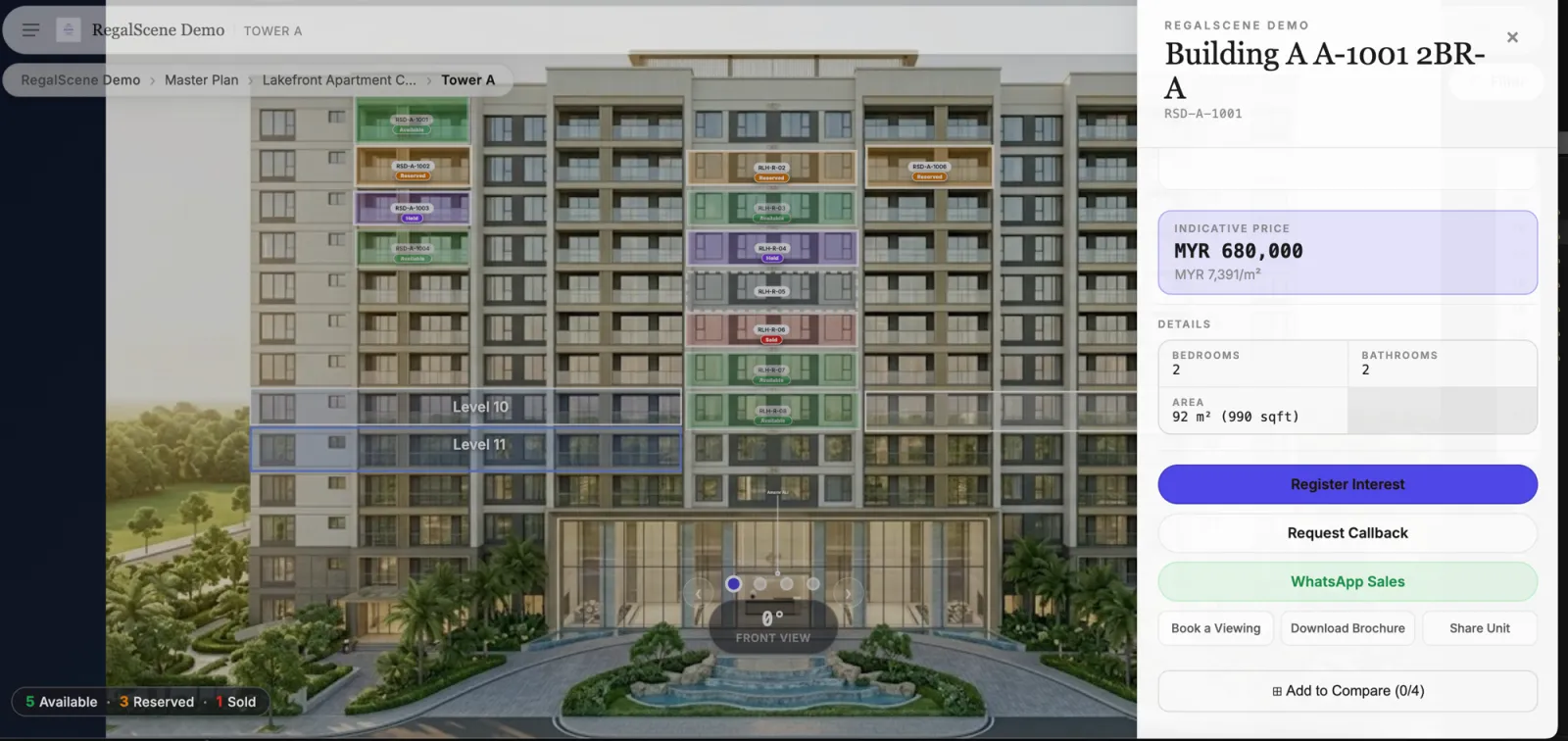
RegalScene is designed to capture buyer interactions at the project level, not the page level. When a buyer explores an interactive project experience, the system can record their navigation path, the views they visited, the units they viewed, the CTAs they engaged with, and the source that brought them there.
Because every embed is tied to a placement, and every placement carries source, campaign, and channel context, this engagement data is automatically connected to where the buyer found the project.
This creates the foundation for comparing campaigns based on real buyer behavior, not just traffic volume.
Placement-level visibility
When a marketing team runs simultaneous campaigns, each with its own landing page and RegalScene placement, the engagement from each channel is tracked independently.
This helps teams answer practical questions:
- Which campaign drives buyers who actually explore specific units?
- Which agency partner's page produces the deepest project engagement?
- Does the roadshow QR code generate more unit-level interest than the social media campaign?
- Which channel brings buyers who compare layouts and return later?
These are questions that matter for budget allocation, campaign optimization, and sales resource planning. Answering them is the job of demand reporting across every placement, which groups the same project's engagement by the source that produced it instead of by the page it landed on.
Sales follow-up with context
For sales teams, centralized engagement data means leads can arrive with the buyer's exploration context attached. Instead of a generic "I'm interested" form submission, the sales agent can see which project, tower, floor, and unit the buyer explored before reaching out.
This changes the nature of the follow-up conversation. The agent does not need to start from scratch. They can reference the buyer's actual exploration and offer relevant next steps.
RegalScene is designed to support this contextual handoff across enquiry types, whether the buyer submitted a web form, requested a callback, or started a WhatsApp conversation from a unit.
A foundation for reporting and optimization
Centralized engagement data creates a foundation that teams can build on over time.
In the short term, it helps marketing see where enquiries come from and helps sales prioritize warmer leads. Over time, it can inform project-level decisions: which unit types attract the most interest, which floors or orientations are underperforming, and which launch channels consistently deliver quality buyer engagement.
This is not a replacement for CRM, financial reporting, or booking systems. It is the layer that captures what happens between the buyer's first project view and the sales enquiry, across every digital channel where the project appears.
Why centralization matters
When engagement data is fragmented across tools and channels, teams make decisions with incomplete information. When it is connected to placements, campaigns, and buyer actions in one system, teams can see which parts of their digital sales strategy are working and where to focus next.
RegalScene is designed to help property developers bring that visibility together, from the first interactive project view to the qualified enquiry, across every website and campaign in the mix.
Related reading:
- Real Estate Buyer Intelligence: A Guide for Developers
- Sell Property Through Agencies Online: The Borderless Sales Engine
- How RegalScene Placements Help Developers Publish Interactive Sales Experiences Anywhere
- Why Buyer Context Matters More Than Basic Contact Forms
- From Enquiry Forms to Buyer Intent: Better Lead Generation for Property Sales
RegalScene helps property developers connect buyer engagement across websites, campaigns, and sales channels. Book a demo to see how centralized analytics supports your sales process.