The most expensive guess in property development is made before a single foundation is poured: will the market actually want this? Land is committed, a product mix is chosen, a price is set. Most of that rests on experience, comparables, and conviction. If the guess is right, the launch flies. If it's wrong, you find out months later, one slow sales weekend at a time, with capital already sunk.
You can't remove that risk entirely. But you no longer have to wait until launch to read it. A digital soft launch lets you put the project in front of real buyers and measure their interest: before you commit to build, before you print a price list, before you staff a gallery. This is how to do it, and what to actually look at.
The old way of testing demand, and why it's thin
Developers have always tried to gauge demand pre-launch. The traditional tools are:
- Expression-of-interest (EOI) books. A sign-up sheet, often collected by agents with their own incentives. Easy to inflate, hard to trust.
- Sales gallery footfall. Expensive to build, geographically limited, and only reachable once you've already spent on the gallery.
- Market studies. Useful for macro context, but they tell you about the market, not about your specific product at your specific price.
All three share the same weakness: they measure intention that's either easy to fake or expensive to collect, and none of them show you which part of your project the demand is actually for.
The new way: measure behavior, not opinions
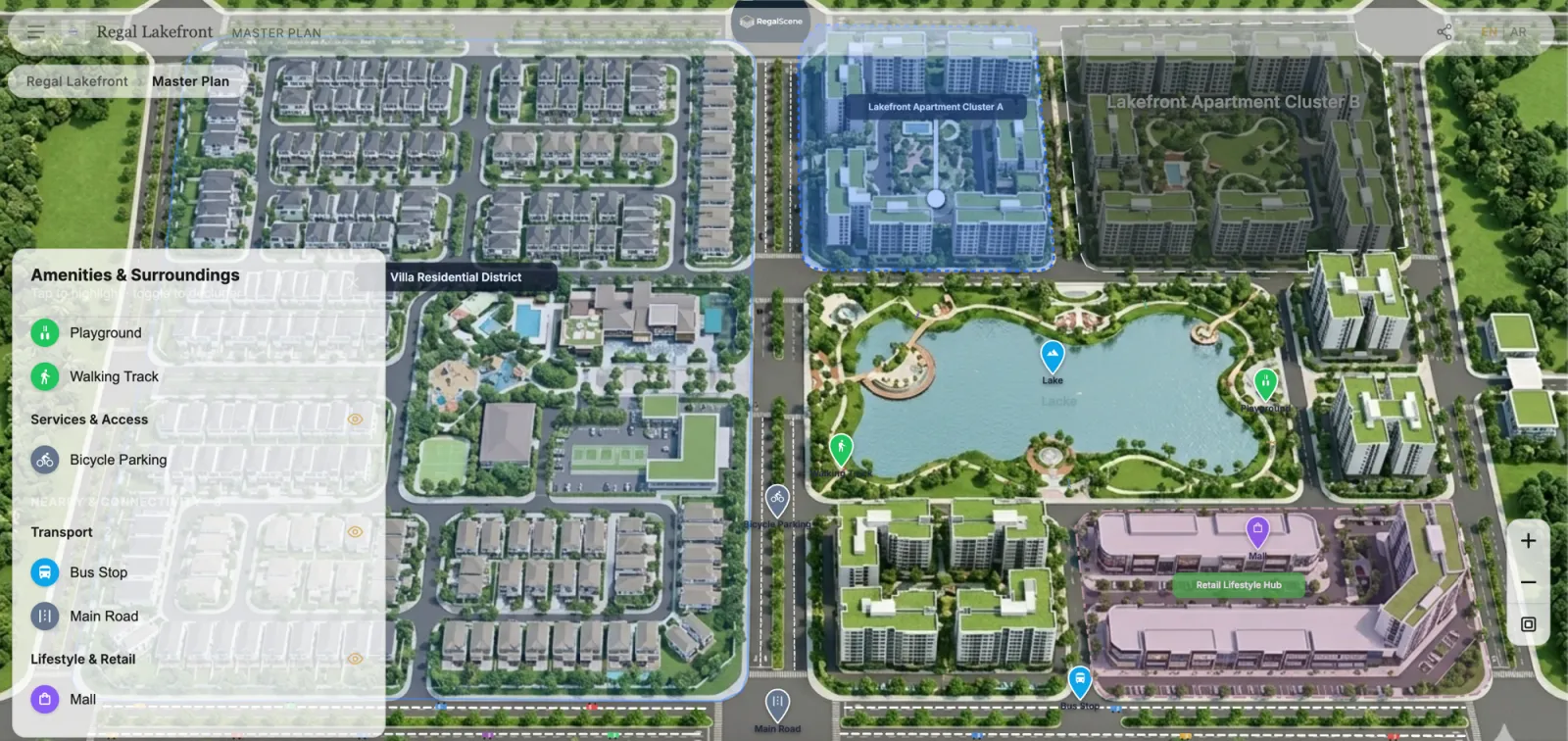
A digital soft launch flips the question. Instead of asking people whether they're interested, you publish an interactive version of the master plan (zones, buildings, floors, unit types), put it behind a campaign, and watch what people actually do. Behavior is far harder to fake than a signature, and it's available the moment you drive traffic, with no gallery required.
Four signals, read in order, tell you almost everything you need for a go / no-go decision.
1. Reach: is anyone showing up?
The first question is simply whether your campaign is reaching real people and whether interest is growing. Unique visitors, a rising traffic trend, and a healthy (not sky-high) bounce rate tell you the top of the funnel is real. Reach alone proves nothing. A thousand bounces is not demand. But without reach, nothing below it matters.
2. Depth of interest: do they explore, or bounce?
This is where a soft launch earns its keep. Of the people who arrive, how many go deeper: explore a view, open a specific unit, click through to a call to action? A clean funnel looks like this:
Visited → Explored the plan → Opened a unit → Showed intent → Registered.
The shape of that funnel is the signal. If most visitors explore and open units, the product is pulling people in. If they land and leave, you have a traffic or a positioning problem. Better to learn that now than after launch.
3. Where the demand concentrates: which product, exactly?
Aggregate interest is useful; product-level interest is gold. When you can see that 60% of all unit interest is landing on one typology (the 4-bedroom villa, say, or the corner units on the lake), you're no longer guessing your product mix. You're reading it off real behavior.
Getting to that view needs analytics that group interest by typology rather than by page, because the unit of measurement here is the product, not the URL a visitor happened to land on.
This is the insight the old tools can't give you. An EOI book tells you "200 people are interested." A demand-by-typology view tells you which 200, in what, and therefore how to phase and price. It can change the building itself: more of what's wanted, less of what isn't, before anything is built.
4. Registrations: will they raise a hand?
Reach and depth are anonymous demand sensing. To turn that into a countable, defensible number, you add one low-friction action: register interest. No obligation, no deposit. Just "notify me." Every registration is a real person raising a hand for a project that doesn't exist yet.
Set a target (say, 500 registrations before you commit Phase 1) and the soft launch becomes a clear instrument: a progress bar toward a go / no-go line, with a weekly velocity you can project against your deadline. "We hit 500 in six weeks" is the kind of evidence that stands up in front of a board or an investment committee.
Reading the verdict
Put together, those four signals resolve into a simple read:
- Weak. Thin traffic, or people arrive and don't engage. The concept, the positioning, or the campaign needs work before you spend more.
- Building. Real, growing interest and genuine exploration, but registrations still short of target. The signal is there; keep the campaign running.
- Strong. Sustained traffic, deep engagement, and registrations tracking to your goal. The market is telling you to proceed.
The point isn't a magic score. It's that every part of the verdict is traceable to a real number you can interrogate. Not a gut feeling, and not a padded sign-up sheet.
Don't waste the near-misses
A soft launch also surfaces something the traditional tools discard entirely: the people who were clearly interested but didn't register. They opened units, viewed details, lingered, then left without raising a hand.
That group is your warmest follow-up list, and where they stall is a message. If most drop off right after opening a unit, they wanted to know more and weren't asked. If they stall after viewing details, the ask to register wasn't compelling or wasn't there. Fixing that stall point is often the cheapest conversion win available, and it's only visible because you measured the journey, not just the outcome.
What good looks like
A well-run demand validation isn't a one-off report. It's a short, honest loop:
- Publish the master plan digitally, built from the renders and site plans you already have. No 3D models, no gallery, no finished product required.
- Drive real traffic to it: paid, social, a QR code on the hoarding, your database.
- Read the four signals over a few weeks. Let volume build before you conclude.
- Act on what you see. Adjust the mix, the price story, the phasing, or the registration ask, and when the target is hit, proceed with evidence instead of hope.
Beyond property
Everything above is written for a residential developer, because that's where the stakes are clearest. But the method isn't property-specific. The same soft-launch loop (publish an interactive experience, measure reach, depth, and intent, capture a waitlist) works for a retail scheme deciding its tenant mix, a mixed-use destination testing appetite, or any large capital project where "will people want this?" is the question that keeps you up at night.
De-risking the build decision used to mean building first and finding out later. It doesn't have to anymore. The market will tell you what it wants — if you give it something to react to, and you measure honestly what it does.
Related reading:
- Real Estate Buyer Intelligence: A Guide for Developers
- How to Launch a Property Project Digitally
- What Is a Digital Sales Center for Real Estate?
- Contextual Leads: Why Where a Buyer Enquires Matters
RegalScene turns your master plan into a demand-sensing instrument — publish it, measure real interest, and decide with evidence. See the platform or book a demo.