Every developer planning a digital launch asks the same question first: what will a virtual sales gallery cost? The honest answer is that the market spans two orders of magnitude — from a few thousand dollars for a basic virtual tour to well into six figures for a custom game-engine experience. The right budget depends on which approach fits your project, not on spending the most.
This guide breaks down the main options, what drives cost in each, and the questions to ask before committing.
The four approaches and their typical cost profiles
1. Basic 360 photo tours
A photographer captures the show unit with a 360 camera and publishes a walkthrough. This is the entry point: typically a one-time fee per unit, in the hundreds to low thousands of dollars range depending on market and unit count.
What you get: immersion inside a finished space. What you don't get: project-level navigation, unit availability, or lead capture. It shows one space — it doesn't sell a development.
2. Render-based virtual tours for off-plan projects
For pre-selling and off-plan projects there is nothing to photograph, so tours are built from CGI renders. Costs scale with the number of rendered viewpoints and the quality bar, from a few thousand dollars for a handful of panoramas to tens of thousands for a fully rendered project.
Most developers already commission these renders for brochures and hoardings, which matters for budgeting: the render spend is usually already committed. The question is whether those renders end up in a static PDF or in an interactive experience.
3. Custom game-engine experiences
Agencies build bespoke walkthroughs in Unreal Engine or Unity: free-roam environments, day/night cycles, cinematic quality. These are genuinely impressive and genuinely expensive: projects commonly run from tens of thousands to several hundred thousand dollars, plus long production timelines and high change costs (a pricing update or a new phase can mean a rebuild).
They suit flagship mega-projects with matching budgets. For most launches, the cost-per-lead math is hard to justify.
4. Platform-based virtual sales galleries
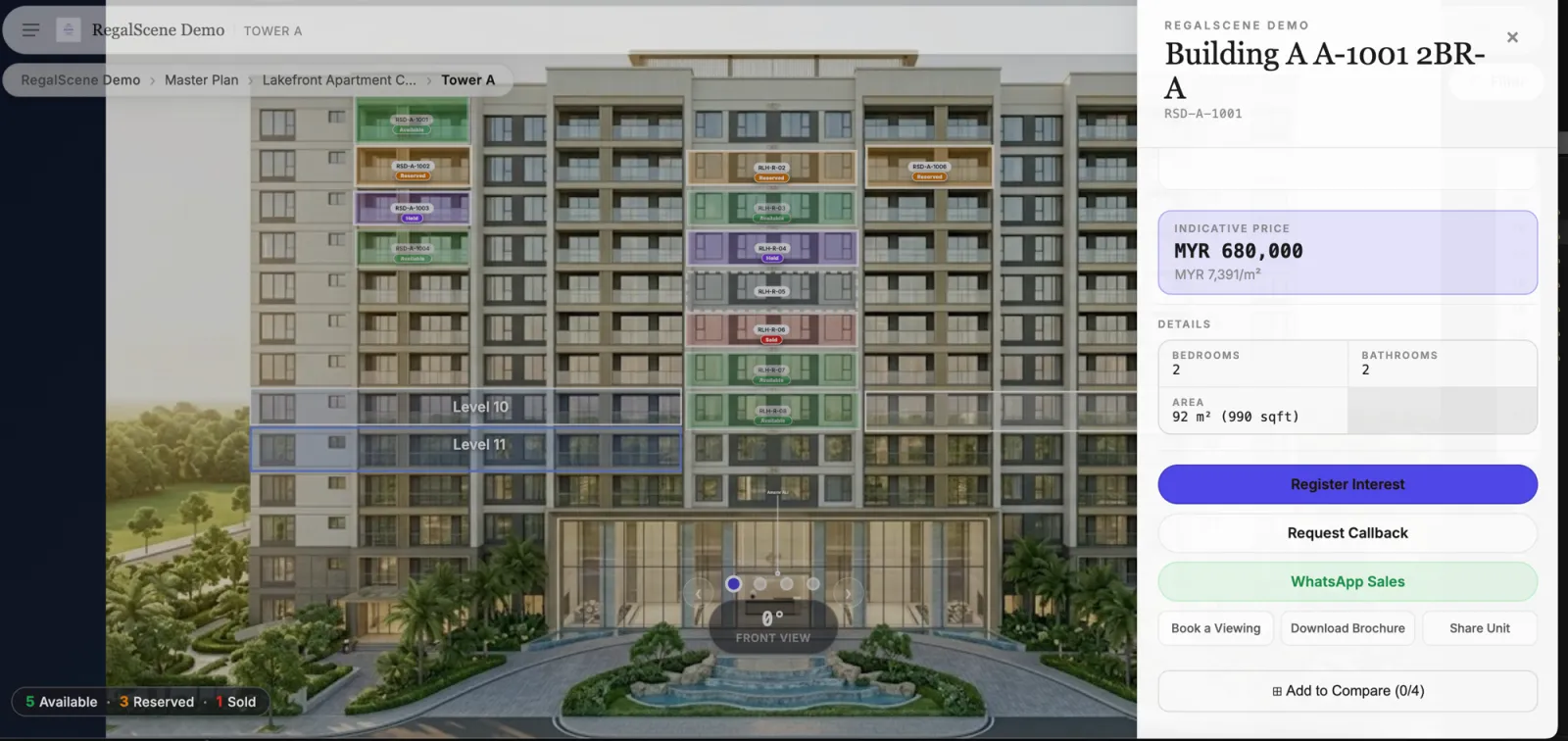
A SaaS platform turns the assets you already have, such as master plan renders, building views, floor plans, and unit layouts, into an interactive, publishable sales experience with current unit availability and lead capture built in. Pricing is typically a subscription, often with a separate one-time setup or authoring fee, placing it between basic tours and custom builds, usually a small fraction of the cost of a game-engine project.
The structural difference is that it stays current. Availability, pricing visibility, and new phases update through an admin console instead of a rebuild — which is why subscription models fit projects that sell over months or years.
What actually drives the price
Whichever route you take, these are the cost drivers to check:
- Asset production vs. asset reuse. If a quote includes producing new 3D renders, that's often the largest line item. Platforms that reuse your existing marketing renders remove it.
- Project complexity. A single tower prices differently from a township with zones, multiple buildings, and thousands of units.
- Unit availability. Current availability and unit-level data separate a marketing toy from a sales tool — and separate quotes accordingly.
- Lead capture and analytics. If the gallery doesn't capture enquiries with context, you're paying for visualization, not sales.
- Updates over the sales cycle. Ask what a price change, a new phase, or a sold-out zone costs to reflect. This is where custom builds get expensive after launch.
- Where it lives. Embedding into your existing website and campaign pages should be included, not a premium add-on.
A sanity check: cost against one sale
A useful frame for any option: compare a year of platform cost against the marketing value of one additional unit sale — or against the cost of running a physical sales gallery, where fit-out alone commonly runs into hundreds of thousands, before staffing. A digital gallery that shortens even a handful of buying decisions typically covers itself.
Questions to ask every vendor
- Can you reuse the renders and floor plans we already have?
- What does it cost to update availability, pricing visibility, or add a new phase?
- Is lead capture included, and do leads arrive with the buyer's exploration context?
- Can the experience embed into our existing website and campaign pages?
- What happens after the project sells out: does the experience retire or keep working for resale and leasing?
How RegalScene approaches pricing
RegalScene scopes and quotes the managed platform around each project, not by the number of apartments, villas, plots, or commercial units in the inventory.
A development with 1,500 units is not automatically quoted above one with 200. What the price follows is what has to be built and operated, and that is agreed with you before anything is committed. The full reasoning is in why RegalScene isn't priced per unit.
What a quote is made of
Four parts, and not every project needs all of them:
- Implementation and onboarding is the one-time work of preparing, mapping, configuring, and launching the experience from your assets.
- Platform subscription is the recurring cost of running it: the live experience, hosting, security, updates, the admin console, and support.
- Capabilities and integrations cover interactive 3D, any custom integration requirements, additional languages, and governance or security requirements, scoped where the project calls for them.
- Expansion covers new phases, towers, developments, or markets, scoped as they arrive.
You pay once for the build, and a steady subscription to run it.
Repetition does not multiply the work
If 30 floors share the same visual layout, RegalScene builds that floor once and maps each level's own inventory onto it. Thirty floors do not become thirty builds.
The same holds across a portfolio. A second development runs inside the same RegalScene environment rather than starting from scratch, and distributing the same experience through ordinary embeds or agency channels does not duplicate anything.
A repeated floor is built once, however many levels reuse it.
What shapes the number
The complexity and phasing of the development, the scale of the portfolio, which interactive views the buyer journey needs, how ready your assets are, any 3D production, any custom integration requirements, the channels it has to run through, the languages and markets it serves, and any enterprise governance or support requirements.
No two projects line those up the same way, which is why RegalScene does not publish a package. The pricing page sets out what shapes a quote, and a short conversation about your project turns that into a written scope and a commercial proposal.
Related reading:
- Why RegalScene Isn't Priced Per Unit
- How Much Does an Interactive Master Plan Cost?
- Resort Launch Budgets: Show Villa vs Digital
- Best Virtual Tour Software for Property Developers in 2026: How to Choose
- Virtual Sales Gallery vs Physical Showroom
- What Is a Digital Sales Center? Virtual Sales Galleries for Real Estate Explained
RegalScene turns the marketing assets you already have into a virtual sales gallery with current inventory and contextual lead capture, priced around active views rather than unit count. See how pricing works, explore the platform, or book a demo.