Every developer knows renders matter — the CGI line is one of the least-questioned items in a launch budget. And the renders do their job: the campaign gets clicks, the hoarding turns heads, the brochure looks expensive. Then the leads come in — fewer than the traffic promised — and the diagnosis begins. Usually in the wrong place.
The issue is rarely the renders. It's the assumption that the thing which wins attention also converts it.
What renders are genuinely good at
Attention is real work, and renders do it better than anything else in property marketing. A striking aerial stops a scrolling thumb; a dusk exterior makes a project feel inevitable; interior CGI sells a life. This isn't faint praise — the render budget is the foundation of everything that follows, and weak renders undermine even the best interactive layer built on top of them.
But look at what a render structurally cannot do:
- It can't say what's available — it shows every unit, including the sold ones, forever.
- It can't say what anything costs — or apply your price-visibility policy.
- It can't let the buyer find their unit — position, floor, facing.
- It can't take the enquiry — there is no action inside an image.
A render-only funnel therefore has a hard ceiling: it generates interested viewers, hands them unanswered questions, and hopes they call. Most don't.
What the interactive layer adds — and why it's the lead engine
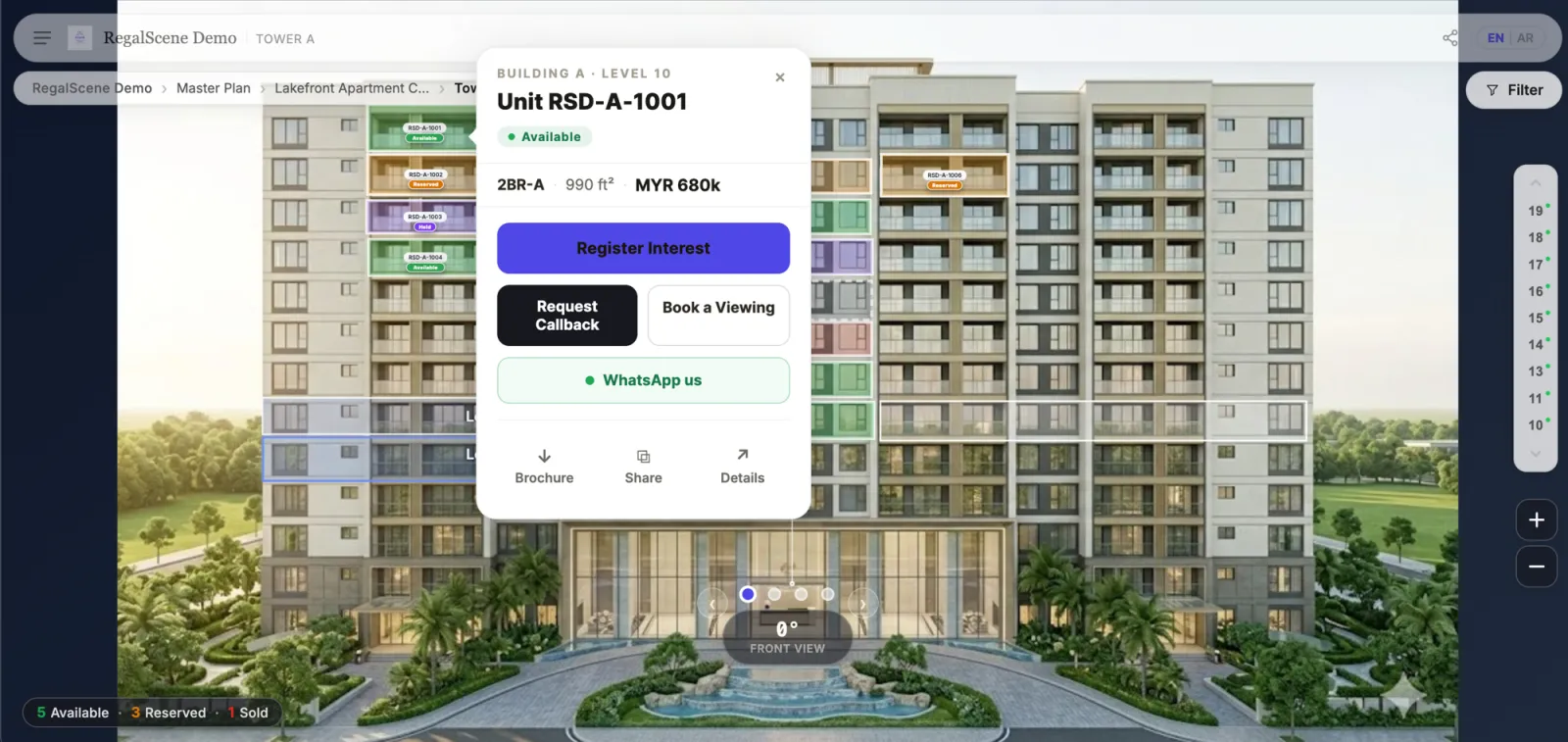
Put the same renders inside a navigable experience and each structural gap closes: the aerial becomes a master plan buyers explore; the elevations become towers with current unit status; floor plans carry availability; and every unit carries its own enquiry actions.
The lead-generation difference is mechanical, not mystical:
- The question gets answered instead of ending the session. "Anything 2BR under 700k?" is a filter, not a phone call the buyer won't make.
- The buyer invests. Someone who navigated to a specific unit has spent effort — and effort converts. Abandoning a brochure costs nothing; abandoning your shortlisted unit costs something.
- The action is in reach at the peak of intent. Register interest / WhatsApp, right on the unit, the moment it's chosen — not a contact form three pages away.
- The lead arrives with its context. Unit, floor, price seen, path taken. A contextual lead is worth multiples of a name and number, because the first sales touch starts at the buyer's actual intent.
Same renders. Different physics.
When renders alone are the right call
Scope honesty: for awareness work — brand films, out-of-home, press, social reach — standalone renders are exactly right, and adding interactivity to a hoarding is a QR code, not a redesign. Renders are also sufficient when there's nothing to convert to yet: pre-launch teasers before inventory or pricing exist.
The line to hold is the project page. That's the destination every campaign feeds, the place interested buyers arrive carrying questions. Spending campaign money to deliver buyers to a static gallery is paying for attention twice and conversion never.
The budget reframe
The practical takeaway isn't "spend more" — it's that the conversion layer is marginal cost on top of a render budget already committed. The renders exist; making them answer questions and take enquiries is the cheapest lead-generation upgrade in the stack, because the expensive part — the imagery that earns attention — is already paid for.
Related reading:
- How Interactive Property Experiences Increase Sales Conversion
- 3D Rendering for Real Estate Marketing: Make the Renders You Already Paid For Sell Units
- Virtual Tour vs 3D Render vs Interactive Master Plan: Which Sells Property Better?
- Why Contextual Leads Are More Valuable Than Contact Forms
RegalScene turns the renders you already paid for into the layer that answers questions and captures leads — current availability, visual filtering, and enquiry in context. See the platform or book a demo.