Most property marketing budgets are spent on the top of the funnel: media, portals, campaigns. Most conversion problems live somewhere else entirely, in the silent stretch between a buyer becoming interested and a buyer making contact. That stretch is where static marketing loses people, and where interactivity earns its keep.
Where the funnel actually leaks
Follow a typical buyer. An ad works; they land on the project page. They open the e-brochure. And then they hit the questions the brochure can't answer:
- Is anything still available in my budget?
- Which tower has three-bedroom units, and what do they face?
- What would I actually pay?
Each unanswered question is a decision point, and the default decision is to leave. The cruel part: this leak is invisible. The campaign dashboard shows clicks; the sales team sees the enquiries that survived. Nobody counts the interested buyers who quietly closed the tab. So the team keeps optimizing ads while the funnel bleeds in the middle.
How interactivity plugs each leak
An interactive experience converts by answering the questions at the moment they're asked:
Orientation → the master plan. Buyers place the project, see the zones, understand what's near what. The "where do I even start" drop-off disappears because the start is self-evident: explore.
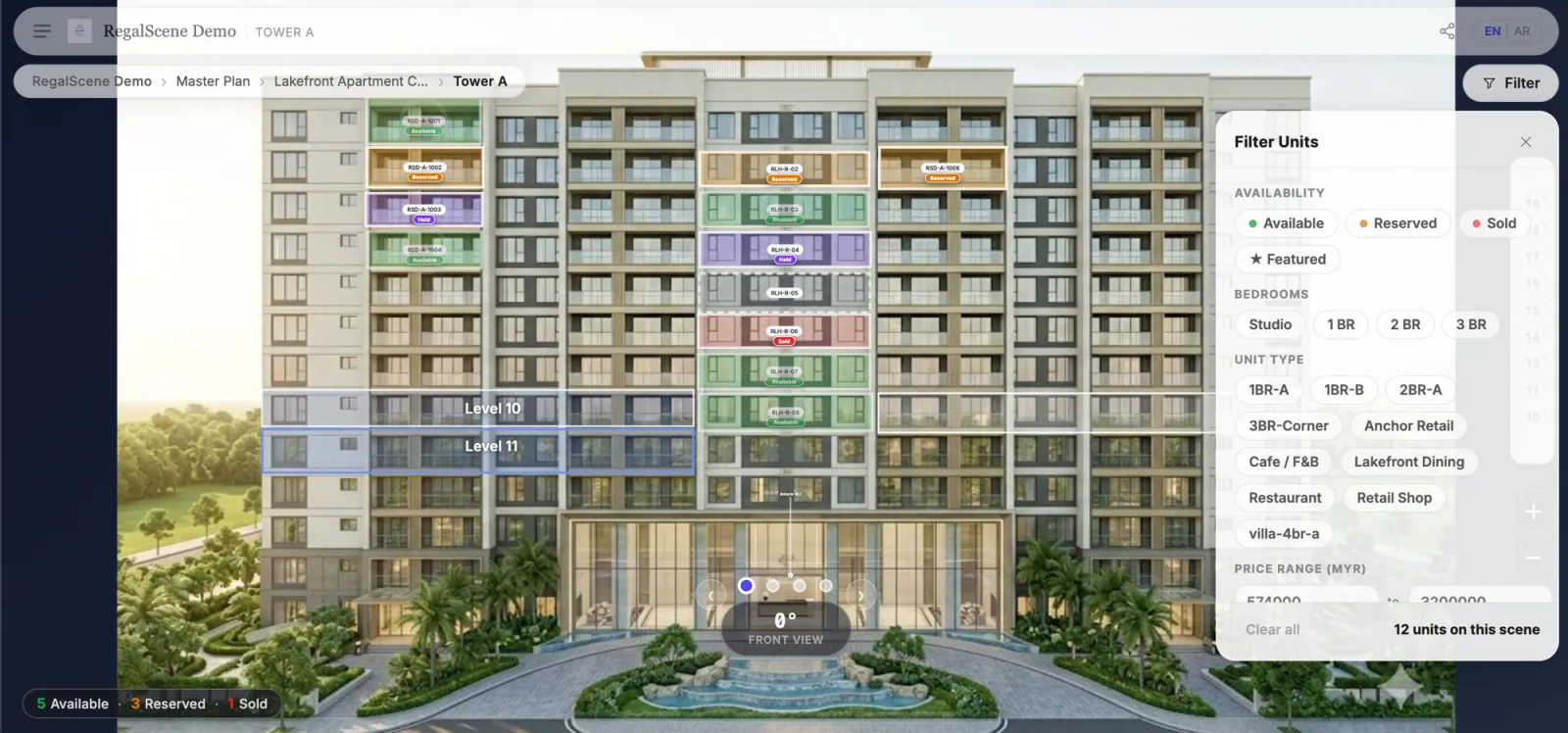
Shortlisting → filtering on the visual. Availability, bedrooms, type, price range, floor. All of it applied on the building itself, so matching units light up and the rest recede. Buyers do in ninety seconds what a sales call spends twenty minutes on.
Verification → current data. The moment of truth is "is this unit actually available, and what does it cost?" Current status and price visibility (exact, range, or on-request, whichever your policy allows) answer it honestly. Nothing kills conversion like discovering the shortlisted unit sold last month.
Action → enquiry in place. Register interest, callback, or WhatsApp from inside the unit. The threshold drops because the buyer isn't starting a conversation from zero — they're pointing at something.
The compounding effect is the context: the lead arrives labeled with the unit, the view, and where the buyer came from. Capturing an enquiry with its unit still attached is what makes the second gain possible. Sales conversion improves twice: more enquiries in, and each one warmer.
The measurement loop most funnels never get
Because every step is digital, the invisible middle becomes visible: which zones get explored, which unit types get compared, where sessions stall. That's not vanity analytics. It's the feedback loop for fixing conversion causes: a stalling floor might be mispriced; an ignored zone might need better imagery; heavy comparison of one type signals where demand concentrates before you release the next phase. Seeing any of it needs reporting on where sessions stall inside the experience, not on where the clicks landed outside it.
What interactivity honestly can't fix
A clean funnel doesn't sell a bad product. If units are priced against the market, if the location story is weak, if the renders underneath are poor, an interactive layer will deliver that bad news more efficiently, not reverse it. What it guarantees is narrower and more valuable: qualified demand stops leaking silently, and you learn why buyers walk instead of guessing.
The teams that get the most from interactivity treat it as the front door of a measured journey, not as a magic conversion switch.
Related reading:
- Real Estate Buyer Intelligence: A Guide for Developers
- Interactive Experiences vs 3D Renders: What Actually Generates Leads
- Selling Off-Plan Property Digitally: Reducing Buyer Uncertainty
- Why Contextual Leads Are More Valuable Than Contact Forms
- Interactive Master Plan Benefits: What Property Developers Actually Gain
RegalScene turns the leak between interest and enquiry into a measured, converting journey — current availability, visual filtering, and contextual leads on one platform. See how it works or book a demo.