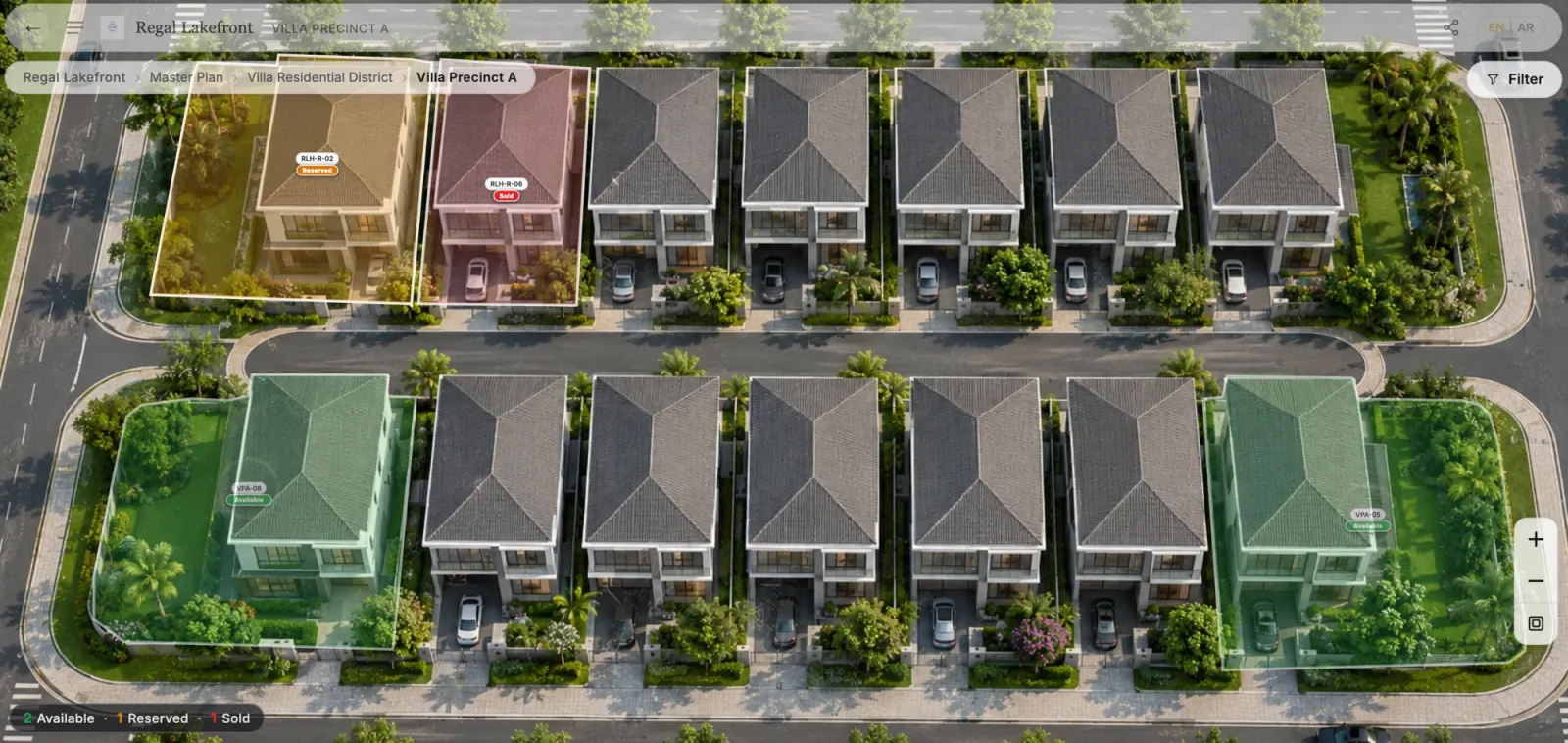
Most articles about interactive master plans list the same benefit five different ways: "it looks impressive." That's true, and it's also the least valuable thing an interactive master plan does. A static render can look impressive. The benefits that justify the investment are the ones that show up in your sales pipeline — and they come from what the master plan does, not how it looks.
Here's what developers actually gain, in the order it tends to matter.
1. Buyers qualify themselves before they ever talk to sales
A static master plan render leaves every question — "which building has 3-bedroom units?", "what's near the lake?", "is anything still available in phase one?" — for your sales team to answer, one call at a time. Most buyers never make that call; they close the brochure and move on.
An interactive master plan answers those questions in the buyer's own hands: pan and zoom across the development, tap a zone to see what it holds, click a building to enter it, filter down to a unit. By the time a buyer contacts you, they've already found something specific they want. Your team stops doing orientation and starts doing conversion.
2. Availability at a glance builds urgency — and trust
The single most persuasive piece of information on a master plan isn't the landscaping. It's which units are still available. Current availability overlays turn the plan into a real-time answer: green means act, sold means the project is moving.
This works in both directions. Buyers trust a project that shows sold inventory honestly — it signals momentum without a salesperson saying a word. And it removes the awkward failure mode of static marketing: a buyer falling in love with a unit that sold out three weeks ago.
3. Leads arrive with context, not just contact details
A contact form tells you someone exists. An enquiry made from inside an interactive experience tells you what they want: the project, the building, the floor, the unit type they were looking at when they pressed the button — and, where enabled, whether they saw the price.
That context changes the first sales call from discovery to follow-up. It also changes marketing: when you know which zones and unit types generate enquiries, you know where demand actually is — not where you assumed it would be.
4. One link that works everywhere your buyers are
An interactive master plan is a URL. That sounds mundane; it's the distribution superpower. The same experience embeds in your project website, opens from a QR code on a hoarding or press ad, and travels through WhatsApp, WeChat, and agent chats — on any phone, with nothing to install.
Compare that with sales-gallery-only tools: touchscreen software and game-engine walkthroughs impress visitors who are already in the room. A link reaches the buyers who aren't.
5. Updates take minutes, not change orders
Projects change: a new phase releases, prices move, a zone sells out, a building's renders get upgraded. With static collateral — or a bespoke 3D application — each change means going back to an agency or studio.
With a platform-based master plan, the update is an admin task: change the status, adjust the config, publish. The published experience buyers see stays stable and controlled; the data behind it stays current. Over a multi-year, multi-phase project, this is frequently the difference that decides the business case.
6. You learn what demand looks like before you commit to it
Every interaction on a master plan is a signal: which zones get explored, which buildings get entered, which unit types get compared, where buyers stall and leave. Aggregated, that's demand data you otherwise only get after launch — when it's expensive to act on.
Developers use this to sequence phase releases, adjust the unit mix story, and test appetite for a product before pouring concrete. It's the difference between marketing collateral and a sales instrument.
7. It keeps working after the launch campaign ends
A launch microsite retires when the campaign does. A master plan built on current data doesn't have to: the same experience carries the project through later phases, and — after sell-out — into resale and leasing, where the development itself becomes the map of available units.
Where an interactive master plan is not the answer
Honesty matters here. If you're selling a single completed show unit, a 360 capture tour is faster and cheaper. If your project is a small single building with a dozen units, an interactive floor plan may be all the navigation you need. The master plan earns its keep when there's a development to navigate — zones, multiple buildings, phases — and inventory whose availability changes.
And it doesn't replace your renders — it's built from them. If you've already invested in CGI, the master plan is how those renders become a working sales asset instead of a static image.
None of this works if the plan is exported as a picture. The benefits hold only while the master plan stays connected to current inventory, and that connection is what an interactive master plan platform provides.
Related reading:
- RegalScene's interactive master plan platform
- What Is an Interactive Master Plan?
- Interactive Property Map for Real Estate Developers
- Interactive Master Plan Features: A Developer's Checklist
- 3D Rendering for Real Estate Marketing: Make the Renders You Already Paid For Sell Units
- Interactive Master Plans for Property Launches
RegalScene turns your master plan render into a navigable sales experience with current availability, contextual leads, and analytics — publishable to your website, QR codes, and agent channels. Book a demo.