Off-plan selling has a structural handicap no other retail category tolerates: the product doesn't exist. The buyer is asked to commit years of income to a unit they can't stand in, on a floor that hasn't been poured, in a development that's currently a fence and a signboard. Everything about off-plan marketing is, underneath, uncertainty management — and digital tools have quietly become the best uncertainty-management technology developers have.
The three uncertainties that stall off-plan buyers
Product uncertainty — "what am I actually buying?" Renders show the dream; buyers need the specifics. Which unit, on which floor, facing what? A gallery of CGI images answers none of it, which is why static collateral fails hardest in off-plan.
Truth uncertainty — "is what they're telling me real?" Is unit 12-03 genuinely available, or is the "limited units" line theater? Off-plan buyers have learned to discount marketing claims. Anything that demonstrates rather than asserts punches above its weight.
Process uncertainty — "what happens next?" Phasing, handover, payment milestones. Not spatial, but every bit of clarity here compounds trust built elsewhere.
The digital toolkit, mapped to each uncertainty
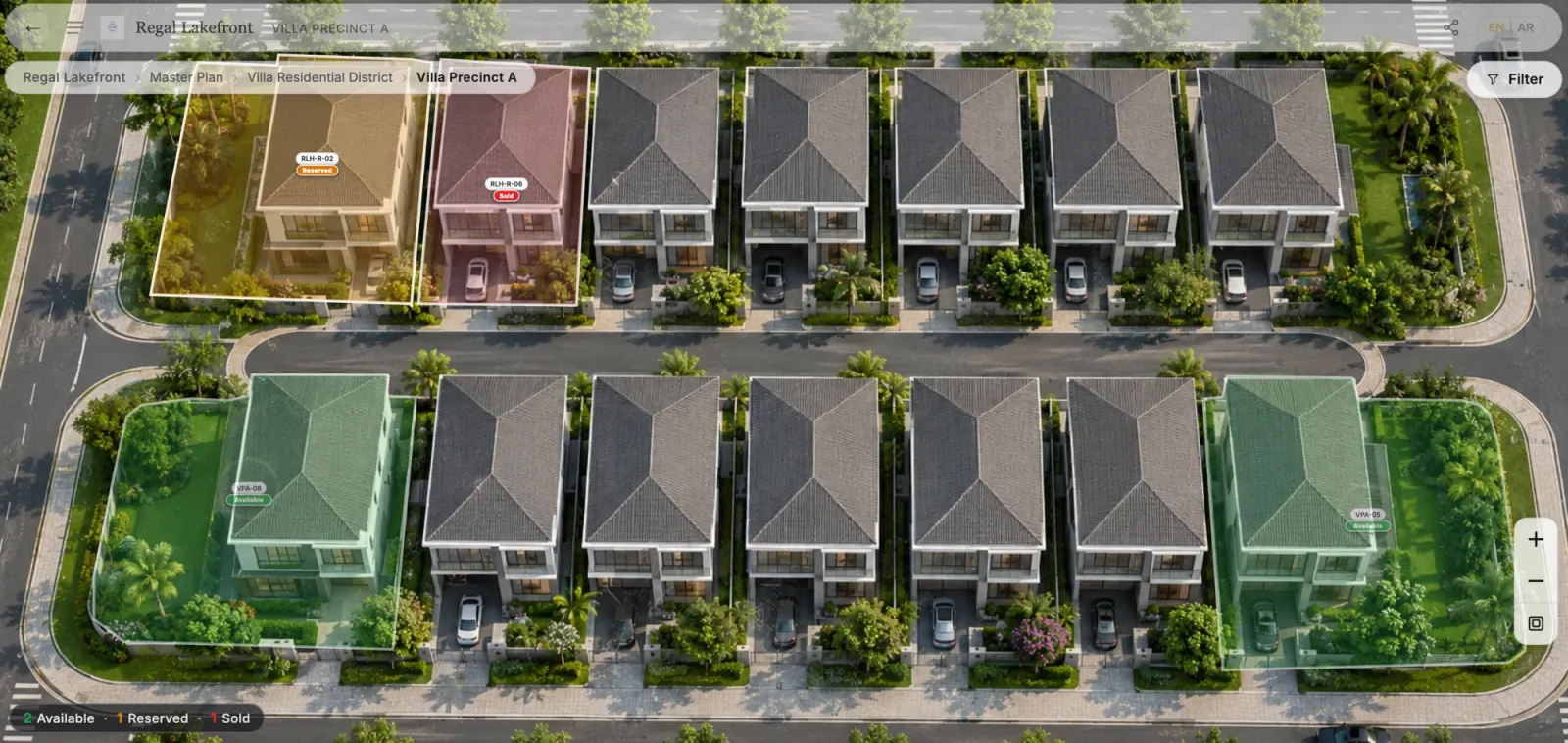
Product: make the renders navigable. The CGI you commissioned already contains the answers — the aerial shows position, the elevations show facing, floor plans show layout. Connected into an interactive journey, those renders let a buyer find their unit: master plan → tower → floor → unit, with the unit's position visible at every level. The buyer who has navigated to unit 12-03 themselves has, in a real sense, visited it.
Truth: show current availability, including the sold ones. A plan that displays sold and reserved units honestly does two things at once: it proves the availability claims are real data, not persuasion — and the sold overlays quietly demonstrate momentum. This is the counterintuitive part for teams used to controlling the narrative: showing what's gone sells what's left. Price transparency belongs here too — exact, range, or on-request is your policy decision, but whatever the policy, applying it consistently in the experience beats making buyers extract numbers on a call.
Process: publish the phases. When phase two releases, the same experience updates — new zone live, new availability, same link everyone already has. Buyers who watched phase one sell out through the same map arrive at phase two pre-convinced.
The overseas buyer case
For international buyers, digital isn't an enhancement to the sales process — it is the sales process. They won't visit the gallery; their entire journey happens on a phone, usually inside WhatsApp or WeChat where an agent or a family member dropped a link. Off-plan projects courting overseas demand need the experience to open instantly in a webview, show current availability without an app or account, and take the enquiry right there. A share-link-native experience matches how these buyers actually behave: in groups, across time zones, forwarding "this one?" to each other.
What digital can't de-risk
The honest boundary: digital tools reduce information uncertainty, not execution uncertainty. A buyer worried about developer track record or completion risk needs your delivery history, escrow structure, and regulatory framework — not a better map. The best off-plan funnels pair the interactive experience (information trust) with visible proof of delivery (execution trust) and let neither carry the other's weight.
Related reading:
- How Interactive Property Experiences Increase Sales Conversion
- Interactive Sales for Dubai Off-Plan Developments
- Interactive Master Plan Benefits: What Property Developers Actually Gain
- How to Launch a Property Project Digitally: A Step-by-Step Guide
- Selling Property to Chinese Buyers: Why Digital Sales Experiences Matter
RegalScene is built for off-plan: interactive journeys from the renders you already have, current availability that proves itself, and enquiries that work inside WhatsApp. See the platform or book a demo.