Why sharing is a sales channel, not a feature
Property is a shared decision. Buyers forward listings to a spouse, a parent financing the deposit, or a friend who bought in the same area. In most digital sales tools, that sharing happens outside the system — a screenshot on WhatsApp, a photo of a brochure — and the developer never sees it.
A shareable interactive property link changes that. Every share stays inside the experience, carries full context, and routes the next person back to the live project. Buyers become a distribution channel that works for the developer.
What can be shared, and how
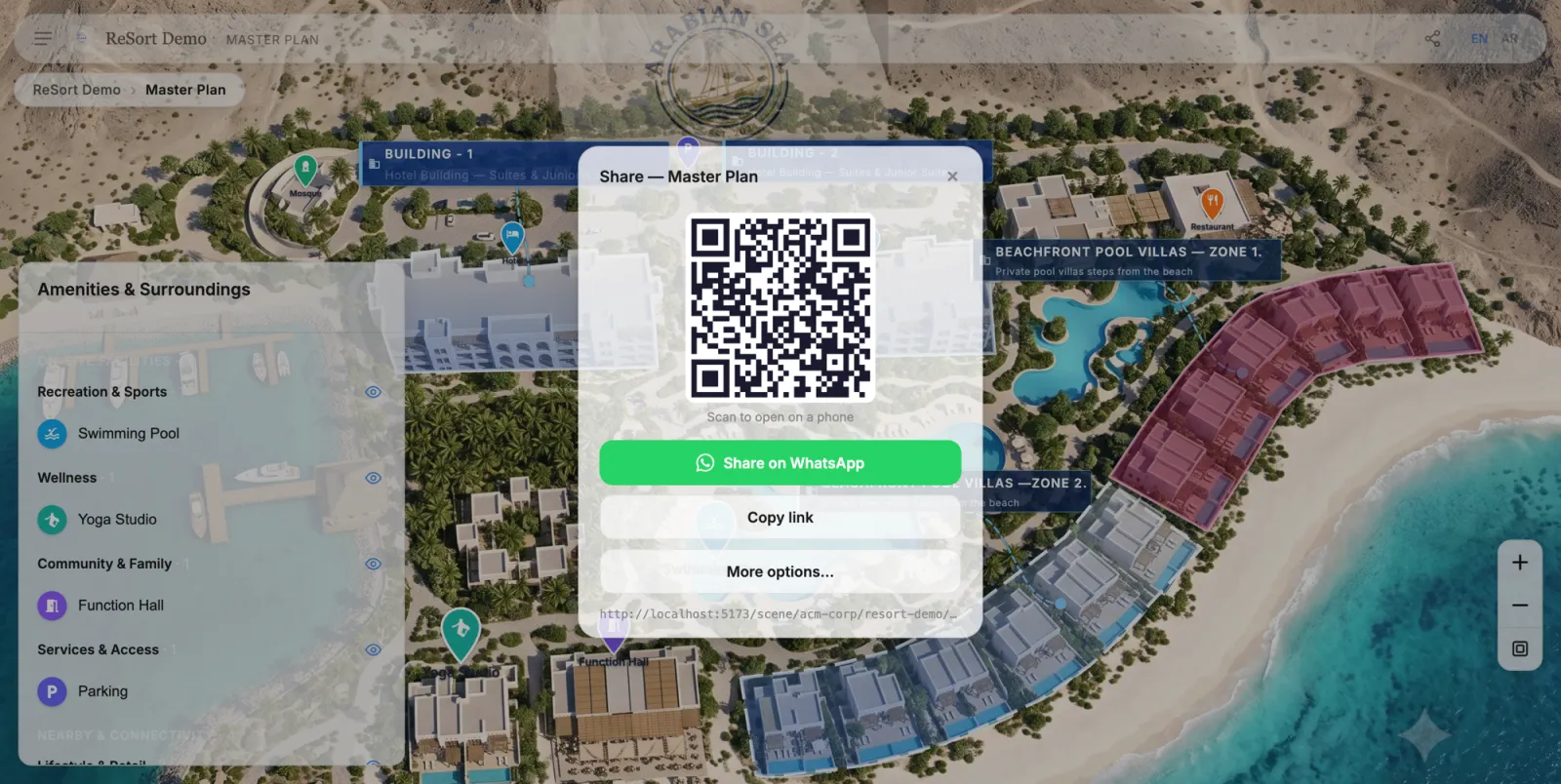
In RegalScene, any level of the experience can be shared:
- The whole project — the master plan entry point
- A specific building — a tower with its current availability
- A single unit — a specific apartment, with its price and layout
And each can be shared in the way the buyer actually uses:
- QR code — to hop from a gallery screen or a printed banner straight onto a phone
- WhatsApp — the default channel for property buyers across Southeast Asia and the GCC
- Copy link — for email, LINE, WeChat, Zalo, or anywhere else
Why "share a specific unit" matters
Sharing a whole project is common. Sharing a specific unit is where decisions happen. When a buyer sends their partner a link to unit LT-07-10 — not the project homepage — the person who opens it lands exactly where the conversation is: the right tower, the right floor, the right price. No re-explaining, no hunting.
That precision shortens the family decision loop that so many property sales stall inside.
The link still belongs to the developer
This is the part that makes sharing a business advantage rather than a leak.
- Every shared link points back to the developer's published experience — the single source of truth for content, availability, and pricing.
- When the recipient explores and enquires, that lead is captured with full context — which unit, which path, which source.
- Availability and pricing are always current, so a link shared today never shows a stale price tomorrow.
Buyers do the distribution. The developer keeps the traffic, the data, and the lead.
From gallery to phone in one scan
The QR code closes a gap that used to cost developers momentum. A buyer standing at a sales gallery screen scans the QR and carries the exact view home on their phone. A prospect at a roadshow booth scans a printed code and enters the full experience. The physical and digital touchpoints become one continuous journey instead of two disconnected ones.
What to look for
If you are evaluating a digital sales platform, sharing should be:
- Available at every level — project, building, and unit
- Multi-channel — QR, WhatsApp, and copy link at minimum
- Attributed — every shared link and the leads it generates trace back to a source
- Always live — shared links reflect current availability and pricing
Anything less turns your best organic distribution into an untracked screenshot.
Related reading:
- How Developers Can Sell Through Multiple Brokerages Without Losing Control
- Centralizing Buyer Intent Across Websites, Campaigns, and Sales Channels
- Why Buyer Context Matters More Than Basic Contact Forms
Scene Engine makes every project, building, and unit shareable by QR, WhatsApp, and link — with every lead attributed back to the developer. Learn more or book a demo.