Most property developers don't sell entirely on their own. They work with external agencies, brokerages, and sales partners — sometimes two or three, sometimes twenty. These partners bring buyer networks, local market knowledge, and sales capacity that the developer's in-house team can't always cover alone.
This is especially true in Asia's cross-border property markets. A developer in Kuala Lumpur may work with agencies in Singapore, Hong Kong, Jakarta, and Shanghai to reach overseas buyers. A developer in Bangkok may partner with brokerages across Southeast Asia and the Middle East. The more markets you want to reach, the more partners you need.
The challenge isn't finding agencies to work with. The challenge is keeping control of the project information, inventory visibility, pricing, and leads once you start distributing across multiple channels.
The problem with manual project distribution
When a developer onboards a new agency partner, the typical process looks something like this:
- Send the agency a PDF brochure, a pricing sheet, and a set of floor plan images.
- Share an Excel or Google Sheet with current unit availability.
- The agency creates their own marketing materials, social media posts, and listing portal entries using the provided assets.
- When the agency secures a buyer enquiry, they forward it via email or WhatsApp to the developer's sales team.
- The developer's team manually updates the availability sheet and responds.
This works when you have one or two agency partners. It starts breaking down at five. At ten or more, it becomes a coordination burden.
What goes wrong
Outdated information. The brochure the agency received last month still shows units that have since been reserved or sold. The agency shares it with a buyer who enquires about an unavailable unit. The developer's team has to correct the information and redirect the buyer.
Inconsistent presentation. Each agency adapts the materials to their own style. Some add their own branding. Some crop the renders. Some simplify the pricing. The buyer experience varies depending on which agency they found first.
Lost or duplicated leads. A buyer enquires through Agency A and separately through Agency B. Both agencies claim the lead. The developer doesn't have a central view of which buyers came from which channel, and the buyer gets contacted twice.
No visibility into sales activity. The developer knows how many brochures were sent out, but has no visibility into how agencies are actually using the materials — which projects they're promoting, which buyers they're engaging, and where the pipeline stands.
Slow availability updates. When a unit is reserved or sold, the developer has to manually notify all agency partners. If one agency doesn't get the update, they continue promoting an unavailable unit.
What developers actually need
The solution isn't to stop working with agencies. External sales partners are essential for market reach, especially for cross-border property sales. The solution is to give agencies a controlled, always-current view of the project — instead of static files that go stale the moment they're sent.
Here's what that looks like in practice:
One official project source
Instead of distributing PDFs and spreadsheets, the developer maintains one interactive master plan that serves as the official project presentation. This master plan is always current — it reflects the latest renders, the latest availability, and the latest pricing visibility settings.
Agencies don't receive a copy of the project. They receive access to the live project. When the developer updates a floor plan or changes a unit's status, every agency sees the change immediately.
Controlled access per agency
Not every agency needs to see every project. A developer with five active projects might assign two projects to Agency A (their Singapore partner) and three projects to Agency B (their Jakarta partner). Each agency only sees the projects they've been assigned.
Within each project, the agency can view the interactive master plan, browse the inventory, and see unit availability — but they cannot edit anything. They can't change a unit's status, modify the pricing, or alter the master plan content. The developer remains the sole editor.
Price and data visibility managed by the developer
Whether agencies can see pricing depends on the developer's settings. Some developers want agencies to show prices openly. Others prefer to keep pricing hidden until the buyer engages directly with the developer's team. This is a developer-level setting, not something agencies can override.
The same applies to other data points — unit attributes, detailed specifications, and internal notes. The developer decides what's visible to agency users.
Agency-level lead ownership
When a buyer submits an enquiry through an agency's sales channel, the lead is tagged to that agency. The agency can see and follow up with their own leads. They cannot see leads from other agencies or from the developer's direct channels.
The developer, meanwhile, has a central view of all leads — from all agencies and from direct channels. This gives the developer full pipeline visibility without exposing one agency's leads to another.
How RegalScene supports this workflow
RegalScene is built around this model. Here's how the pieces connect:
The developer creates the project. The interactive master plan, building explorers, floor plans, and inventory are managed centrally by the developer's admin team. This is the single source of truth for all project content.
The developer creates agency accounts. Each agency is set up as an external sales partner within the developer's tenant. Agency users are invited with a fixed view-only access role — they can see assigned projects and inventory, but cannot edit anything.
The developer assigns projects to agencies. Each agency is given access to specific projects. An agency in Singapore might have access to the Johor township project. An agency in Jakarta might have access to the Bali resort project. Assignments are managed by the developer at any time.
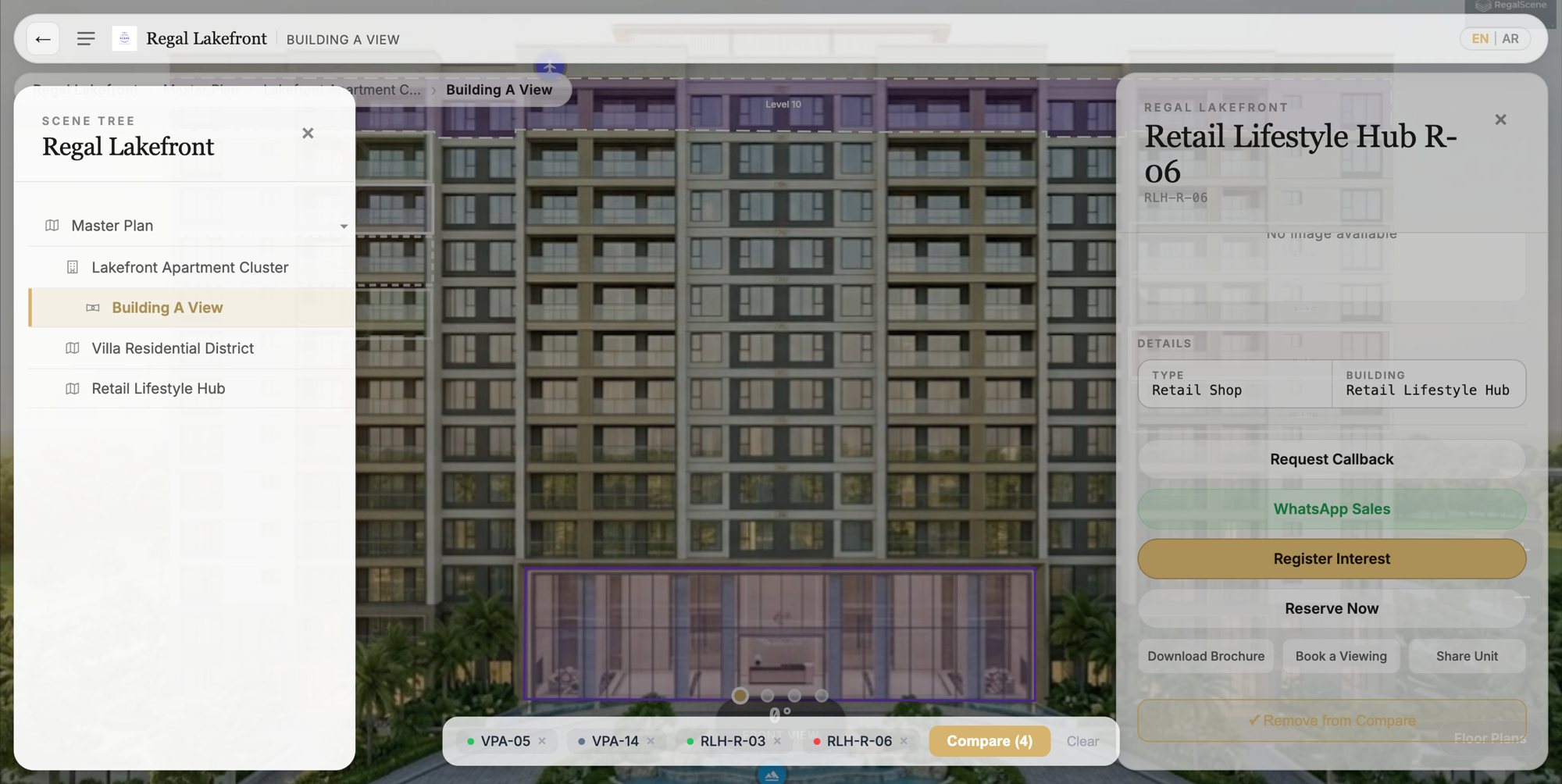
Agency users explore and share. Agency users log in and see only their assigned projects. They can view the interactive master plan, browse inventory, check availability, and use the project in their own buyer conversations — sharing links, presenting on video calls, or displaying at their own offices.
Leads are captured with agency attribution. When a buyer submits an enquiry through an agency's channel, the lead is automatically associated with that agency. The agency user can view and follow up with their own agency's leads only.
The developer sees everything. The developer's admin has full visibility across all agencies, all projects, and all leads. They can see which agencies are active, which projects are getting traction, and where leads are in the pipeline.
Why this matters in Southeast Asia
Southeast Asia's property markets have characteristics that make multi-agency sales management particularly important:
Cross-border sales are the norm. Malaysian developers sell to Singaporean buyers. Thai developers market to Chinese investors. Indonesian developers attract buyers from across ASEAN. Each target market often requires a local agency partner who understands the buyer profile, regulatory environment, and communication preferences.
Agency networks are fragmented. Unlike markets with a few dominant brokerage chains, Southeast Asian markets have hundreds of independent agencies, boutique brokerages, and freelance agents. Developers often work with many smaller partners rather than one or two large ones.
Messaging-first communication. Agencies in SEA communicate with buyers primarily through WhatsApp, LINE, and WeChat. Sharing a link to an interactive master plan is far more effective in these channels than attaching a 20MB PDF brochure.
Competitive project launches. In competitive markets like Kuala Lumpur, Bangkok, and Jakarta, the speed of information matters. A developer who can give agencies live availability and an interactive presentation tool has an advantage over one sending weekly Excel updates.
GCC and other markets
The same model applies in other high-growth real estate markets. In Saudi Arabia, the UAE, and Qatar, large-scale developments often involve multiple sales channels — direct sales teams, local brokerages, and international agency networks targeting expatriate and overseas buyers.
The dynamics are similar: developers need to maintain central control while enabling external partners to sell effectively. The scale may be different — GCC mega-projects can involve thousands of units across multiple phases — but the underlying challenge of consistent information, controlled access, and clear lead attribution is the same.
What this means for your sales operation
Working with multiple agencies doesn't have to mean losing control of your project's presentation, inventory data, or lead pipeline. With the right structure, you can:
- Maintain one official version of your project that all agencies use
- Control what each agency can see — which projects, which data, which pricing
- Track leads by agency without exposing one partner's pipeline to another
- Update availability once and have it reflected across all channels immediately
- Reduce the coordination overhead of managing static files, manual updates, and email-based lead forwarding
This isn't about adding complexity to your sales operation. It's about removing the friction that comes with manual multi-channel distribution, so your team can focus on selling and your agency partners can focus on reaching buyers.
Related reading:
- Sell Property Through Agencies Online: The Borderless Sales Engine
- How Malaysian Property Developers Can Manage Multi-Agency Sales Digitally
- Property Sales Distribution in Singapore: Working With Agencies More Effectively
- Property Sales Channels for the Chinese Market
RegalScene helps real estate developers manage interactive project experiences, inventory, and leads across multiple sales channels. Learn more about how it works, or get in touch to discuss your agency distribution setup.