Malaysia's property market has always been outward-facing. Developers in Johor sell to Singaporean buyers. Developers in Kuala Lumpur market to investors from China, Hong Kong, the Middle East, and the Malaysian diaspora in Australia, the UK, and Singapore. Large township developers launch projects that span years and involve dozens of agency partners across multiple countries.
This cross-border reach is a strength. But it also creates a coordination challenge that many developers still manage with PDF brochures, WhatsApp groups, and Excel availability sheets.
The cross-border sales reality for Malaysian developers
A typical Malaysian developer launching a new residential phase might work with:
- Two or three agencies in Singapore targeting HDB upgraders and cross-border investors
- A handful of agencies in Hong Kong and mainland China targeting Chinese-Malaysian buyers and pure investors
- Local agencies in KL, Johor Bahru, and Penang covering the domestic market
- One or two agencies in Jakarta or Bangkok for regional ASEAN buyers
- Occasionally, agencies in the Middle East targeting expatriate Malaysians or Gulf-based investors
Each of these partners needs project materials — master plan renders, floor plans, pricing, availability, and brochures. Each operates in a different market with different communication preferences. And each generates leads that need to flow back to the developer's sales team.
When the developer has two or three active projects, each with ten or more agency partners, the volume of coordination becomes significant.
Why PDF brochures and WhatsApp aren't enough anymore
The traditional distribution model works like this: the developer's marketing team prepares a set of materials — PDF brochure, pricing sheet, floor plan images, availability list — and sends them to each agency partner. The agency uses these materials to create their own marketing content, share with buyers, and generate enquiries.
The problems are predictable:
Materials go stale. The availability list sent last week doesn't reflect the three units reserved over the weekend. The pricing sheet doesn't include the revised prices for higher floors. The agency shares outdated information, the buyer enquires about an unavailable unit, and the developer's team spends time correcting rather than selling.
Presentation varies. Each agency adapts the materials differently. Some create professional presentations. Others simply forward the PDF via WhatsApp with a message in their own language. The buyer's impression of the project depends on which agency they happened to find first.
Lead attribution is unclear. A buyer contacts Agency A in Singapore, doesn't get a response fast enough, and then contacts Agency B through a different listing. Both agencies claim the lead. The developer has no central record of the buyer's journey.
No visibility into activity. The developer knows they sent materials to fifteen agencies. They don't know which agencies are actively promoting, which buyers are engaging, and where the sales pipeline stands across channels.
Managing agencies across Singapore, Hong Kong, and ASEAN
For Malaysian developers selling cross-border, the coordination challenge is amplified by distance, time zones, and language.
An agency in Singapore might be conducting a buyer briefing on Saturday morning, presenting the Johor project to a room of prospective buyers. If they're showing a PDF brochure from two weeks ago, with outdated availability and last month's pricing, the presentation starts on the wrong foot.
An agency in Hong Kong might be marketing the KL project to Chinese investors through WeChat groups and online property exhibitions. The materials they use need to be in Simplified Chinese, reflect current availability, and capture leads in a format the developer can track.
A local agency in JB might be handling walk-in buyers at their office, using a printed version of the master plan pinned to the wall. When a buyer points at a building and asks "What's available here?", the agent checks a WhatsApp group for the latest update.
In each case, the fundamental problem is the same: the agency doesn't have a live, always-current view of the project. They're working from snapshots that were accurate at a point in time.
How a central digital sales platform helps both sides
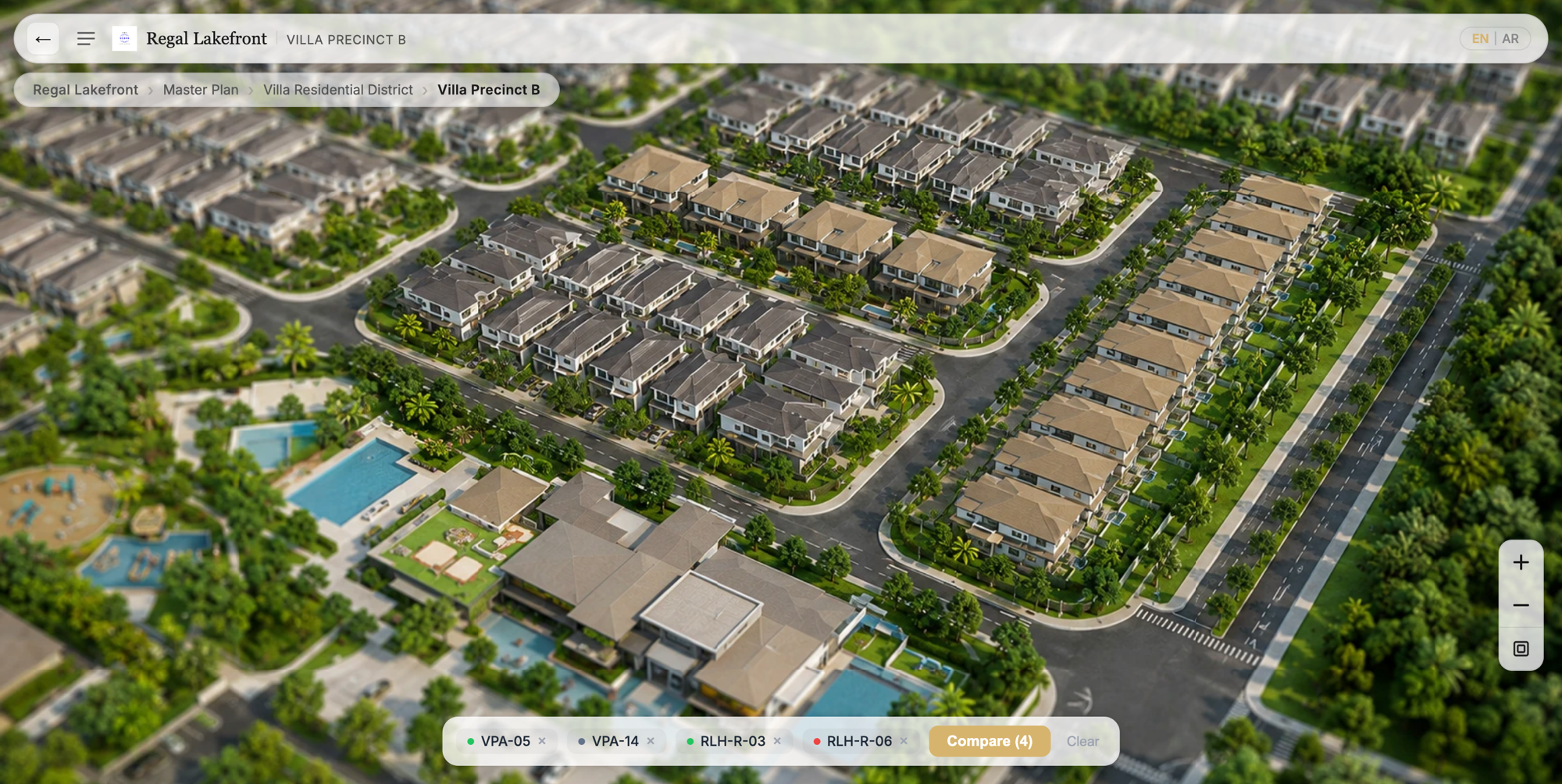
The alternative to distributing static files is giving agencies controlled access to the live project. Instead of sending a brochure, the developer gives the agency a link to the interactive master plan — the same one used on the developer's own website.
For the developer
- One source of truth. The interactive master plan, inventory, and pricing are maintained centrally. When the developer updates a unit's status or revises pricing, every agency sees the change immediately.
- Controlled access. Each agency is assigned access to specific projects. A Singapore agency might see the Johor project but not the KL project. A local agency might see both. The developer decides.
- Central lead visibility. Every lead from every agency flows into one system. The developer can see the full pipeline, identify which agencies are performing, and avoid duplicate lead conflicts.
- Price and data control. Whether agencies see pricing depends on the developer's settings. Some developers share prices openly with agency partners. Others prefer to control pricing disclosure. Either way, it's the developer's decision, not the agency's.
For the agency
- Always-current information. The agency presents the live project — current availability, current imagery, current floor plans. No more checking whether the brochure they have is the latest version.
- Professional presentation tool. Instead of forwarding a PDF, the agency shares a link to an interactive master plan that buyers can explore on their phones. The presentation quality is consistent regardless of the agency's own marketing capabilities.
- Own lead management. The agency can see and follow up with their own leads. They have clear visibility into which buyers they've generated and what those buyers were interested in.
- Less manual back-and-forth. The agency doesn't need to message the developer's team every time a buyer asks "Is this unit still available?" — the answer is visible on the live inventory.
What this means for your next project launch
Malaysian developers don't need to stop working with agencies. Agency partners are essential for market reach, especially across borders. But the coordination model can be improved.
Instead of distributing PDFs that go stale, share live project access. Instead of managing availability updates via WhatsApp groups, maintain a central inventory that all partners can see. Instead of tracking leads through email forwarding, capture them in a system that attributes each lead to the right agency.
This doesn't require a complex technology migration. It requires a platform that's designed for exactly this workflow — one official project, multiple agency partners, controlled access, and clear lead attribution.
For market-specific approaches, see interactive master plans for township sales in Johor, KL high-rise sales galleries, Selangor townships, and Penang waterfront and high-rise projects, plus the Johor Bahru digital sales gallery approach for cross-border reach. For KL and Selangor specifically, see KL floor plans as interactive journeys, digital sales for multi-tower KL developments, presenting multi-phase Selangor projects, and Penang mixed-use developments.
Related reading:
- Property Sales Technology for Malaysian Developers
- How Developers Can Sell Through Multiple Brokerages Without Losing Control
- Property Sales Distribution in Singapore: Working With Agencies More Effectively
- Selling Property to Chinese Buyers: Why Digital Sales Experiences Matter
RegalScene helps Malaysian property developers manage interactive project experiences, inventory, and leads across multiple agency channels. Learn more or get in touch to discuss your agency distribution setup.