Chinese buyers are among the most active overseas property purchasers in the world. From condominiums in Bangkok and Kuala Lumpur to apartments in Singapore, Melbourne, and London, Chinese capital flows into international real estate markets through a network of agencies, brokerages, key opinion leaders, exhibition organisers, and digital platforms.
For property developers in Southeast Asia and beyond, reaching Chinese buyers is often a priority. But the Chinese buyer market has its own ecosystem — its own communication platforms, its own sales channels, and its own expectations for how property information should be presented.
Managing project distribution into this market requires understanding how information flows and ensuring the developer retains control of that information throughout.
The Chinese overseas property buyer landscape
Chinese overseas property buyers are not a single demographic. They include:
- Investors seeking rental yield, capital appreciation, or portfolio diversification in markets like Thailand, Malaysia, Japan, and Australia.
- Families purchasing property for children studying abroad — in Singapore, the UK, Canada, and Australia.
- Lifestyle buyers looking for second homes or retirement properties in destinations like Phuket, Bali, or the Gold Coast.
- Businesspeople acquiring property in markets where they have commercial interests — particularly in Southeast Asia.
- Diaspora buyers — Chinese nationals living abroad who purchase property in their country of residence or back in China.
Each segment has different motivations, budgets, and decision-making processes. But they share common channels through which they discover and evaluate overseas property.
How developers reach Chinese buyers through agency networks
The sales channels for reaching Chinese buyers are distinct from those in other markets:
Local Chinese agencies and brokerages
Property agencies in Shanghai, Beijing, Guangzhou, Shenzhen, and other Chinese cities offer overseas property advisory services. These firms maintain buyer databases and actively market international projects to their clients. A developer targeting the Chinese market typically partners with several of these agencies.
WeChat and social media
WeChat is the dominant communication and marketing platform in China. Property agencies, developers, and independent agents use WeChat official accounts, group chats, and mini-programs to market overseas projects. A single WeChat article about a Bangkok condominium can reach thousands of prospective buyers through shares and group forwarding.
Property exhibitions and roadshows
International property exhibitions in Shanghai, Beijing, and other major cities bring developers face-to-face with Chinese buyers. These events are organised by exhibition companies and attended by agency partners, developers, and buyers. Materials distributed at these events enter the broader information ecosystem.
Key opinion leaders and referral networks
KOLs (key opinion leaders) in the Chinese property space — real estate bloggers, financial advisors, and lifestyle content creators — influence buyer decisions. Some developers work with KOLs to promote projects through content marketing and live streaming.
Cross-border platforms
Online platforms specialising in overseas property listing and advisory — such as Juwai, Uoolu, and others — connect Chinese buyers with international projects. Developers list projects on these platforms and receive enquiries.
Why project control matters when selling into China
The diversity of channels is a strength — it provides reach. But it also creates a control challenge.
When a developer sends project materials to five Chinese agencies, and those agencies share the materials through WeChat groups, KOL partnerships, and exhibition handouts, the information can travel far beyond the developer's direct oversight.
Information distortion
Project details can be simplified, mistranslated, or repackaged as they pass through multiple channels. Pricing might be quoted in a different currency without accurate conversion. Floor plans might be presented without context. Availability information might be weeks out of date.
Inconsistent buyer experience
A buyer who discovers the project through a professional agency partner might receive a polished presentation. A buyer who finds the project through a forwarded WeChat post might see a cropped image with incomplete information. The developer's project is being represented at different quality levels through different channels.
Lead fragmentation
Leads generated through Chinese channels often reach the developer through informal means — a WeChat message from an agency partner, an email from an exhibition organiser, or a form submission on a listing platform. Without a central lead tracking system, the developer has limited visibility into the total pipeline from the Chinese market.
Duplicate enquiries
A buyer might interact with two or three different agencies or channels before making contact with the developer. Without lead attribution, the developer may not realise they're dealing with the same buyer through multiple agencies.
Digital tools that help both developers and Chinese agencies
The solution isn't to reduce the number of channels — reach matters in the Chinese market. The solution is to give agency partners better tools so the project is represented accurately and leads are tracked clearly.
Interactive project experience in Chinese
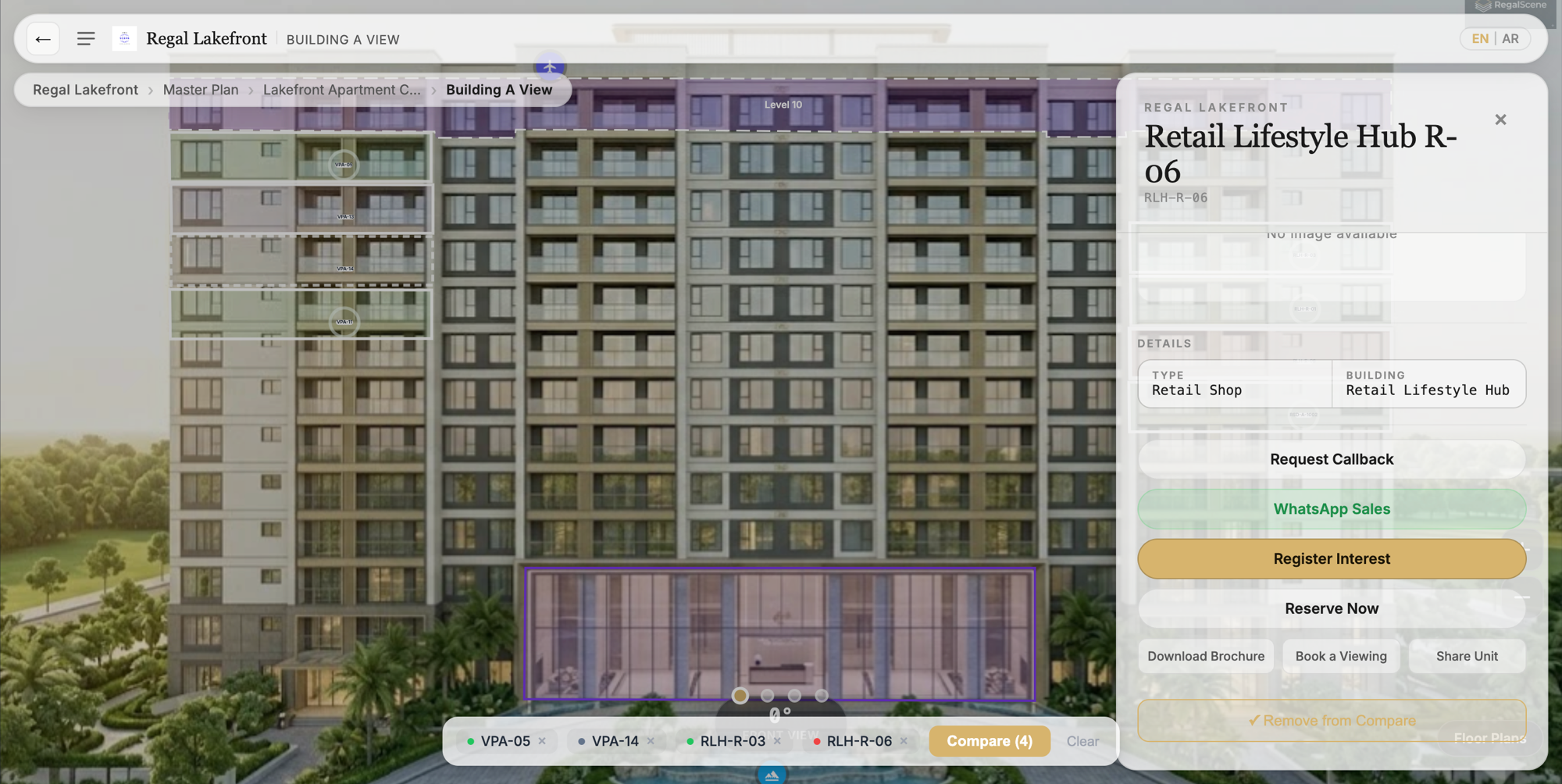
Instead of relying on agencies to translate and repackage PDF brochures, the developer can provide a Chinese-language interactive master plan that agencies share directly with buyers. The master plan loads in a browser, works on WeChat's built-in browser, and presents the project with consistent quality regardless of which agency shared the link.
Live inventory visibility
Agencies in China can see current availability in real time, without waiting for the developer to send an updated spreadsheet. When a buyer asks "Is this unit still available?", the agency can answer immediately by checking the live inventory.
Agency-attributed lead capture
When a buyer submits an enquiry through an agency's shared link, the lead is automatically tagged to that agency. The developer can see all Chinese market leads in one view, segmented by agency, while each agency manages their own pipeline independently.
Controlled pricing
Whether Chinese agencies can see and share pricing is controlled by the developer. Some developers prefer to share pricing openly to accelerate buyer decisions. Others prefer to withhold pricing until the buyer engages directly. The developer's settings apply consistently across all agency channels.
Practical steps for developers targeting Chinese buyers
For developers expanding their Chinese buyer reach, the practical approach is:
-
Prepare Chinese-language project assets. Ensure the interactive master plan, key descriptions, and lead capture forms are available in Simplified Chinese. This is more effective than relying on individual agencies to translate PDF brochures.
-
Partner with established agencies. Work with reputable Chinese property agencies that have genuine buyer networks. Assign each partner access to the relevant projects with appropriate visibility settings.
-
Use digital distribution, not just file sharing. Share links to the live interactive experience rather than static files. These links work in WeChat, on mobile browsers, and on desktop — meeting buyers where they browse.
-
Track leads by channel. Implement agency-level lead attribution so you can measure which Chinese partners and which channels are generating qualified interest. This data helps you allocate resources to the most productive partnerships.
-
Maintain central control. Keep the interactive master plan, inventory, and pricing managed centrally. Agency partners access the project but cannot modify it. Updates you make are reflected across all channels immediately.
This approach applies whether you're a Malaysian developer targeting Chinese investors for a Johor township, a Thai developer marketing Bangkok condominiums to Shanghai buyers, or a developer in any market seeking to reach the Chinese overseas property buyer.
For developers in GCC markets — Saudi Arabia, UAE, and Qatar — the same model applies to Chinese expatriate buyers and investors looking at Gulf real estate. The channels and agencies may differ, but the need for controlled distribution and lead attribution is the same.
Related reading:
- How Developers Can Sell Through Multiple Brokerages Without Losing Control
- Selling Property to Chinese Buyers: Why Digital Sales Experiences Matter
- How Thai Property Developers Can Work With Agencies More Effectively Online
- Sell Property to Buyers Anywhere, Without a Site Visit
RegalScene helps property developers manage interactive project experiences, inventory, and leads across international agency channels, including the Chinese buyer market. Learn more or get in touch to discuss your cross-border sales distribution.