Thailand's property market — particularly in Bangkok, Pattaya, Phuket, and Chiang Mai — attracts one of the most internationally diverse buyer pools in Southeast Asia. Chinese investors, Singaporean second-home buyers, Hong Kong professionals, Russian expatriates, Middle Eastern investors, and Japanese retirees all feature in Thailand's buyer demographics.
Reaching these buyers requires working with agencies and brokerages across multiple countries, languages, and communication channels. A Bangkok developer might have agency partners in Shanghai, Singapore, Hong Kong, Dubai, Moscow, and Tokyo — each operating in different languages, on different platforms, with different buyer expectations.
This international reach is what makes Thailand's market dynamic. It's also what makes multi-agency coordination difficult.
Thailand's international property buyer market
The numbers tell the story. In Bangkok alone, foreign buyers account for a meaningful share of condominium purchases, with Chinese buyers consistently among the top nationalities. Pattaya and Phuket have even higher proportions of overseas buyers.
These buyers don't typically walk into a sales gallery in Bangkok. They discover projects through:
- Overseas agency partners — local brokerages in Shanghai, Singapore, or Dubai that market Thai properties to their client base.
- Property exhibitions — developer roadshows and property fairs in target cities.
- Online channels — WeChat groups, LINE communities, property portals, and social media advertising in multiple languages.
- Referral networks — existing owners, diaspora communities, and personal connections.
For the developer, this means the project needs to be presentable and accessible to buyers in multiple countries, often without the developer's direct involvement in the first interaction.
The challenge of distributing projects across overseas agencies
When a Thai developer partners with an agency in Shanghai to sell Bangkok condominiums, the typical flow looks familiar:
- The developer sends project materials — brochures, floor plans, pricing, and availability — to the agency.
- The agency translates or adapts the materials for their local market.
- The agency markets the project through their channels — WeChat, property portals, client briefings, or exhibitions.
- Interested buyers contact the agency.
- The agency forwards the lead to the developer, usually via email or messaging.
The delay between steps is where problems emerge. Materials go out of date. The pricing shared last month may have changed. The availability list sent via WeChat doesn't reflect the units reserved at last weekend's Bangkok sales event. The agency is presenting a version of the project that no longer matches reality.
For developers working with agencies in five or more countries, this information lag multiplies. Each agency is working from a slightly different version of the truth.
One master plan, many markets: keeping control centrally
The practical solution is to give international agency partners access to a live, always-current project experience — rather than static files that become outdated as soon as they're sent.
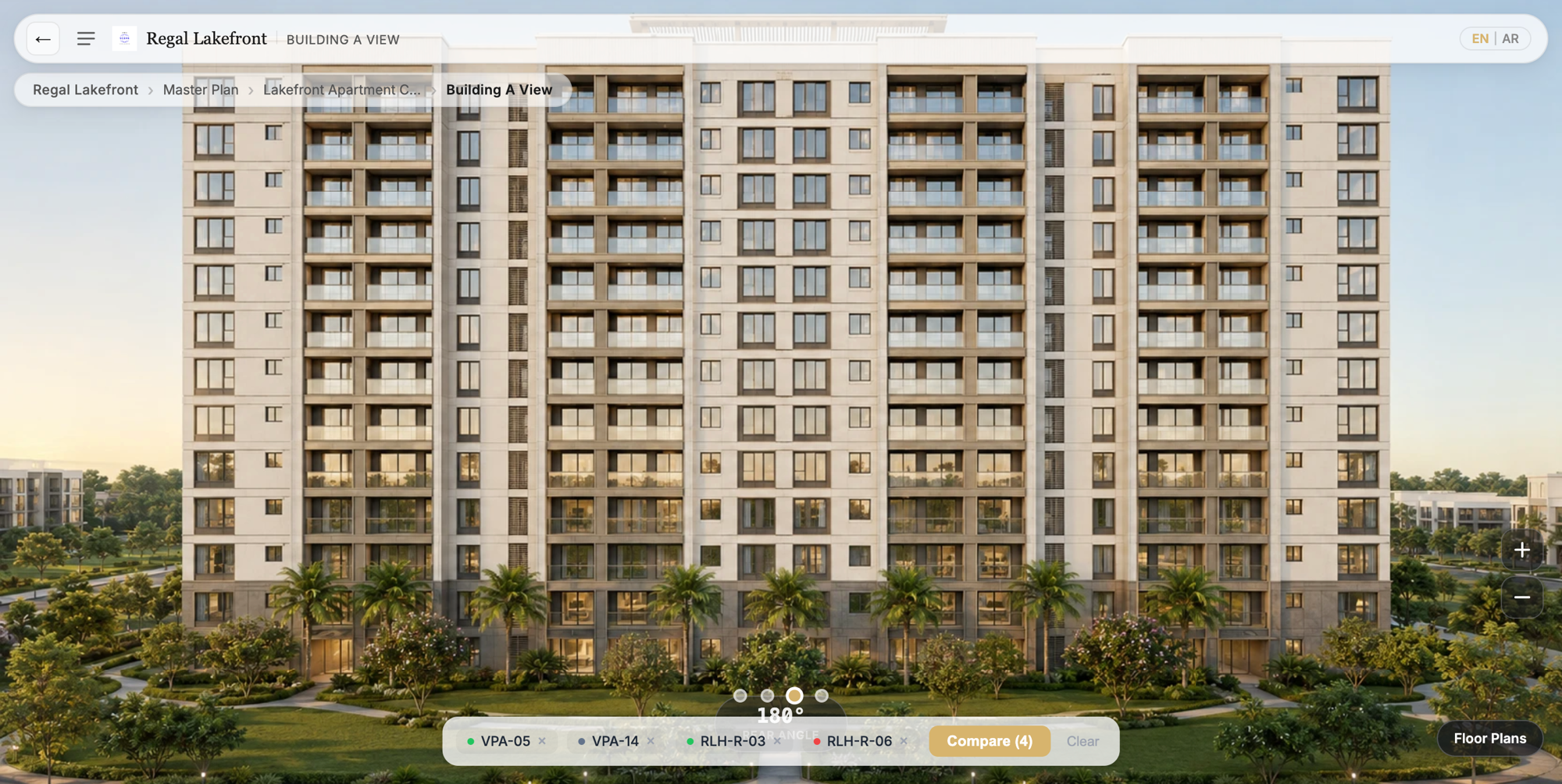
This means the developer maintains one interactive master plan that serves as the official project representation. This master plan includes navigable visuals, floor plans, live inventory status, and lead capture. It works in a browser on any device, in any country.
When the developer assigns the project to an agency in Shanghai, that agency can access the live master plan — view the current availability, explore unit options, and share the experience with their buyers via WeChat or their own website.
When the developer assigns the same project to an agency in Singapore, that agency sees the same live project. When a unit is reserved in Bangkok, both the Shanghai and Singapore agencies see the status change immediately.
The developer controls:
- Which projects each agency can access. An agency in Dubai might be assigned the Phuket resort project but not the Bangkok office tower project.
- What data is visible. Price visibility, unit attributes, and inventory detail are managed by the developer's settings.
- The project content itself. The master plan, imagery, floor plans, and descriptions are maintained centrally. Agencies cannot modify the content.
Agency lead attribution for international sales channels
For Thai developers selling through international agencies, lead attribution is particularly important. When a buyer in Shanghai submits an enquiry through Agency A's WeChat channel, and a buyer in Singapore submits an enquiry through Agency B's website, the developer needs to know:
- Which lead came from which agency
- What the buyer was interested in (which project, which building, which unit)
- What action the buyer wanted (book a viewing, request pricing, register interest)
Without this attribution, the developer's sales team receives leads via email or messaging with minimal context. They don't know which agency generated the lead, and they can't measure which international channels are performing.
With proper lead attribution:
- Each agency sees their own leads. The Shanghai agency manages their leads. The Singapore agency manages theirs. Neither sees the other's pipeline.
- The developer sees all leads centrally. The developer can compare performance across agencies and markets, identifying which channels deliver the most qualified buyers.
- Follow-up is faster. Leads arrive with context — which unit, which project, what the buyer explored — so the follow-up conversation starts with relevant information rather than generic qualification.
A better digital workflow for Thai developers
Thai developers don't need to change their agency relationships or stop working with international partners. They need better tools for coordination.
The shift is from distributing static snapshots of the project to providing live, controlled access. From tracking leads through WhatsApp forwarding to capturing them in a system with automatic agency attribution. From sending availability updates manually to maintaining a live inventory that all partners can see.
For developers with projects targeting buyers across China, Singapore, Hong Kong, the Middle East, and other markets, this coordination improvement translates directly into faster response times, fewer information errors, and clearer visibility into the international sales pipeline.
Related reading:
- How Developers Can Sell Through Multiple Brokerages Without Losing Control
- Digital Property Sales for Indonesian Developers: Managing Agencies Across the Archipelago
- Property Sales Channels for the Chinese Market
RegalScene helps Thai property developers manage interactive project experiences, inventory, and leads across international agency channels. Learn more or get in touch to discuss your multi-market sales distribution.