Indonesia's property market operates at a scale that few countries in Southeast Asia can match. Major developers manage portfolios spanning multiple cities — townships in Tangerang, condominiums in Central Jakarta, resort developments in Bali, landed estates in Surabaya, and mixed-use projects in Medan and Makassar.
These developers don't sell through a single channel. They work with networks of agencies, brokerages, and independent agents spread across the archipelago and, increasingly, across international markets targeting Chinese-Indonesian diaspora buyers, Singaporean investors, and other overseas purchasers.
The geographic scale of Indonesia makes coordinating these sales channels a distinct challenge.
This article covers the agency and distribution side. For the wider picture of how RegalScene works with developers here, including the asset types that matter locally, see property sales technology for Indonesian developers.
The scale of multi-city property sales in Indonesia
A large Indonesian developer might have ten active projects across four cities, sold through a network of fifty or more agency partners. Each project has its own master plan, inventory, pricing, and availability status. Each agency partner needs current materials for the projects they've been assigned to sell.
In practice, this means:
- The marketing team in Jakarta prepares brochures, pricing sheets, and availability lists for each project.
- These materials are distributed to agency partners via email, WhatsApp, or cloud storage links.
- Agencies in Surabaya, Bali, Medan, and other cities receive the materials and adapt them for their local market.
- Overseas agencies — typically in Singapore, Hong Kong, or Malaysia — receive English and sometimes Mandarin versions.
- When availability changes, the marketing team sends updated files to all partners.
This process repeats for every project, every phase, and every pricing change. The volume of file management alone is significant.
Why manual project distribution creates fragmentation
When project information flows through manual channels, fragmentation is inevitable.
Geography compounds the problem. An agency in Surabaya might not receive the same update as an agency in Jakarta. An overseas agency in Singapore might be working from materials that are a week behind the Jakarta team.
Language adds complexity. Indonesian projects marketed domestically use Bahasa Indonesia. Projects targeting overseas buyers need English and often Mandarin. Managing multiple language versions of static brochures doubles or triples the file management burden.
Township projects evolve continuously. Large township developments release new phases, adjust pricing, update infrastructure plans, and change availability on an ongoing basis. Static materials captured at a point in time cannot keep up with this pace.
Agent turnover is constant. In a market with hundreds of agencies and thousands of agents, new agents join, existing agents switch firms, and the developer needs to onboard new partners regularly. Each time, the same materials need to be distributed and explained.
Keeping one official project source across all partners
The alternative to distributing static files is maintaining a single, live project source that all agency partners access. This means:
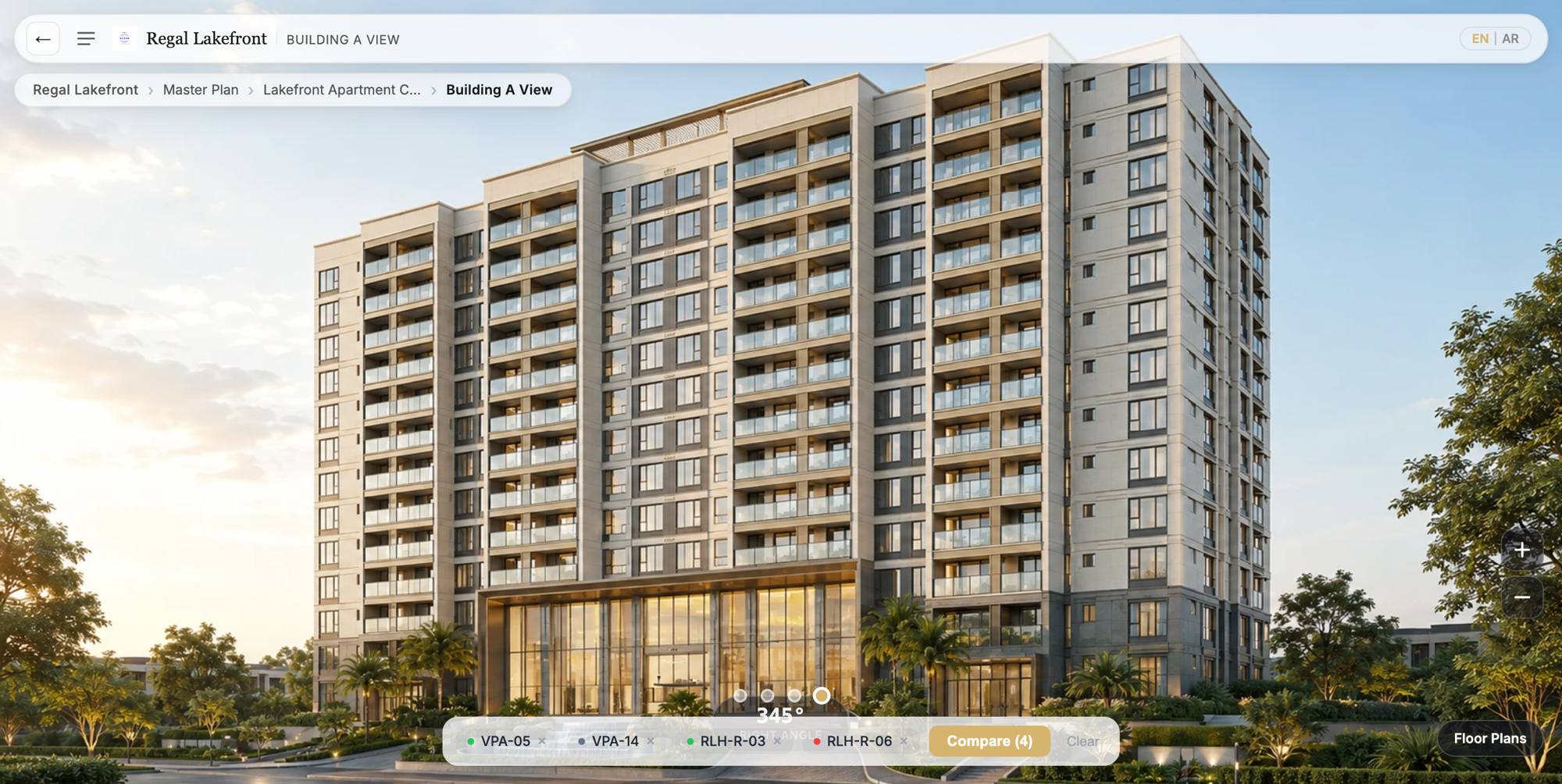
The developer creates an interactive master plan for each project — a high-resolution, navigable visual experience where buildings, zones, and facilities are clickable and connected to live inventory data. This master plan is the official representation of the project.
When the developer assigns an agency to sell a specific project, the agency gets access to the live master plan — not a copy, not a PDF export, but the actual live experience. The agency can view the master plan, explore the inventory, check availability, and share the experience with their buyers.
When the developer updates a unit's status — from available to reserved, or adjusts the pricing — every agency sees the change immediately. No file distribution needed.
For a developer with ten projects and fifty agency partners, this eliminates thousands of manual file distributions per year.
How agency-level lead tracking improves follow-up
Beyond inventory and content management, lead tracking across agencies is a practical operational improvement.
In the current model, an agency generates a lead and forwards it to the developer via email or WhatsApp. The developer's team receives the lead, logs it manually, and follows up — or asks the agency to follow up. If multiple agencies generate leads for the same project, the developer may not have a clear picture of the overall pipeline.
With agency-level lead attribution:
- Each lead is tagged to an agency. When a buyer submits an enquiry through an agency's channel, the lead is automatically associated with that agency.
- Agencies see their own leads. Each agency can view and manage the leads they've generated. They have clear ownership and can follow up directly.
- The developer sees all leads. The developer's admin has a central view of all leads — from all agencies and from direct channels. They can see which projects are generating interest, which agencies are performing, and where the pipeline is strong or weak. The same view answers a harder question: which units buyers are actually circling before anyone enquires.
- Duplicate detection. If the same buyer enquires through two different agencies, the developer can identify the overlap and manage the situation proactively.
What Indonesian developers can do today
For Indonesian developers looking to improve their multi-agency sales coordination, the practical steps are:
- Start with your highest-volume project. Choose the project with the most agency partners and the most frequent availability changes.
- Create a live interactive experience. Convert the master plan into a navigable, clickable visual connected to your inventory data.
- Assign agency access. Give each partner access to the live project with view-only permissions. Set price visibility according to your sales strategy.
- Enable lead capture. Embed enquiry forms within the experience so leads arrive with full context — which project, which building, which unit.
- Monitor centrally. Use the central lead dashboard to track pipeline across all agencies and identify which channels are delivering results.
This approach doesn't require replacing existing tools or changing how agencies operate. It gives them better materials to work with and gives the developer better visibility into how those materials are performing.
Related reading:
- Maket vs Interactive Masterplan for Indonesian Developers
- Property Sales Technology for Indonesian Developers
- How Developers Can Sell Through Multiple Brokerages Without Losing Control
- How Thai Property Developers Can Work With Agencies More Effectively Online
- Why Real Estate Developers Need a Visual Inventory Layer, Not Just a CMS
RegalScene helps Indonesian property developers manage interactive project experiences, inventory, and leads across multiple agency channels and cities. Learn more or get in touch to discuss your agency distribution setup.