The GCC property market is in the middle of a digital shift. Across Saudi Arabia, the UAE, Qatar, Kuwait, Bahrain, and Oman, developers are launching large-scale communities, mixed-use districts, and mega-developments at a pace that demands a faster, more visual way to sell.
At the same time, buyers are changing. They research online before visiting a sales gallery. RegalScene works across the region — see how it applies to property sales across the GCC. They compare options on their phones. Many are buying from a different city — or a different country entirely. The expectation is no longer a phone call and a PDF. It's a self-guided, visual experience that helps them understand what they're buying.
For developers competing across GCC markets, the question is no longer whether to digitise the sales journey. It's how quickly they can do it — and how much buyer friction they can remove in the process.
The problem with static sales material
Most developers still rely on a combination of renders, brochures, price lists, and PDF floor plans to communicate their projects online. These assets are expensive to produce and visually impressive — but they create a disconnected buyer experience.
A buyer looking at a master plan render cannot click on a building to see what's inside. A floor plan PDF doesn't tell them which units are still available. A price list doesn't show them where the unit sits relative to the park, the mosque, or the retail strip.
The result is friction. Buyers struggle to understand spatial context. They send WhatsApp messages asking which units face the garden. They request callbacks just to confirm availability. Sales teams spend time answering questions that a well-structured visual experience could resolve instantly.
For large-scale developments — the kind common across the GCC — this friction compounds. A community with 40 buildings, 12 floor types, and thousands of units cannot be explained through flat images and spreadsheets. The complexity of the product demands a more capable format.
Interactive master plans as a digital sales layer
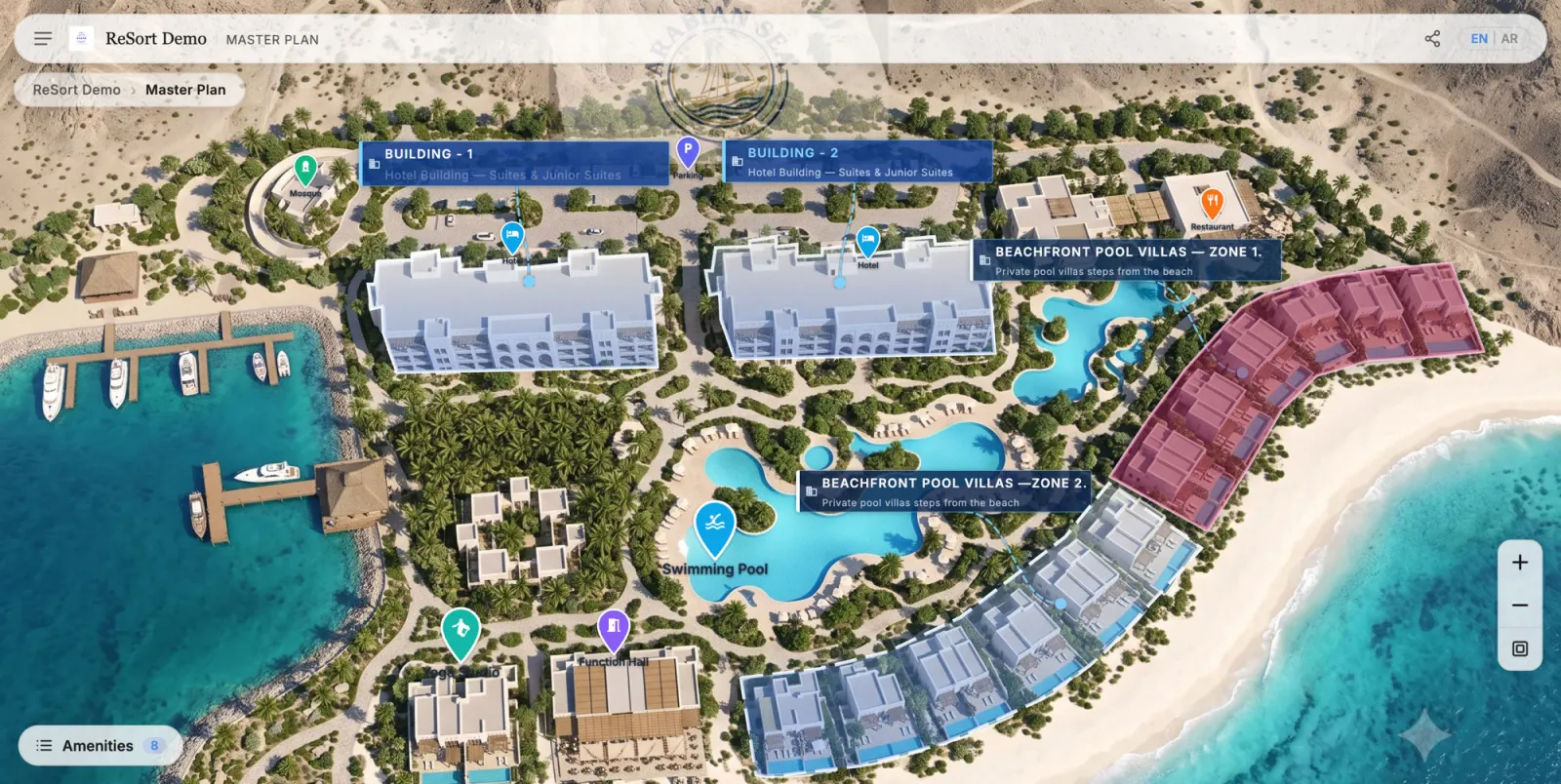
An interactive master plan turns the developer's existing site plan into a navigable, clickable experience. Buyers start at the development level, zoom into zones and precincts, click on buildings, explore floors, and arrive at individual units — all within a single connected journey.
This is not a 3D model or a virtual reality experience. It uses the same high-resolution renders and marketing imagery that developers already produce, enhanced with interactive layers: hotspots, availability overlays, navigation links, and contextual information panels.
The key difference is structure. Instead of presenting a flat image and hoping the buyer understands the layout, an interactive master plan guides the buyer through the development logically — from the big picture down to the specific unit.
What buyers can do
- Explore the master plan by zooming and panning across the full development layout
- Click on zones or buildings to navigate to detailed views — building facades, 360-degree angles, or floor plans
- See live availability with colour-coded overlays showing which units are available, reserved, or sold
- Drill down to unit details including floor position, facing, size, price, and status
- Compare options visually by exploring multiple buildings or floors within the same experience
- Register interest in context — the system captures exactly which unit, building, or zone the buyer was exploring
Why this matters for GCC developers
Buyers are mobile-first and often remote
Across the GCC, a significant share of property interest comes from buyers who are not physically present — overseas investors, cross-border professionals, and diaspora buyers. These buyers need to understand a development without visiting a sales gallery. An interactive master plan gives them a self-guided way to explore the project, build confidence in the layout, and identify the units that interest them.
Developments are large and complex
Saudi Arabia's giga-projects, Abu Dhabi's island communities, Dubai's district-scale developments, and Qatar's mixed-use waterfronts are among the most ambitious in the world. These projects have dozens of buildings, multiple unit types, phased releases, and evolving availability. Static material cannot keep up with the scale or the pace of change.
Sales teams need better-qualified conversations
When a buyer submits an enquiry from an interactive master plan, the sales team knows exactly what the buyer explored — which precinct, which building, which floor, which unit. That context transforms the first sales conversation from a cold introduction into a focused discussion about a specific interest. Sales cycles shorten because both sides start from the same point.
Real-time availability reduces back-and-forth
One of the most common sources of friction in GCC property sales is availability confirmation. Buyers ask about a unit, wait for a response, and sometimes discover the unit was already reserved. When availability is displayed directly on the master plan with live status overlays, buyers can focus on what's actually available — and sales teams spend less time on status enquiries.
Embedded placement extends campaign reach
An interactive master plan is not limited to the developer's main website. It can be embedded into campaign landing pages, agency partner portals, exhibition microsites, or sales team dashboards. Wherever the buyer encounters the development, the experience is the same — consistent, visual, and connected to live data.
From digital interest to qualified conversation
The shift from static material to interactive visual sales is not just a marketing upgrade. It changes the structure of the sales funnel.
At the top, more buyers engage because the experience is intuitive and self-paced. In the middle, buyers qualify themselves by exploring specific units and checking availability. At the bottom, the leads that reach the sales team carry context — the buyer's exploration path, the units they viewed, the actions they took.
This is where platforms like RegalScene fit into the picture. RegalScene is built specifically for this workflow — turning master plans, building views, floor plans, and unit data into a connected visual sales experience with embedded lead capture. Developers bring their existing visual assets, and RegalScene turns them into an interactive journey that works across devices, languages, and markets.
For GCC developers managing multi-phase communities or launching across borders, this kind of platform removes the operational gap between marketing material and sales readiness.
What this means for GCC property marketing
The GCC real estate market is moving toward a model where buyers expect to explore developments visually before they speak to a sales team. Interactive master plans meet that expectation.
Developers who adopt this approach gain three advantages: faster buyer decisions (because the buyer already understands the product), better-qualified leads (because the system captures exploration context), and more efficient sales teams (because conversations start with shared understanding rather than cold introductions).
Static brochures and PDF floor plans will not disappear overnight. But for developments that compete on scale, quality, and buyer experience — the kind that define the GCC market — interactive visual sales is becoming the standard.
The developers who move first will set the expectation. The rest will follow.
Related reading:
- What Is an Interactive Master Plan?
- Interactive Master Plans for Property Launches
- Why Static Brochures Are No Longer Enough for Property Launches
- Why Buyer Context Matters More Than Basic Contact Forms
RegalScene helps property developers turn master plans into interactive visual sales experiences. Learn more or book a demo.