Somewhere in most platform evaluations, a stakeholder asks for "our own app." It's an understandable instinct — apps feel premium, and vendors sell them confidently. But for selling property, the app-versus-web question has a structural answer, and it comes down to one word: distribution.
The distribution math apps can't win
Follow one buyer from an ad to an enquiry. With a web experience: they tap the link — from Instagram, a portal, a WhatsApp message, a QR code on a hoarding — and they're inside the project in seconds, on any phone. With a native app: they hit an app-store page, download tens of megabytes, maybe sign in… for one development they're casually comparing against five others.
Every step sheds prospects, and the sheds multiply. Buyers comparing projects won't install an app per project; overseas buyers on WeChat or WhatsApp won't leave the chat at all — they expect the experience to open inside the webview. A native app is invisible to exactly the channels where property demand actually moves.
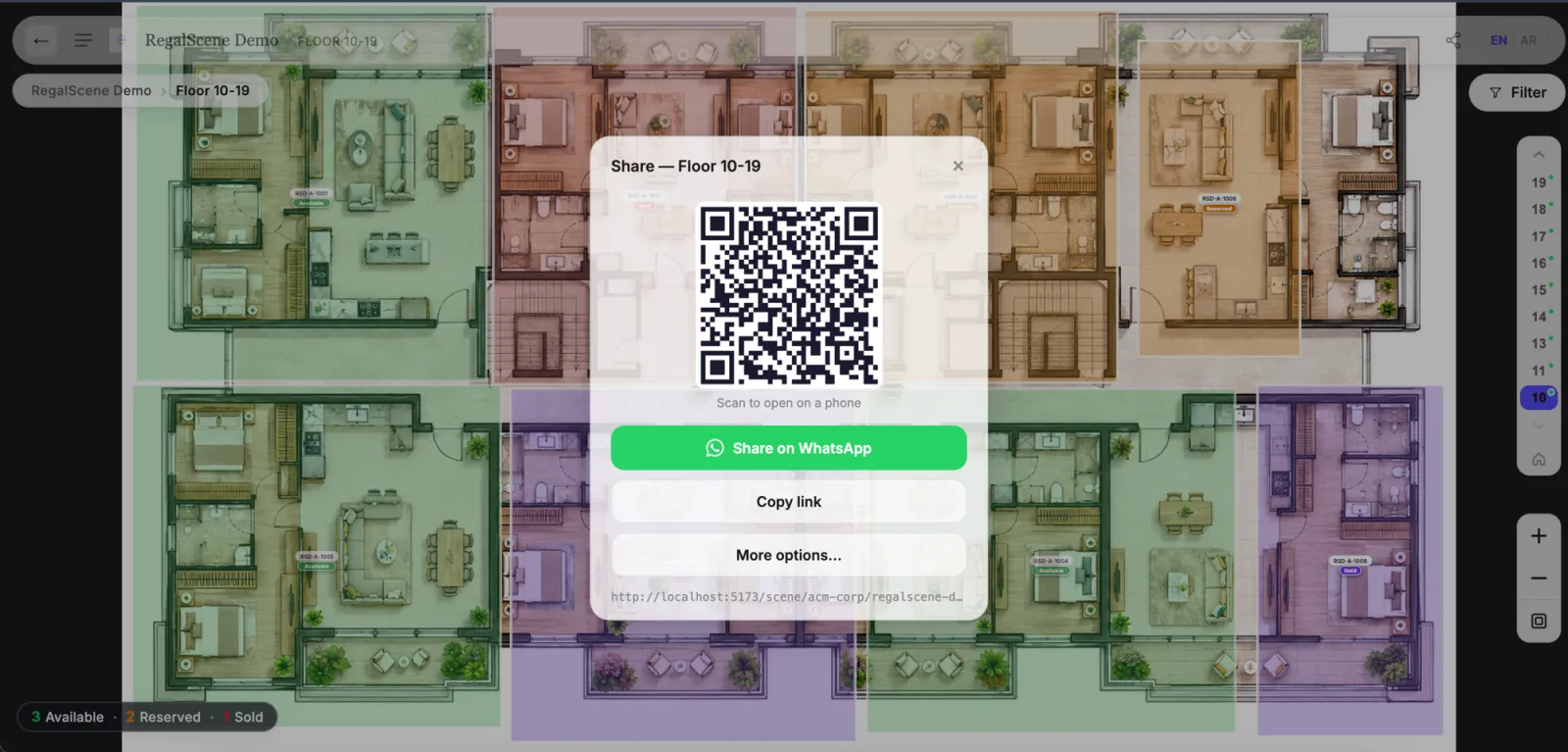
There's a second, quieter cost: links. A web experience makes every unit a shareable URL — the "is this the one?" message between spouses, the QR code on the hoarding, the agent's WhatsApp forward. An app can't participate in that loop; at best it deep-links for the tiny minority who installed it.
The update problem
A sales tool is wrong the moment its data is stale. Web platforms publish availability and price changes centrally — every buyer sees the current state on the next load. Native apps add an app-store review cycle and, worse, depend on users updating. During a launch weekend, "most buyers have the version from last month" is not a hypothetical — it's the default.
Search doesn't index apps
Your buyers start on Google — that's likely how you found this article. A web-based project experience is a page: it can rank, be linked from portals and press, and receive campaign traffic directly. App content is a black box to search. For a marketing team spending on demand generation, sending traffic into an install funnel instead of the project itself is paying twice for the same buyer.
Where native apps genuinely make sense
Honesty over dogma: there is a legitimate home for installed software — hardware you control. Sales-gallery touchscreens and roadshow kiosks benefit from full-screen, always-on experiences, and installations tolerate poor connectivity. If your roadshows run in venues with unreliable networks, an offline-capable installation has real value.
But note what that is: a venue tool, not a distribution tool. And even there, a web platform usually covers it — the same experience runs full-screen in a browser on gallery hardware, which means the gallery, your website, agent links, and QR campaigns are one system showing one truth, not an app and a website drifting apart.
The question behind the question
Teams asking for an app are usually asking for something else: a premium, branded, controlled experience. That's a design and platform question, not a packaging one. A web-based digital sales center delivers the premium experience and the reach — buyers in the project within seconds of a tap, from any channel, always current.
The evaluation shortcut: ask any vendor proposing a native app how a buyer in a WhatsApp conversation reaches unit-level detail in under ten seconds. Then ask how many of your last campaign's clicks would have survived an install prompt.
Related reading:
- Digital Sales Center Software: How to Choose in 2026
- Shareable Interactive Property Links: QR Codes and WhatsApp
- How to Launch a Property Project Digitally: A Step-by-Step Guide
- What Is a Digital Sales Center? Virtual Sales Galleries for Real Estate Explained
RegalScene is web-based by design: one published experience that runs on buyers' phones, gallery touchscreens, campaign embeds, QR codes, and WhatsApp — always live, nothing to install. See the platform or book a demo.