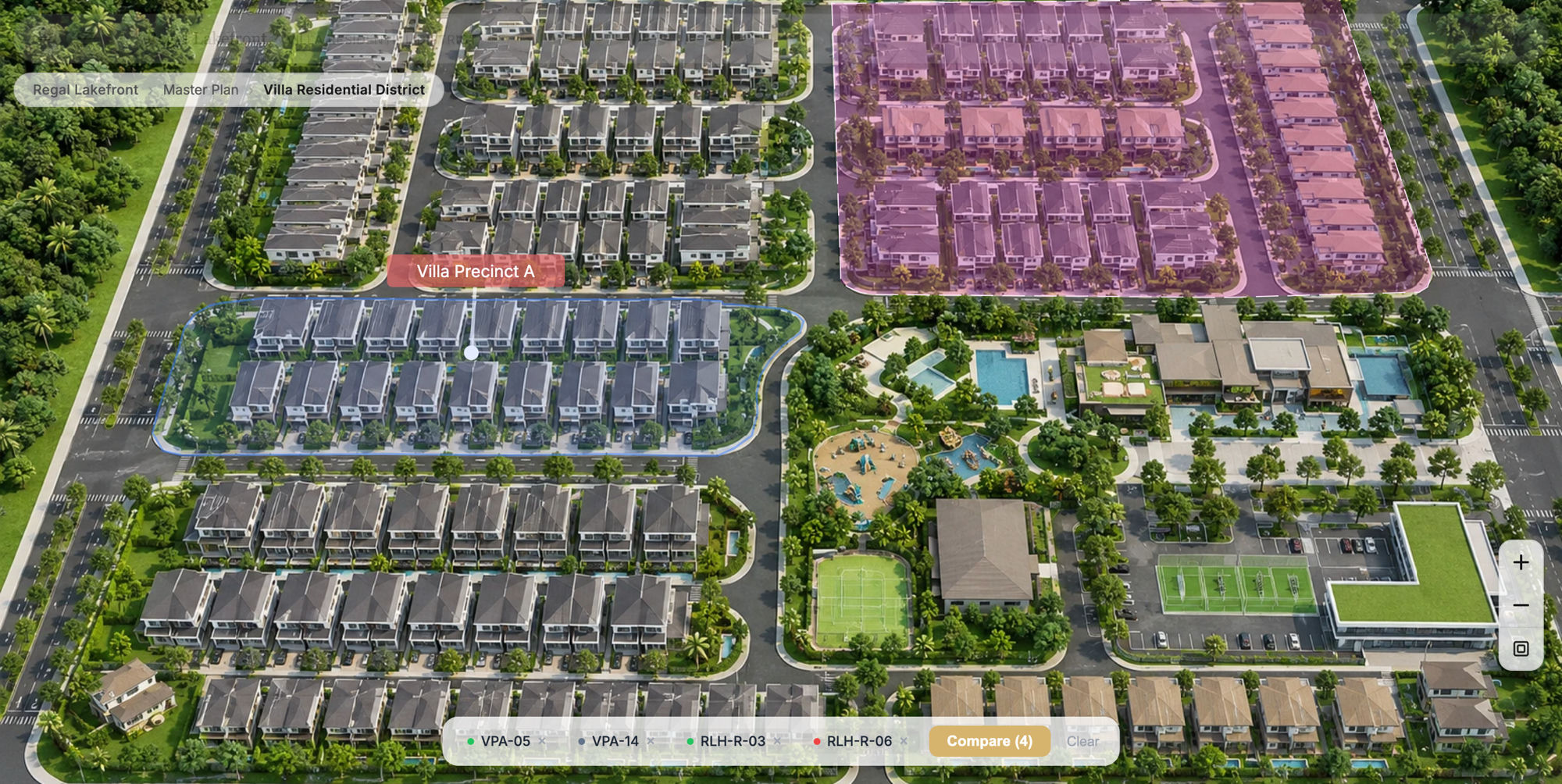
A master plan is usually the first thing a buyer sees when exploring a new development. It sets the context — where the buildings sit, what surrounds them, how the community is laid out. But in most property sales operations across Asia, the master plan is still a flat image in a PDF or a static render on a website.
That flat image doesn't answer the questions buyers actually have: Which buildings have available units? What does the view look like from this floor? How far is the pool from this block? Can I see the floor plan?
Interactive master plans change this. They turn a static overview into a guided exploration experience — and for developers in Malaysia, Singapore, Thailand, Indonesia, and across Asia, they're becoming a practical tool for accelerating sales.
What is an interactive master plan?
An interactive master plan is a high-resolution, navigable visual of a development where every element is clickable. Buildings, zones, amenities, land plots, and facilities are mapped as interactive areas. When a buyer clicks on a building, they can drill down into floor plans, unit layouts, availability, and pricing — all without leaving the experience.
Unlike a 3D model or virtual tour, an interactive master plan works instantly in a browser. There's no app to download, no plugin to install, and no heavy rendering required. It loads fast on mobile and desktop.
Why this matters for property sales in Asia
Buyers explore remotely before visiting
In markets like Malaysia, Singapore, and Thailand, a significant share of buyers explore projects online before visiting a sales gallery. Cross-border buyers — Singaporeans looking at Johor, Chinese investors considering Bangkok, or Malaysian diaspora buyers abroad — may never visit in person before making a decision.
An interactive master plan lets these buyers explore the full project context from their phone or laptop, at their own pace, in their own time.
Large-scale developments need navigation
Asia's property landscape includes mega townships, mixed-use developments, and master-planned communities with dozens of buildings and thousands of units. A flat site plan can't communicate the scale or help buyers find what they're looking for.
Interactive navigation lets buyers move from the master plan into a specific zone, then into a building, then into a floor, and finally to an individual unit — following a logical discovery path that mirrors how they'd explore the project in person.
Availability changes daily
In active sales phases, unit availability changes constantly. Interactive master plans can reflect real-time inventory status — showing which units are available, reserved, or sold — directly on the visual. This removes the need for sales teams to manually update PDFs or respond to availability enquiries.
Lead capture happens in context
When a buyer clicks on a specific unit or building and submits an enquiry, the sales team receives a lead with full context: which project, which building, which unit, and what action the buyer wanted. This is far more useful than a generic website form submission.
How developers are using interactive master plans today
Township and master-planned community launches
Developers launching large townships in markets like Johor, Greater KL, or the Eastern Seaboard of Thailand use interactive master plans to give buyers an overview of the entire community — residential zones, commercial areas, parks, schools, and transport links — before drilling into individual phases or buildings.
High-rise condominium projects
For high-rise developments in city centres like Kuala Lumpur, Bangkok, or Jakarta, interactive master plans help buyers understand the building's position within its surroundings and explore floor-by-floor availability, unit types, and views.
Mixed-use developments
Mixed-use projects that combine residential, retail, office, and hospitality components benefit from interactive master plans because they help buyers understand how different components relate to each other — where the retail podium sits relative to residential towers, where the lobby is, where parking access is located.
Industrial and logistics zones
Beyond residential, developers of industrial parks, logistics zones, and special economic zones in Southeast Asia use interactive master plans to showcase available land plots, warehouse facilities, and infrastructure to corporate tenants and investors.
What a good interactive master plan includes
A practical interactive master plan for property sales should include:
- Deep-zoom imagery — high-resolution renders or aerial photography that stays sharp when zoomed in
- Clickable zones and buildings — each area links to detailed information, floor plans, or sub-views
- Real-time availability — unit status (available, reserved, sold) displayed visually on the plan
- Lead capture points — enquiry forms embedded at the point of interest, not on a separate page
- Mobile-responsive design — works smoothly on phones, tablets, and desktops
- Multi-language support — essential for cross-border markets in Asia
The impact on sales operations
Interactive master plans don't just improve the buyer experience — they improve how sales teams work.
Faster qualification. When a lead comes in with specific context (project, building, unit, action), sales teams can prioritise and respond more effectively than with generic enquiries.
Fewer repetitive enquiries. Buyers can self-serve for basic information — availability, floor plans, pricing visibility — reducing the volume of routine calls and messages to the sales team.
Better cross-border sales. For developers selling to overseas buyers, an interactive master plan serves as a 24/7 digital sales gallery that works across time zones.
Consistent presentation. Every buyer sees the same professional experience, whether they're exploring from Singapore, Beijing, or Sydney. The quality of presentation doesn't depend on which agent they contact.
Getting started
For developers considering interactive master plans, the practical starting point is straightforward: take an existing master plan render or aerial image, map the interactive areas, connect them to your inventory or unit data, and publish the experience online.
Platforms like RegalScene are designed specifically for this — enabling property developers to create interactive visual sales experiences without custom development, and to manage views, inventory, and leads from a single admin console.
The technology is proven, the implementation is fast, and the results are measurable in leads captured and sales accelerated.
Related reading:
- From Lead to Unit Selection: Improving the Online Property Buying Journey
- Why Real Estate Developers Need a Visual Inventory Layer, Not Just a CMS
- Digital Property Sales in Southeast Asia: What Developers Need Now
RegalScene helps real estate developers across Asia create interactive master plans, building explorers, and digital sales galleries. Learn more or get in touch to see how it works for your next project.