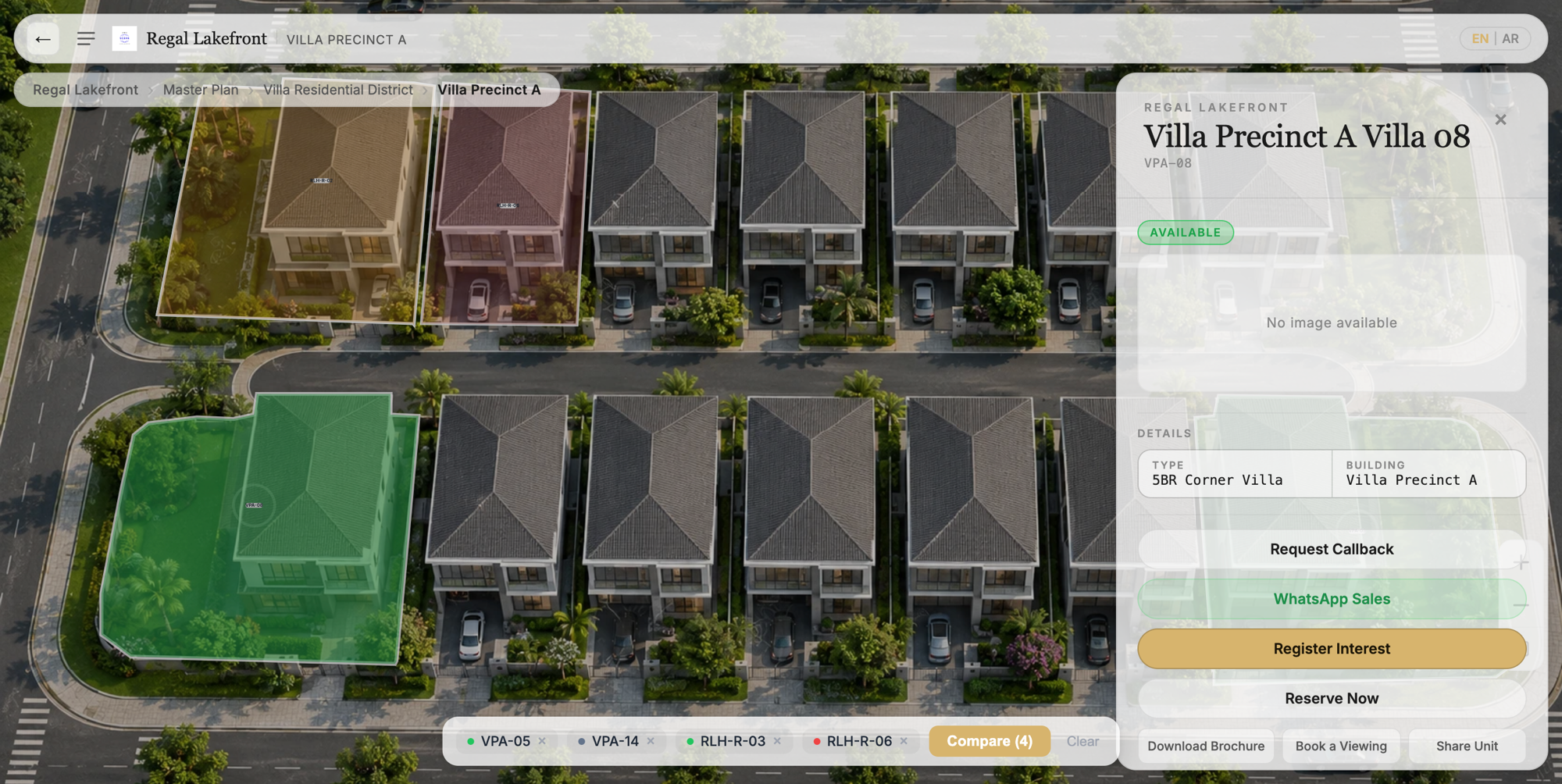
The online property buying journey is rarely a single moment. A buyer doesn't land on a website, click "buy," and complete a transaction. Instead, they move through a series of steps: discovering the project, understanding its context, exploring available units, comparing options, making an enquiry, and eventually engaging with a sales team.
For most property developers in Asia, these steps happen across disconnected tools: a marketing website, a PDF brochure, a WhatsApp conversation, an Excel availability sheet, and a CRM. The buyer experience feels fragmented, and the sales team loses visibility into what the buyer actually explored before making contact.
Connecting these steps into a coherent digital journey doesn't require a complex technology overhaul. It requires the right structure.
The five stages of the digital property buying journey
1. Project discovery
The journey starts when a buyer first encounters the development, whether through an ad, a listing portal, a social media post, or a referral link. At this stage, the buyer wants to understand what the project is, where it's located, and whether it's worth exploring further.
What works: a clear project landing experience that immediately communicates the development's identity, location context, and key selling points. An interactive master plan or aerial overview gives buyers a sense of scale and quality that static images can't match.
What doesn't work: a generic website with a photo carousel and a "Download Brochure" button. The buyer gets a PDF, maybe opens it, and the developer has no idea what happened next.
2. Contextual exploration
Once interested, the buyer wants to explore. They want to understand the project layout, see what's near different buildings, discover amenities, and get a feel for the community.
This is where interactive visual experiences add the most value. A buyer should be able to move from the master plan into a specific zone, then into a building cluster, then into a building. Each step shows how that level of detail sits inside the one above it.
For a township in Johor or a mixed-use development in Bangkok, the surroundings are half the product. Buyers need to understand not just the unit, but the neighborhood within the development.
3. Unit discovery and comparison
At some point, the buyer's interest narrows to specific units. They want to see what's available, compare floor plans, understand pricing (if visible), check unit sizes, and evaluate views or orientations.
This stage is where most digital sales experiences break down. The buyer is sent a PDF floor plan or told to contact an agent for availability. The momentum built through visual exploration is lost.
A better approach: show live availability directly on the interactive experience. Let buyers filter by unit type, floor, size, or status. Let them compare two or three units side by side. Keep them engaged in the visual experience rather than sending them to a separate portal.
4. Lead capture in context
When a buyer decides to enquire, the quality of the lead depends on how much context is captured. A form submission that says "I'm interested in Project X" is far less useful than one that says "I'm interested in Unit B-12-03 in Tower B of Project X, and I want to schedule a viewing."
Contextual lead capture means putting enquiry points inside the exploration experience itself: at the building level, the floor level, or the unit level. The buyer's intent is recorded alongside their journey, so the sales team already has the context when the follow-up starts.
For developers operating across markets (selling Malaysian properties to Singaporean buyers, or Thai properties to Chinese investors), this context is even more valuable, because the sales team may not have an in-person opportunity to qualify the buyer.
5. Sales follow-up and conversion
The final stage happens off-platform — a WhatsApp message, a phone call, a virtual meeting, or a gallery visit. But the quality of this interaction depends on what the sales team knows about the buyer's journey.
When a lead names the project, the building, the unit, and the action taken, the sales team can prepare a relevant response. They can pull up the right floor plan, confirm availability, and have a productive conversation instead of starting from scratch.
Read across every buyer instead of one at a time, that same record becomes buyer intent measured across the whole journey: which stages hold attention, which ones quietly lose it, and which unit types are drawing the most exploration before anyone enquires.
What this looks like in practice
Large township launch in Malaysia
A developer launching a township with 8 residential phases, a commercial district, and community facilities creates an interactive master plan as the primary sales tool. Buyers explore the master plan, navigate into specific phases, and drill into available units. Each enquiry captures the phase, building, and unit of interest. The sales team receives qualified leads segmented by project phase.
High-rise condo in Bangkok
A developer with a 40-storey condominium in central Bangkok publishes an interactive building explorer. Buyers can select a floor, see the layout, check which units are available, view the floor plan for each unit type, and submit an enquiry for their preferred unit. The experience works in Thai, English, and Chinese to serve the project's target markets.
Mixed-use development in Jakarta
A mixed-use project combines residential towers, a retail mall, serviced apartments, and office space. The interactive experience lets each buyer segment explore only the components relevant to it: homebuyers, retail tenants, office tenants, and investors each get their own inventory view and their own lead capture form.
Investment property marketed to overseas buyers
A developer marketing investment properties in Kuala Lumpur to buyers in Singapore, Hong Kong, and mainland China uses the interactive experience as their primary digital sales channel. Buyers explore units, compare yields, and submit enquiries without needing to visit Malaysia. The experience supports multiple languages and captures leads with full unit context.
Connecting the tools
The digital buying journey doesn't require replacing every existing tool. It requires connecting them.
- The visual experience (interactive master plan, building explorer, floor plans) is the buyer-facing layer
- The inventory system provides real-time availability and pricing data
- The lead engine handles contextual lead capture built into the exploration, routing each enquiry to the right sales team member with the buyer's path already attached
- The CRM or sales tool receives enriched leads for follow-up
What matters is that these layers stay connected. The buyer's journey from discovery to enquiry holds together, and the sales team picks it up from lead to conversion already knowing what happened before the form.
Why this matters now
Property markets across Asia are competitive. Buyers have more choices, more information, and higher expectations. The developers who give them a clear, professional digital journey will capture more qualified leads and close sales faster.
This isn't about replacing the human sales process. It's about making sure the digital experience that precedes it is working in the developer's favor.
Related reading:
- Real Estate Buyer Intelligence: A Guide for Developers
- Interactive Master Plans for Asian Property Sales
- Why Real Estate Developers Need a Visual Inventory Layer, Not Just a CMS
- Contextual Leads in Real Estate: Why Source and Intent Matter
RegalScene connects visual exploration, inventory, and lead capture into one platform for property developers. See how it works or contact us to discuss your next project.