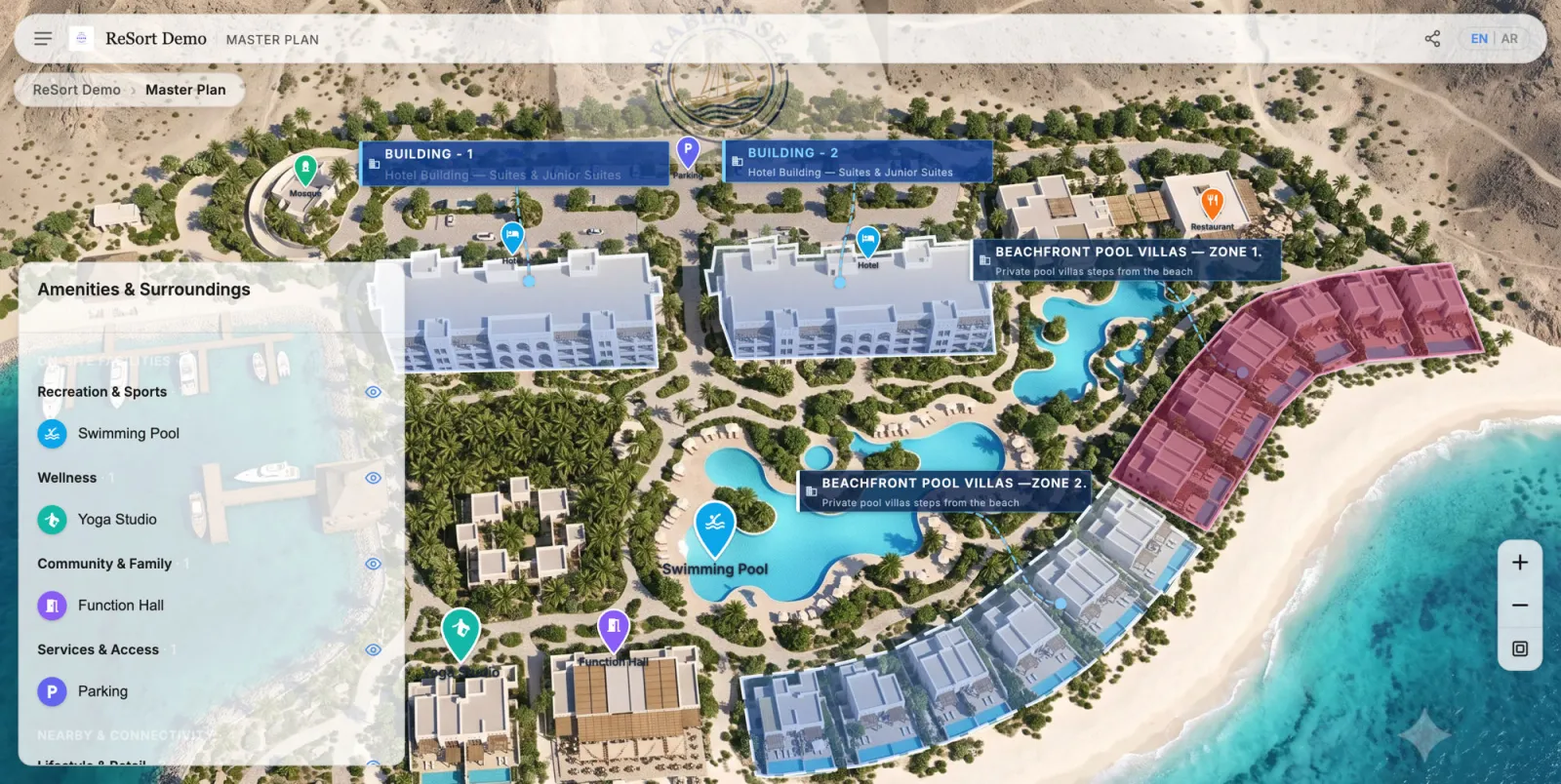
Hotel and resort projects are among the heaviest users of 3D rendering in all of real estate — and among the least effective at putting those renders to work. A resort render has to sell an experience: the arrival, the pools, the beach club, the villa at sunset. Studios deliver exactly that, beautifully. Then the renders go into a PDF fact sheet and an investor deck, where nobody can explore anything.
For hospitality projects that sell something — branded residences, resort villas, fractional units, hotel rooms as investment products — that's a conversion problem, because the buyer's questions are spatial: Which villas face the water? How far is this unit from the beach club? What's still available in phase one?
Why hotel marketing renders work harder than residential ones
A residential tower render mostly needs to communicate the building and the view. A resort render carries more weight:
- The layout is the product. Proximity to the pool, the spa, the beach — buyers pay for position, and a static aerial makes them guess at it.
- Amenities do the selling. The beach club and kids' area aren't extras; they're the reason to buy. They need to be findable, not just visible in one hero shot.
- Two audiences at once. The same materials serve individual buyers (emotion, lifestyle) and investors (masterplan logic, inventory, phasing). Static collateral forces you to pick one.
This is why hospitality developers commission so much CGI. The waste is in what happens next.
The upgrade: the resort as an interactive map
The same renders, made navigable, answer the spatial questions directly — this is an interactive master plan applied to a resort rather than a residential township:
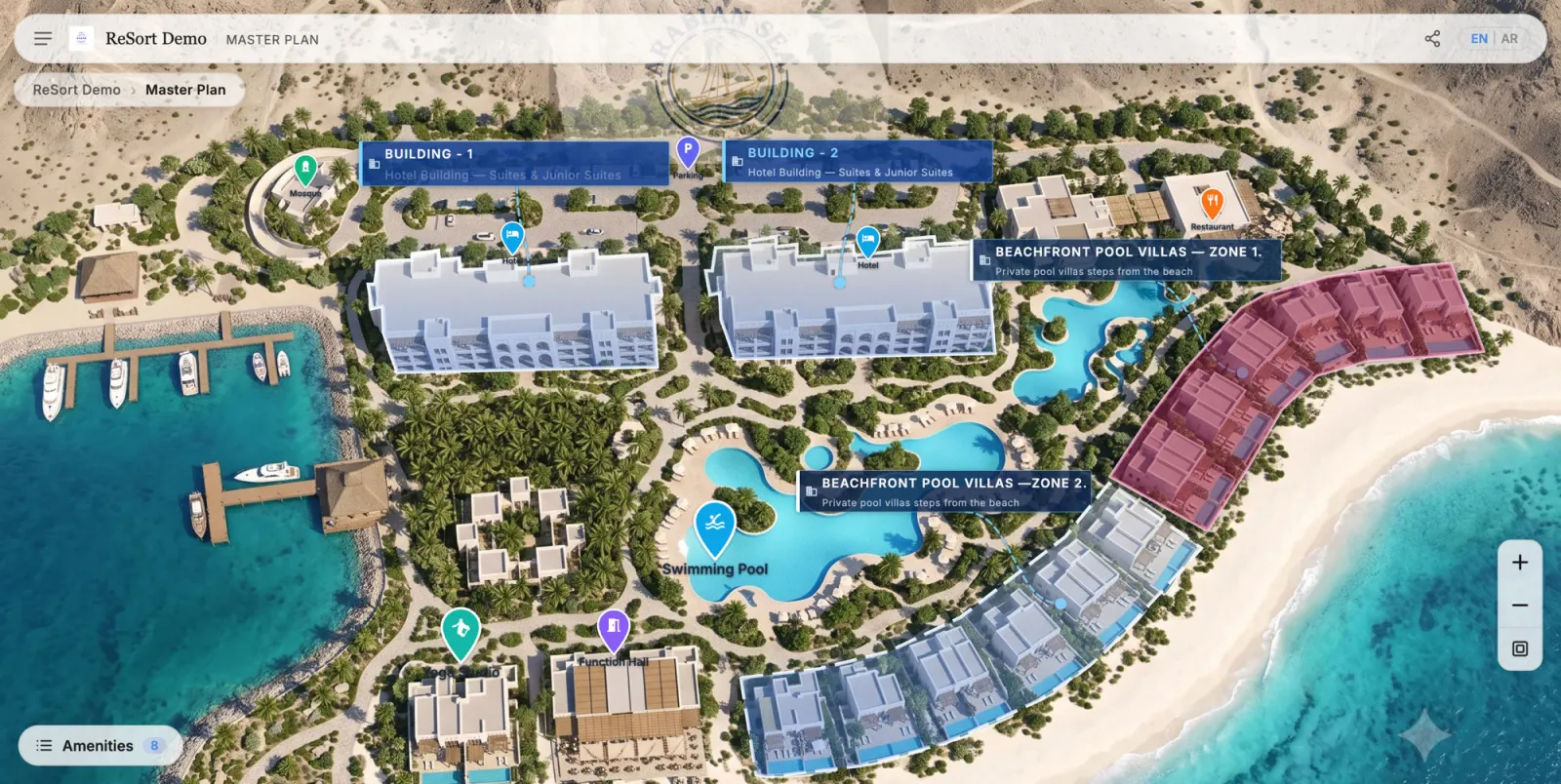
The aerial becomes the resort map. Buyers pan across the property, amenities are marked and tappable, villa clusters and residence buildings highlight as they explore. The "how far from the pool?" question answers itself — visually.
Villas and residences carry current status. Available, reserved, sold — on the map, from your actual inventory. For phased releases, buyers see exactly what this phase offers, and sold overlays quietly signal momentum to investors.
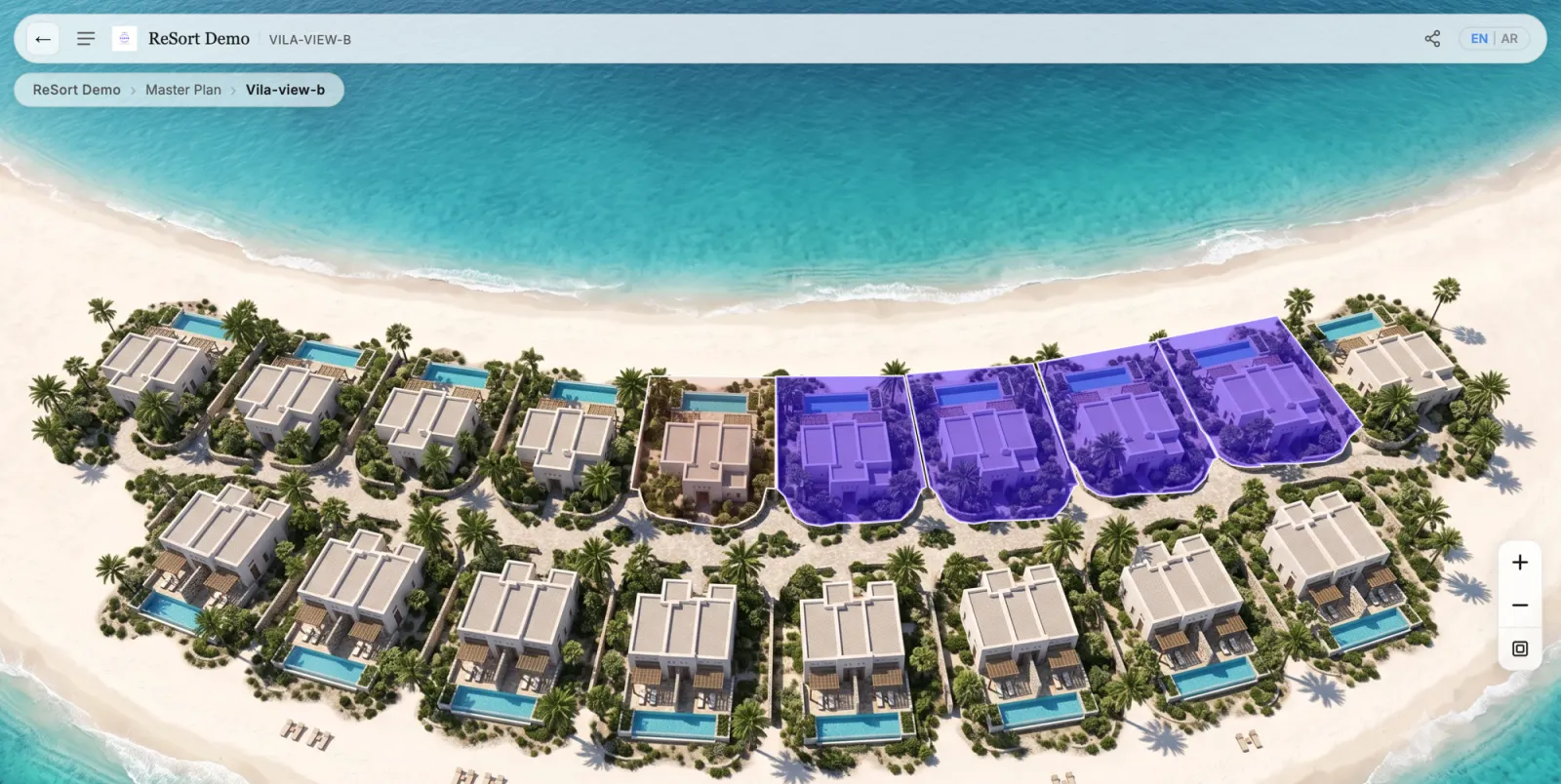
Unit types open in place. Tap a villa to see the type, size, orientation, renders or a 360 view of the interior — and enquire right there, so the lead arrives knowing which villa, which phase, and what the buyer had just seen. Your sales team opens that lead and sees the buyer's steps from the visit, from the masterplan to the villa they asked about.
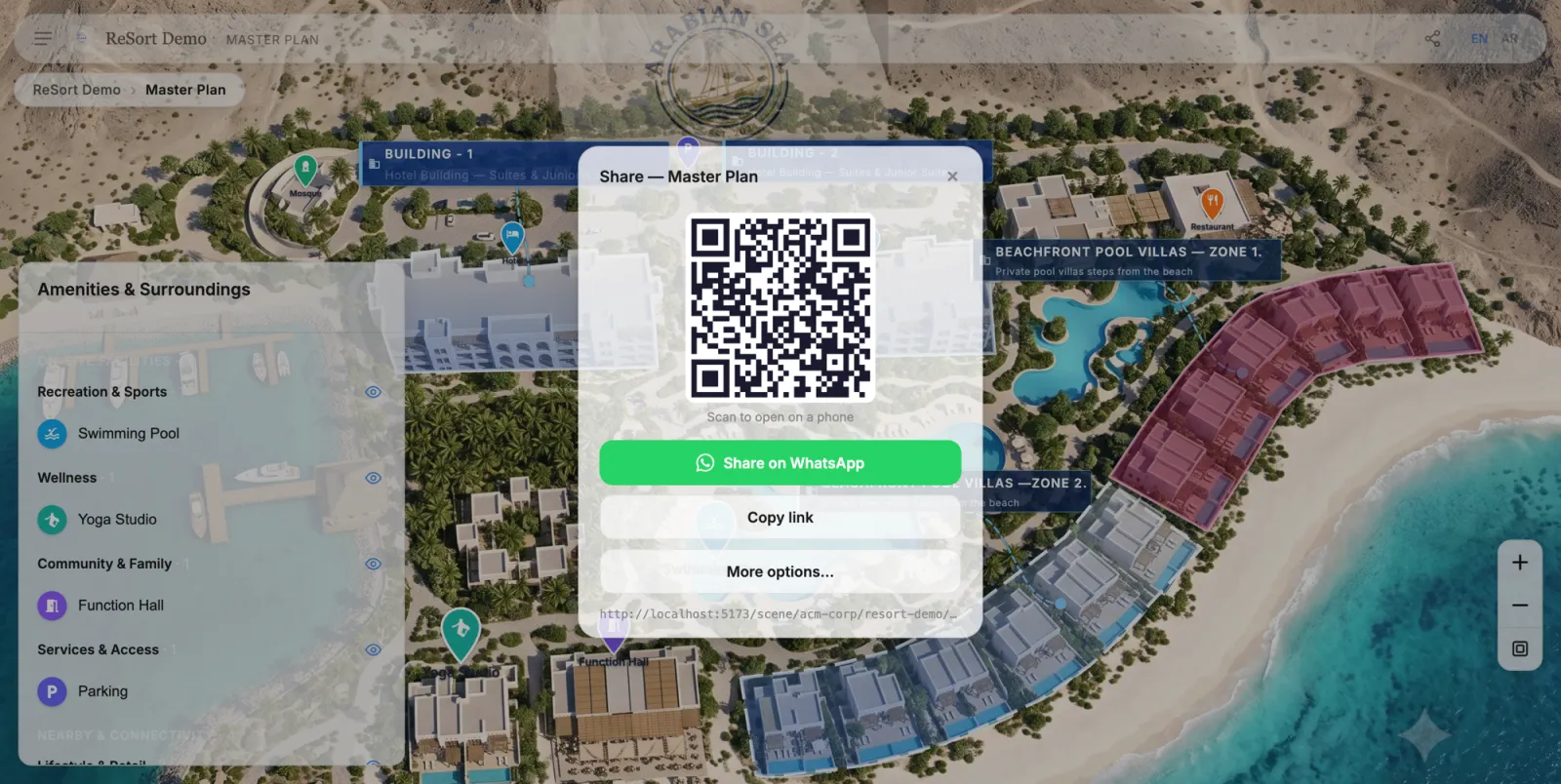
One link serves both audiences. The same experience embeds on the project website for buyers, opens from a QR code at a sales event, and walks an investor committee through the masterplan logic — on any device, nothing installed.
None of this requires new rendering. It's the same principle as residential render reuse: the assets you've already paid for become the interface.
What hospitality projects need that residential tools miss
A subtle point if you're evaluating software: most interactive property tools assume apartments. Hospitality inventory doesn't behave like apartments — you're selling villas, suites, plots, berths, or fractional units, each with its own attributes (beachfront distance, plunge pool, brand flag, rental program participation). The tool needs configurable asset types and attributes, not a hard-coded "bedrooms/bathrooms" template.
The rest of the feature checklist applies unchanged: current availability your team updates itself, contextual enquiries, and analytics — knowing whether buyers linger on the overwater villas or the garden residences is exactly the demand signal a phased resort release needs.
Where static renders still win
Keeping this honest: the cinematic hero shots — dusk exteriors, lobby interiors, lifestyle views — belong in campaigns, films, and press exactly as they are. Interactivity adds nothing to a mood image. The interactive layer earns its place where decisions happen: the resort layout, unit selection, and availability. Most hospitality projects need both, and the render budget already paid for both.
Related reading:
- What Is an Interactive Hotel and Resort Master Plan?
- Virtual Tours for Tourism Destinations: Resorts, Hotels & Attractions
- How Branded Residences Are Sold Off-Plan
- 3D Rendering for Real Estate Marketing: Make the Renders You Already Paid For Sell Units
- Interactive Property Map for Real Estate Developers: The Complete Guide
- Interactive Master Plan Benefits: What Property Developers Actually Gain
- RegalScene Beyond Residential: One Platform for Any Mapped Asset
RegalScene turns resort and hotel renders into interactive experiences — resort maps, villa availability, amenity navigation, and contextual leads, with asset types configured for hospitality inventory. See how the platform works, or book a demo.