The GCC is building at a scale that has no precedent. Saudi Arabia's giga-projects span entire coastlines. The UAE is developing island communities, logistics corridors, and vertical cities. Qatar, Kuwait, Bahrain, and Oman are investing in mixed-use districts, tourism destinations, and economic free zones designed to attract global capital.
These developments are extraordinary in ambition — and extraordinarily difficult to sell using traditional methods. RegalScene for GCC property developers starts from that problem.
A static master plan image, a brochure, or a website gallery cannot communicate the depth of a project that contains residential communities, commercial districts, hospitality assets, logistics zones, retail precincts, and public infrastructure within a single boundary. The scale of the product has outgrown the format used to present it.
The developers and operators behind these projects need a digital sales experience that matches their ambition — one that can guide a buyer, investor, or tenant from the master plan level down to the specific asset they care about, with live data, visual context, and a clear path to action.
Why static material falls short at mega-project scale
A residential tower with 200 units can be explained in a brochure. A master-planned community with 15 districts, 60 buildings, mixed-use zones, and phased delivery cannot.
The challenge is not a lack of visual assets. Most GCC mega projects invest heavily in renders, aerial perspectives, and marketing imagery. The challenge is structure. Static images present everything at the same level of detail. A buyer looking at a master plan render has no way to click on a district, zoom into a building, check which floors have availability, or compare two units side by side.
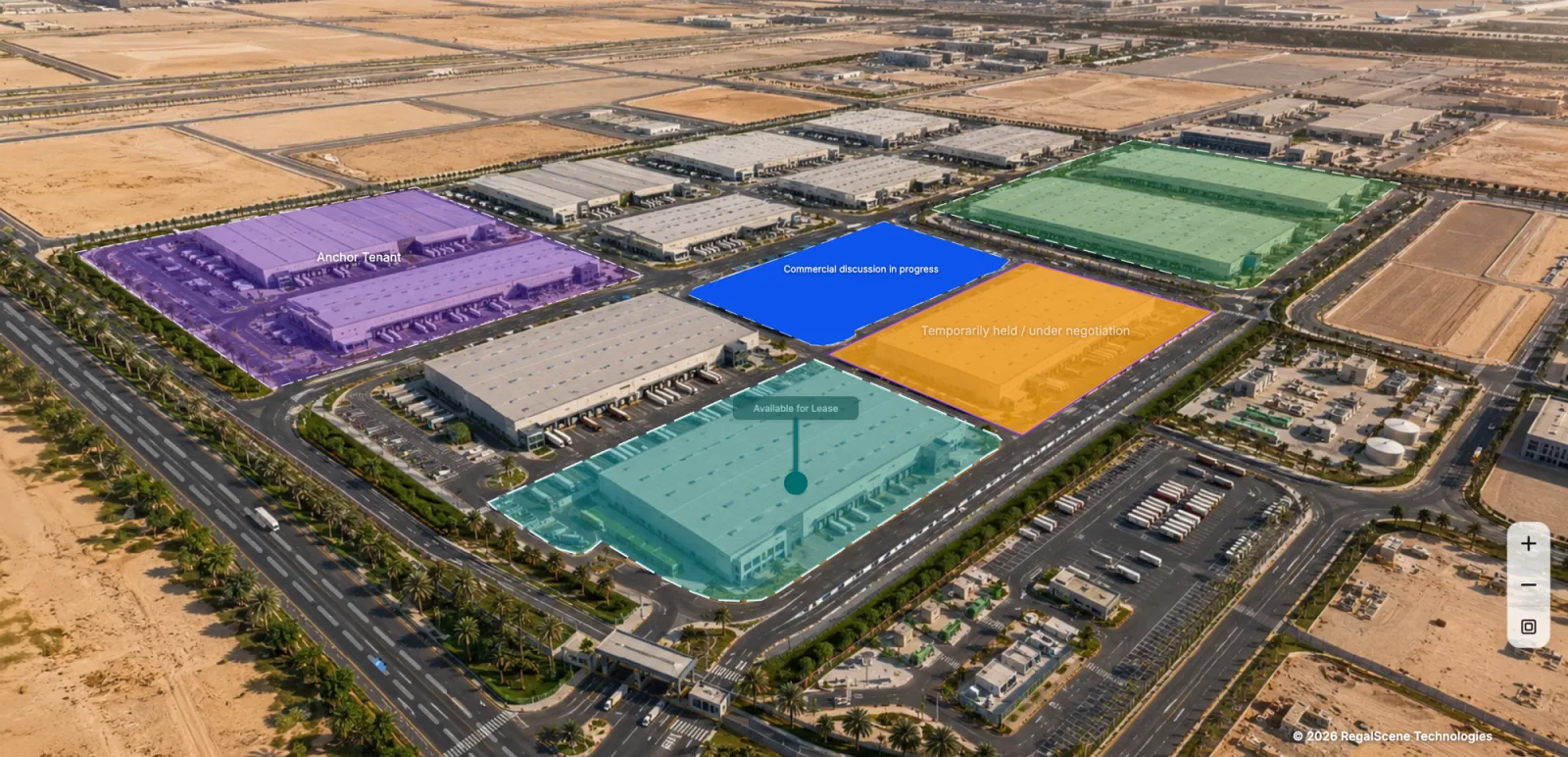
The result is a gap between what the project offers and what the buyer understands. Investors request lengthy presentations to grasp the layout. Tenants ask for floor-by-floor availability that takes days to compile. Sales teams spend time explaining spatial context instead of closing deals.
For projects competing for international capital — where buyers and investors may be in London, Mumbai, Singapore, or Riyadh — this gap is a commercial liability.
The digital sales center model
A digital sales center transforms a master plan into a navigable, layered experience. Instead of showing a flat image with labels, it lets users explore the development interactively — moving from the macro view down through zones, districts, buildings, floors, and individual assets.
The experience follows the buyer's logic: start with the big picture, understand the structure, then focus on what matters.
How it works
At the top level, the user sees the full master plan — tiled for deep-zoom viewing, with clickable zones and district boundaries. Clicking on a district navigates to a detailed view of that area. From there, the user can explore buildings, floor plans, individual units, plots, or other assets depending on the project type.
Each level can display relevant information: phased delivery timelines, infrastructure highlights, amenity proximity, unit specifications, pricing guidance, and live availability status. Lead capture forms and call-to-action prompts are embedded at the asset level — so when a user registers interest, the system records exactly what they were exploring.
This is not a 3D model or a virtual reality experience. It uses the same renders, plans, and imagery that developers already produce, structured into an interactive journey that works on any device.
Use cases across GCC project types
The digital sales center model is not limited to residential developments. The same visual exploration approach applies wherever a buyer, investor, or tenant needs to understand a large-scale project before committing.
Residential master communities
Township and community developments with multiple precincts, building clusters, villa compounds, and shared amenities. Buyers navigate from the community master plan to a specific precinct, then to a building or villa plot, then to a unit with availability and pricing context.
Mixed-use districts
Projects that combine residential towers, retail podiums, office space, hospitality, and public amenities within a single masterplan. Different user types — homebuyers, retail tenants, office occupiers — each follow a path to the asset class relevant to them.
Logistics and free zones
Economic zones, logistics parks, and free-trade areas where the "buyer" is a corporate tenant or investor evaluating warehouse plots, build-to-suit parcels, or ready-built facilities. The master plan shows infrastructure, road access, utilities coverage, and plot availability across the zone.
Industrial parks
Manufacturing zones and industrial corridors where tenants need to understand plot sizes, utility connections, zoning designations, and proximity to transport infrastructure. Interactive exploration replaces static PDF plot catalogues with a visual, filterable experience.
Tourism destinations
Hospitality-led developments, resort communities, and entertainment districts where investors evaluate branded residences, hotel keys, or retail concessions within a destination masterplan. The interactive layer communicates the guest journey and the investment proposition simultaneously.
Smart city districts
Technology-focused urban developments and innovation districts where tenants range from startups to multinational anchors. The digital sales center presents the district layout, building typologies, amenity clusters, and leasing availability in a format that supports both self-service exploration and guided sales presentations.
Benefits for buyers, investors, and sales teams
For buyers and investors
Spatial understanding improves dramatically when a user can navigate the project visually rather than reading a document. Buyers identify the units or plots that match their criteria faster. Investors grasp the project's structure, phasing, and value proposition without requiring a dedicated presentation.
For tenants and occupiers
Commercial and logistics tenants can evaluate available space in context — seeing where a plot sits relative to access roads, utilities, neighbouring tenants, and shared infrastructure. This self-service exploration reduces the time between initial interest and serious enquiry.
For sales and leasing teams
Every lead arrives with context. The system captures the user's exploration path — which district, building, floor, or plot they viewed, which assets they compared, which call-to-action they responded to. Sales conversations start from a position of shared understanding rather than a blank introduction.
For marketing and campaign teams
The digital sales center is not confined to the developer's website. It can be embedded into campaign landing pages, agency partner portals, exhibition microsites, investor data rooms, or internal sales dashboards. The experience travels with the project across every channel.
A platform approach, not a custom build
Building an interactive digital sales center from scratch for each project is expensive and slow. A platform approach — where the visual sales engine is reusable across project types — changes the economics fundamentally.
RegalScene is built on this principle. Its template-driven architecture allows developers to configure a digital sales center for a residential community, a logistics free zone, or a mixed-use destination using the same platform. Each project defines its own asset types, navigation structure, availability data, and lead capture flows — without custom development.
For GCC operators managing portfolios of projects across different sectors and markets, this means a single platform can serve a residential township in Riyadh, a logistics park in Jebel Ali, and a tourism destination in Oman — each with its own visual identity, asset structure, and sales workflow.
The direction is clear
GCC mega projects are defined by ambition, scale, and complexity. The digital sales experience should reflect all three.
Static master plan images and PDF brochures served an earlier era of property marketing. Today's developments — with their multiple asset classes, phased delivery, international buyer pools, and competitive positioning — demand an interactive, data-connected format that lets every stakeholder explore the project on their own terms.
The developers and operators who invest in this capability will shorten sales cycles, improve lead quality, and present their projects with the clarity and confidence that the scale of the investment deserves.
The future of mega-project sales is visual, interactive, and built to match the ambition of the project itself.
Related reading:
- How Interactive Master Plans Can Speed Up Online Property Sales Across the GCC
- Interactive Sales for Dubai Off-Plan Developments
- Interactive Master Plans for Multi-Tower Dubai Projects
- Interactive Master Plans for Abu Dhabi Waterfront
- What Is an Interactive Master Plan?
- RegalScene Beyond Residential: Supporting Commercial and Mixed-Use Projects
- RegalScene for Master Plans, Free Zones, and Large-Scale Developments
RegalScene helps developers, free-zone operators, and destination owners turn master plans into interactive digital sales centers. Learn more or book a demo.