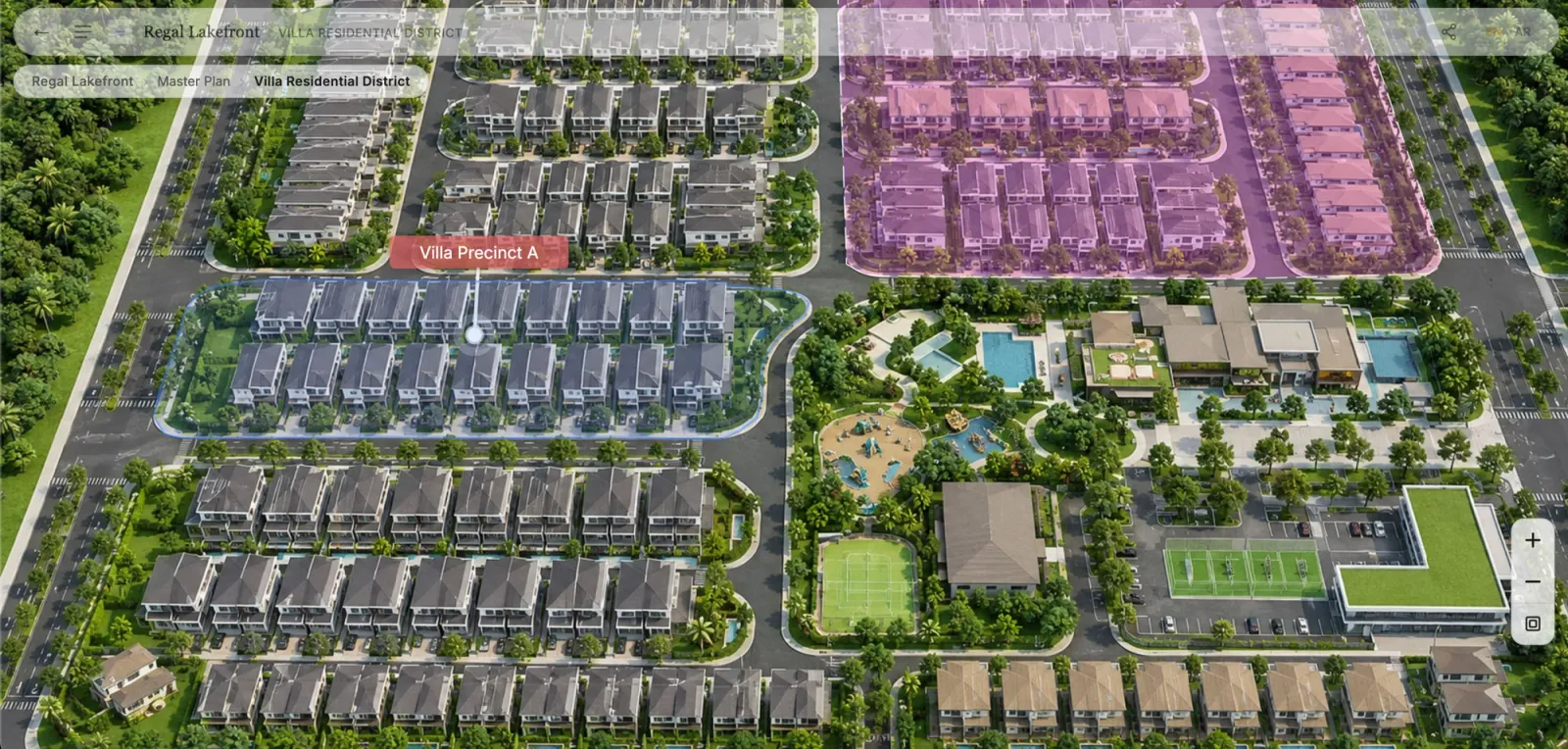
Ask three vendors for an interactive master plan quote and you can receive numbers an order of magnitude apart — for what sounds like the same deliverable. The spread isn't dishonesty; it's that "interactive master plan" spans three fundamentally different ways of building and paying for the same idea. Once you know which model a quote belongs to, the numbers make sense — and so do the trade-offs.
The three pricing models
1. Custom build by a visualization studio
A studio builds a bespoke interactive application around your renders — often as an add-on to a CGI package. Pricing is project-based: typically US$10,000–$60,000+ depending on scope, with large multi-phase projects going well beyond that.
What the number usually covers: the initial build. What it usually doesn't: changes. New phase, revised pricing display, a sold-out zone — each is a change request against studio rates and timelines. Over a three-year sales cycle, the maintenance total can quietly pass the build cost.
2. Game-engine experience
A free-roam cinematic walkthrough in Unreal or Unity, built for flagship projects and sales-gallery hardware. Budgets start around US$50,000 and commonly reach six figures, with months of production. Spectacular where a spectacle is the goal; the cost structure makes iteration painful, and the result usually lives on gallery machines rather than in your buyers' browsers. We've covered this category in detail in our virtual sales gallery pricing guide.
3. Platform subscription
A SaaS platform assembles the experience from your existing assets, and you pay a recurring fee — typically hundreds to low thousands of US dollars per month depending on project scale, seats, and features. The build cost collapses because there's no bespoke software: your team (or the vendor's onboarding) configures views, draws overlays, imports inventory, publishes.
The structural difference is where updates live: in a platform, a price change or phase release is an admin task included in the subscription, not a change order. That's also the honest trade-off — you're renting capability, not commissioning an artifact you own outright.
What actually drives the price
Across all three models, the same five factors move quotes:
- Levels of navigation. A master plan alone is cheap; master plan → zones → buildings → floors → units multiplies the surfaces to build or configure.
- Unit count and inventory complexity. 60 villas is a different job from 5,000 mixed-use units with typologies, phases, and current status.
- Asset readiness. If your aerial renders, building views, and floor plans exist, you're assembling. If they don't, you're commissioning CGI first — the render budget is its own line item in any model.
- Integrations. Connecting to inventory or CRM systems you already run is custom work on almost any platform, while agency distribution and analytics are often built in. Confirm exactly what is included before comparing quotes.
- Change velocity. The most underrated factor: how often will this need to change? Multiply your expected changes by each model's cost-per-change before comparing quotes.
The hidden costs that surface after launch
Whatever the model, ask about these before signing, because they arrive after the invoice:
- Update fees — the change-order rate, or what's included in the subscription
- Hosting and bandwidth — who serves the experience, and what happens at campaign traffic peaks
- New phases — is phase two a new project fee or the same subscription
- Handover — if you leave the vendor, what do you keep? (Renders: yours. Bespoke app code: usually theirs.)
- Sell-out — does the experience retire with the campaign, or keep working for resale and leasing
The sanity check: cost against one sale
The arithmetic that settles most budget debates: take your average unit price and your gross margin per sale, and ask how many additional sales the interactive experience must influence to pay for itself. For most developments, the answer for a platform subscription is a fraction of one unit — and even a six-figure custom build clears at one to two units on a mid-size project.
That's why the sharper question isn't "what does it cost?" but "which model matches how our project actually behaves?" — a fixed artifact for a fixed launch, or a living system for a multi-phase sales cycle. Our feature checklist is the companion to this question: the features that matter most (current availability, self-service updates, contextual leads) are exactly the ones that separate the models.
If the platform model is the one that matches your project, what the platform model includes is set out feature by feature, alongside the way the subscription is scoped figure.
Related reading:
- Master plan software for developers
- Why RegalScene Isn't Priced Per Unit
- How Much Does a Virtual Sales Gallery Cost?
- Resort Launch Budgets: Show Villa vs Digital
- Interactive Master Plan Features: A Developer's Checklist
- Interactive Master Plan Benefits: What Property Developers Actually Gain
- What Is an Interactive Master Plan?
RegalScene is in the platform category: interactive master plans assembled from your existing renders, with current availability, contextual leads, and self-service publishing on a subscription. See pricing or book a demo.