A branded residence is sold twice. Once on the development: the location, the architecture, the unit itself. And once on the operator's name above the door, which is the reason the buyer is paying a premium in the first place.
Most sales collateral handles the first sale and assumes the second one takes care of itself. It doesn't. The brand promise is experiential: the arrival, the service, the beach club, the sense that this residence sits inside something managed to a standard. A PDF fact sheet with a floor plan and a price communicates none of that, and the buyer looking at it is often in another country, deciding on a building that does not exist yet.
The buyer is usually not standing on the site
Branded schemes sell internationally by design. That is part of why developers attach an operator: the name travels further than the project does. The practical consequence is that the buyer forms their entire opinion remotely, comparing your scheme against two or three others on a phone.
That remote buyer cannot walk the site to answer the questions that actually decide the purchase:
- Where does this residence sit relative to the hotel, the beach, the spa?
- Which way does it face, and what will it look at?
- What is still available in this release, and what has already gone?
These are spatial questions, and a render pack makes the buyer guess at every one of them. The same problem applies to off-plan property generally, but it bites harder here, because position within the resort is a large part of what the premium is for.
Position is the product
In a residential tower, buyers mostly pay for floor level and view. In a branded scheme, they pay for proximity: to the water, to the amenities, to the quiet end of the site away from the arrival court.
That makes the masterplan the primary sales asset rather than a supporting diagram. A buyer who can see that one villa cluster sits two minutes from the beach club and another sits behind the service road understands the price difference without a salesperson explaining it. A buyer looking at a static aerial sees neither.
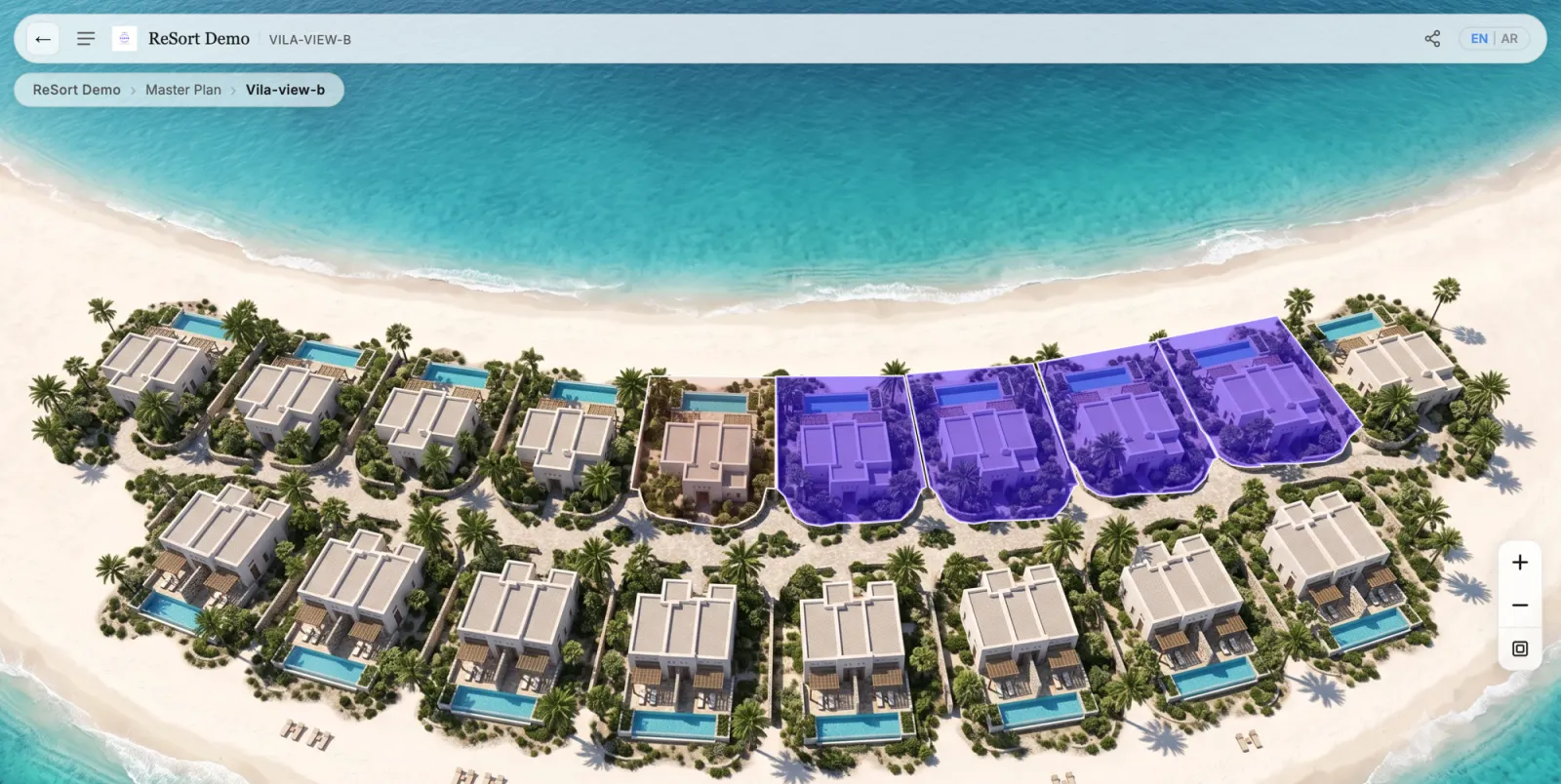
The amenities are not a features list; they are the brand promise made locatable. Marking them on a map the buyer can explore does more for the operator's story than another paragraph about service standards.
Two brands, one source of truth
A branded residence typically sells through more channels than a standard project: the developer's own site, the operator's channels, international agency networks, and often a roadshow programme in the buyer's home market.
Every one of those channels needs current availability. When they each hold a copy of the price list, they drift, and the drift shows up in front of a buyer who has been comparing your scheme for weeks. Keeping distribution controlled across multiple agencies matters more when an operator's name is attached to the inconsistency.
One published experience, embedded everywhere, is what keeps the operator's brand from being represented by a stale spreadsheet. Availability updates once and every channel reflects it, including the agency in another time zone.
What this looks like in practice
The inputs are usually already commissioned. Hospitality projects are heavy users of CGI: the masterplan aerial, the villa elevations, the interior sets for the investor deck. Turning resort renders into a navigable map is an assembly job rather than a new production.
What changes for the buyer:
- The aerial becomes the map. Amenities are marked and tappable. Villa clusters and residence buildings open as the buyer explores.
- Units carry live status. Available, reserved, sold, drawn from the inventory the sales team already maintains rather than from the artwork.
- Orientation and detail sit on the unit. Size, layout, aspect and price on the residence the buyer selected, not in a separate schedule.
- Sharing works the way the decision works. A branded purchase is rarely decided alone. A link or QR that opens on the exact villa lets the buyer bring a spouse or an adviser into the same view, and the enquiry still returns to the developer.
The same pattern serves tourism and destination assets where the thing being sold is a place rather than a unit.
What to prepare
You need less than most developers assume: a high-resolution masterplan or aerial, building views for the residence blocks, unit plans for the types being released, and the inventory as a spreadsheet. Phasing matters — branded schemes usually release in tranches, and the experience should show the current release honestly rather than everything at once.
If the operator has brand standards for digital presentation, surface them at the start. White-label delivery on the developer's own domain is normal for these projects, and it is easier to meet a standard than to retrofit one.
Related reading:
- 3D Rendering for Hotel and Resort Marketing
- Virtual Tours for Tourism Destinations: Resorts, Hotels & Attractions
- Selling Off-Plan Property Digitally: Reducing Buyer Uncertainty
- Managing Multi-Agency Property Sales Without Losing Control
RegalScene turns the masterplan, building views and unit inventory a hospitality project already has into one interactive sales experience, published on the developer's own domain and embeddable across operator and agency channels. See the property sales platform or tell us about your project.