Markets we serve
Interactive Masterplan Software
for Indonesian Developers
Apartemen, rumah tapak, ruko, kavling. One live plan per project, current availability, and enquiries that arrive with the unit attached, shared across every agency you work with.
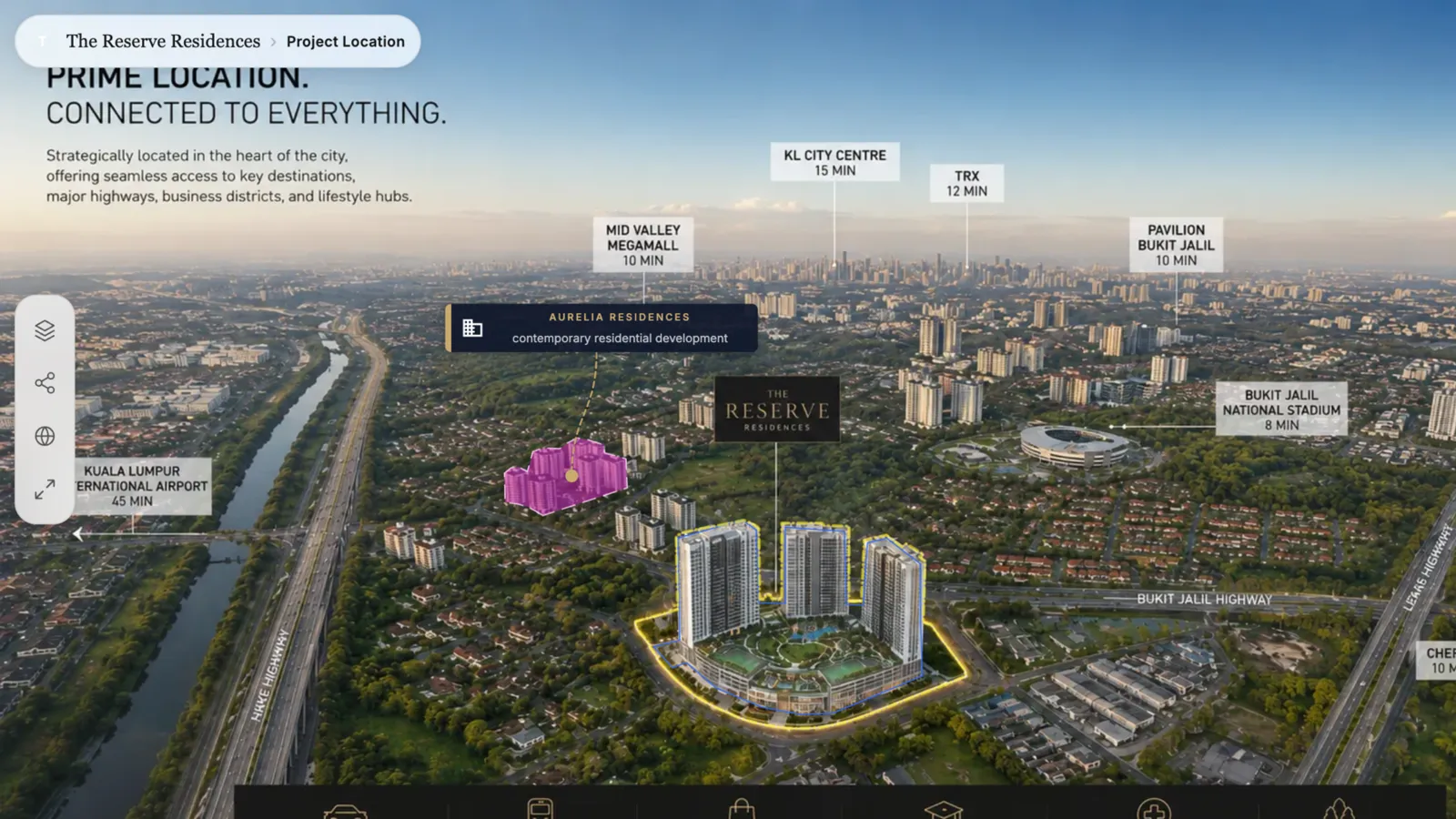
A live RegalScene master plan. Towers, clusters, and precincts are clickable, and every unit behind them carries a real status.
The market
How property is sold in Indonesia
Indonesian developers sell at a scale and a spread that few markets in the region match. The operational problem is rarely the quality of the marketing. It is keeping many projects, many partners, and many cities telling buyers the same thing on the same day.
Portfolios span cities, not sites
A single developer can run a township in Tangerang, towers in Central Jakarta, an estate in Surabaya, and a resort project in Bali at the same time. Each has its own plan, price list, and release schedule, and they rarely move at the same pace.
Sales run through agency networks
Most volume moves through appointed agencies, brokerages, and independent agents spread across the archipelago, plus overseas partners in Singapore, Hong Kong, and Malaysia for diaspora and investor buyers.
Discovery starts on the portals
Buyers usually meet a project on Rumah123, OLX Properti, or Lamudi long before they visit the kantor pemasaran, the marketing office. By the time they reach the developer, they have already compared several projects on their phone.
Materials live in more than one language
Domestic marketing runs in Bahasa Indonesia. Overseas buyers need English and often Mandarin. Every version is another file to keep current, and they drift apart quietly.
Right now
This is a market for selling stock, not launching more of it
Bank Indonesia’s residential property survey has recorded primary-market sales contracting through the first half of 2026, improving markedly between the first and second quarters but still negative, with developers funding most project cost from their own balance sheets. Colliers has reported the Jakarta apartment market in a period of deliberate restraint: very little new supply completed and launches held back while unsold inventory is absorbed.
We take that seriously, because it changes what is worth spending on. When launches are paused and capital is internal, the pressure is not on producing another brochure for a project that has not started. It is on converting inventory that already exists, keeping every sales channel accurate, and knowing which stock buyers are actually circling.
That is the problem RegalScene is aimed at, and it is why this page is not a pitch about launching your next project.
Sources: Bank Indonesia, Survei Harga Properti Residensial, Q1 and Q2 2026. Colliers, Jakarta Apartment Market Report, 2026. Figures move each quarter; check the current release before relying on them.
The problem
Where PDFs break at Indonesian scale
Not because they look bad. Because a file cannot stay current across fifty partners in six cities.
Availability drifts between cities
The marketing team updates a price list in Jakarta. The agency in Surabaya is still sending last week's version, and the partner in Singapore is a week behind that. Nobody is at fault, and the buyer still gets a wrong answer.
Every phase multiplies the file count
A new cluster means a new site plan, a new price list, a new brochure, in up to three languages, distributed to every partner. Repeat for each release, for years.
Onboarding a new agent starts from zero
Agents move between firms constantly. Each one needs the current materials for every project they are assigned, explained again.
Enquiries arrive without the decision attached
A WhatsApp message saying someone is interested does not tell you which cluster, which block, or which unit they were looking at when they decided to ask.
Property types
What has to be navigable here
An Indonesian portfolio is rarely one asset class. Each type has its own decision, and the plan has to answer it.
Apartemen — Strata apartment and condominium towers
Buyers choose by tower, floor level, view direction, and layout. That is a stacking decision, not a list of photographs.
Rumah tapak — Landed housing, usually inside a gated cluster
Position inside the cluster decides the price: which row, which orientation, how far from the entrance and the facilities.
Ruko — Shophouse units, residence above a commercial ground floor
Frontage, corner position, and road access carry most of the value. A buyer needs to see where the unit sits on the block, not just what it looks like.
Kavling — Serviced land plots sold for the buyer to build on
Plot boundaries, dimensions, road frontage, and what is already sold around it. Static plot maps go stale faster than anything else in the portfolio.
Cluster — A named phase released inside a larger township
Each release is effectively its own launch, but buyers still want to understand it as part of the whole township.
The platform
What RegalScene does about it
One live plan per project
The site plan or master plan you already commissioned becomes a deep-zoom view buyers can move through: township, cluster, block, unit. It stays the official version because there is only one of it.
What an interactive master plan isAvailability that changes once
Mark a unit reserved and every agency, every shared link, and every device sees it on the next load. No file goes out, so no partner can be working from an old one.
Access and attribution per agency
Give each appointed agency access to the projects they sell. Enquiries generated through their link are tagged to them, so ownership is clear and the developer still sees the whole pipeline.
Selling through multiple brokeragesBuilt for a phone on mobile data
Large plans load in tiles rather than as one enormous image, so a buyer on a phone outside a major city gets the same experience as someone on office fibre.
How large plans stay fastOne source, several audiences
View labels and content are authored by your team, so a project can carry Bahasa Indonesia for the domestic market and English or Mandarin for overseas partners without maintaining parallel file sets.
Which stock buyers actually want
See which clusters, towers, floors, and layouts draw attention, and which sit untouched. Useful when the question is what to release next, or what to reprice.
Buyer intent and demand signalsDistribution
Working across an agency network
The usual arrangement is that a developer appoints agencies per project, sends them materials, and receives leads back by email or WhatsApp. It works, but it produces two blind spots: the developer cannot see the whole pipeline, and the agency cannot be sure the materials in their hand are current.
Giving each agency access to the live project instead of a copy fixes the second problem outright. Tagging enquiries to the agency that generated them fixes the first: each partner keeps clear ownership of their own leads, and the developer still sees every project, every channel, and every duplicate in one place.
The mechanics are the same ones covered in selling through multiple brokerages without losing control, and the enquiry side is contextual lead capture.
Reach
Domestic and overseas buyers from one source
Most Indonesian projects of any scale end up marketed in more than one language: Bahasa Indonesia at home, English and often Mandarin for diaspora and investor buyers reached through partners in Singapore, Hong Kong, and Malaysia. Handled as files, that is two or three parallel sets to keep in step, and they will not stay in step.
Handled as one live project, the plan, the inventory, and the unit statuses are shared. What differs is the labelling and the content your team writes, and a link an overseas agency shares carries the same availability as the one a Jakarta agent sends.
To be precise about what this is not: RegalScene does not translate your content for you. It removes the need to keep several copies of the same project in sync.
Proof
Open it on your phone
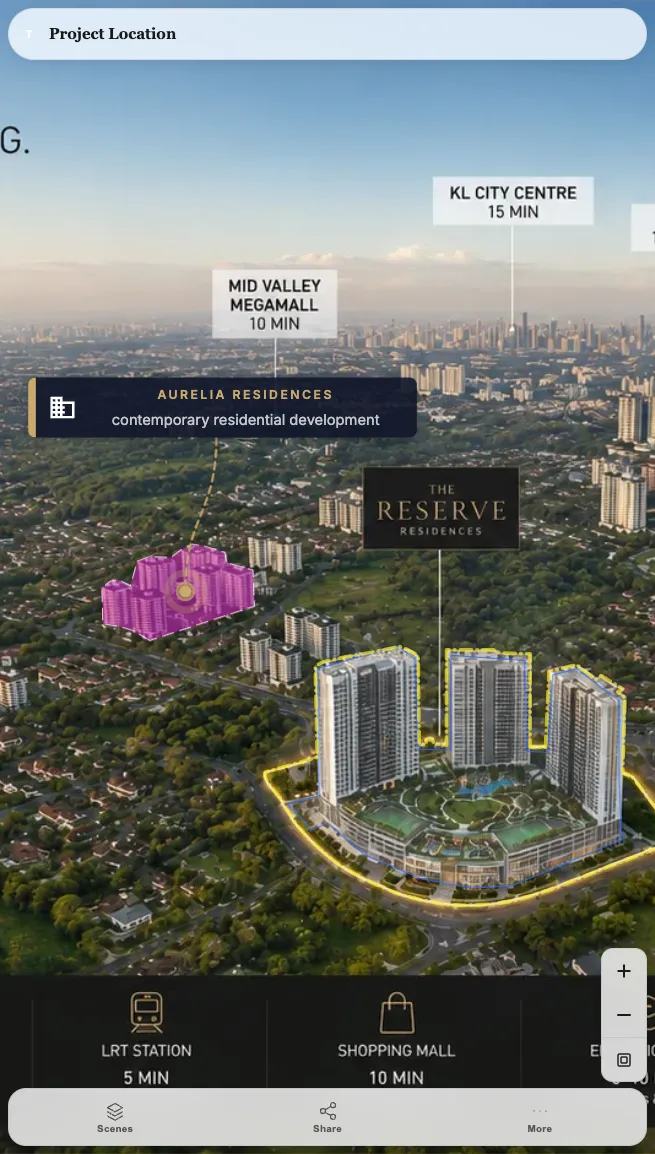
The live showcase is a full RegalScene experience: a master plan with clickable buildings, unit availability on the facade, floor plans with per-unit status, and enquiry from the unit. It opens in a new tab, needs no sign-up, and is worth opening on a phone rather than a laptop, because that is where your buyers are.
How we work
Markets served, not offices opened
RegalScene is operated from Malaysia and works with property developers across Southeast Asia and the Gulf. Indonesia is a market we serve, and we would rather state that plainly than let a country page imply a presence before it is formally established. For Indonesia today, delivery is remote-first, with local partnerships and support added as the market develops. For serious client engagements, the RegalScene team is also willing to travel for in-person meetings, workshops, and project reviews.
In practice, engagements run remotely. You send the plans, renders, and unit list you already have. We build the experience, you review it, and it publishes to a link you can put on your website, hand to an agency, or turn into a QR code for a mall booth or a launch event. Updates to availability are yours to make from then on.
Pricing is scoped around the project rather than charged per unit, so a large township does not automatically cost more than a small one. The pricing page sets out what shapes a project quote.
Indonesia FAQ
- Does RegalScene work with developers in Indonesia?
- Yes. Indonesia is one of the markets we serve. RegalScene is operated from Malaysia and is expanding its market coverage across Southeast Asia and the Gulf. For Indonesia today, delivery, setup, and support are remote-first, with in-person travel available for serious client engagements and local partnerships added as the market develops.
- Is the platform available in Bahasa Indonesia?
- The buyer-facing experience carries whatever language you author into it, so view names, cluster labels, unit descriptions, and enquiry forms can be entirely in Bahasa Indonesia, or in English or Mandarin for overseas partners. The admin interface and this website are in English.
- Can agencies in different cities work from the same project?
- Yes, and that is one of the main reasons developers here use it. Every appointed agency opens the same live project rather than a copy. When availability changes, it changes for all of them at once, whether they are in Jakarta, Surabaya, Medan, or Singapore.
- Can it show ruko and kavling, not just apartments?
- Yes. Anything with a defined position on a plan can be mapped and given a status: shophouse blocks with frontage and corner positions, land plots with boundaries and dimensions, landed clusters, and apartment towers. The unit types and the fields attached to them are yours to define.
- Will it work for a buyer on a phone with mobile data?
- That is the assumption it is built on. Plans are served as tiles rather than one large image, so the view loads progressively and stays responsive on a mid-range phone and a normal mobile connection.
Keep reading
Deeper on the parts of this page that matter most in this market.
Indonesia and the region
Selling through agencies
Selling in another market? See all markets we serve.
Tell us about your projects
Send us a site plan, a tower render, or a unit list from one of your current projects, and we will walk through how it would work as a live experience your agencies can all sell from.