Every developer with a large project has seen the demo that impressed the boardroom and died in the field: a rich 3D experience that ran beautifully on the agency's workstation, then took forty seconds to load on a buyer's phone at a roadshow — on venue Wi-Fi, on a mid-range Android, from a QR code scanned in passing. The buyer waited three seconds, closed the tab, and kept walking.
The uncomfortable truth of digital property marketing is that your experience runs on the worst device your buyer owns, over the worst connection they'll have that day. A township with thousands of units has to open instantly on that device, or the marketing spend that produced the click is wasted.
This is an engineering problem with a known solution. Here is how massive master plans stay fast in a normal browser — and why the answer is architecture, not compression.
The core idea: never send what the buyer isn't looking at
A township master plan render might be a gigapixel image — far too large to send to any phone. The solution is the one mapping applications settled on twenty years ago: slice the image into a pyramid of tiles at multiple zoom levels, and let the browser fetch only the tiles visible on screen right now.
Zoomed out, the buyer sees the whole township served as a handful of small tiles. Zoom into a precinct, and the browser swaps in sharper tiles for that area only — the rest of the township is not loaded, because it is not on screen.
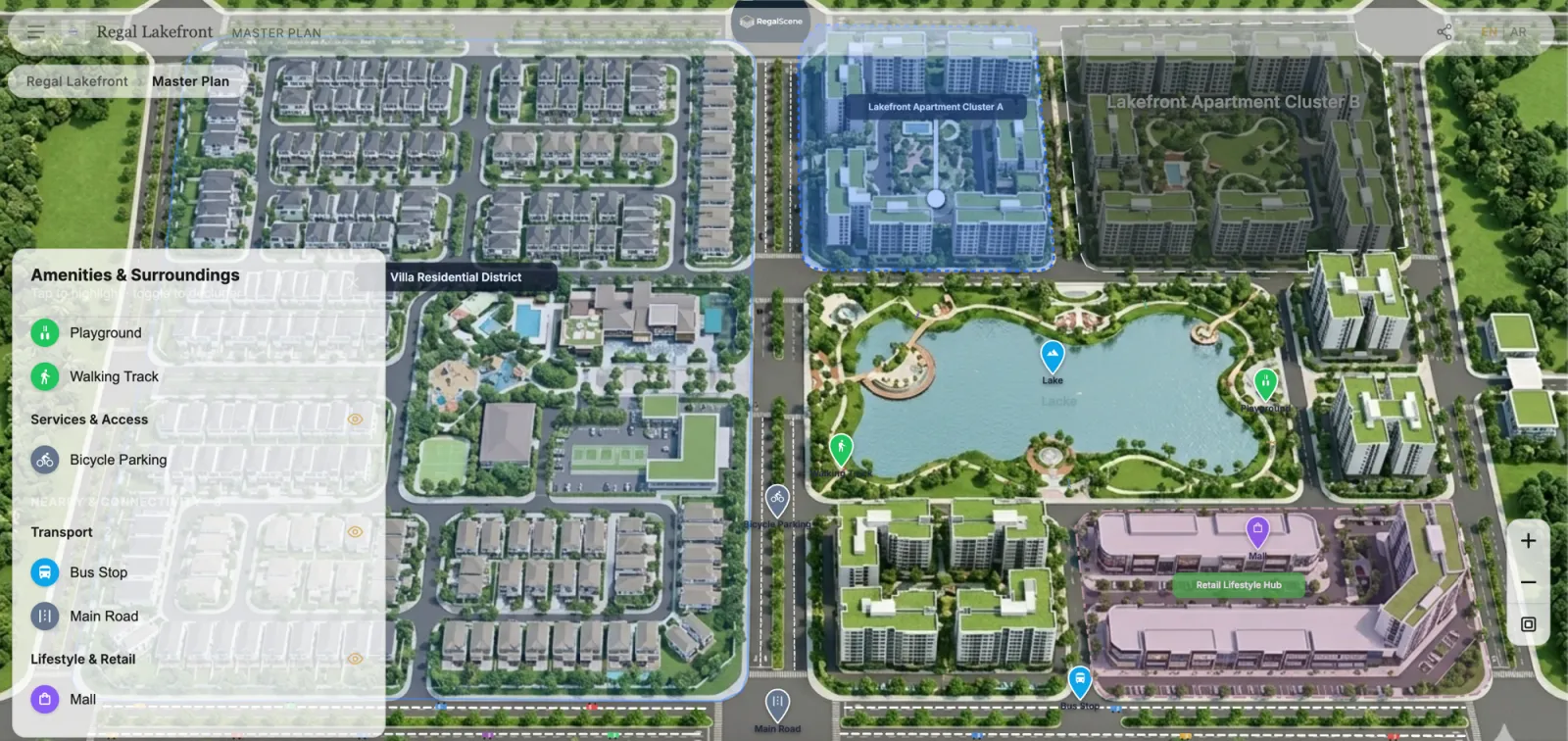
The consequence is counterintuitive: project size stops mattering. A 40-building township and a single tower cost the viewer roughly the same bandwidth at any moment, because the screen can only show so many pixels. The buyer experiences one continuous, sharpening surface; the network sees a trickle of small image requests.
Interactivity is vectors, not pixels
The second decision is what makes the plan clickable without making it heavy. Every selectable element — buildings, zones, villas, plots, amenities — is a vector shape drawn over the tiles, not baked into the imagery.
Vectors are geometry: a villa outline is a few hundred bytes of coordinates, crisp at every zoom level, and cheap to test for taps. Availability colors, highlights, and labels are styling applied to that geometry — so when a unit sells, the overlay restyles instantly. No imagery is re-rendered, nothing re-downloads.
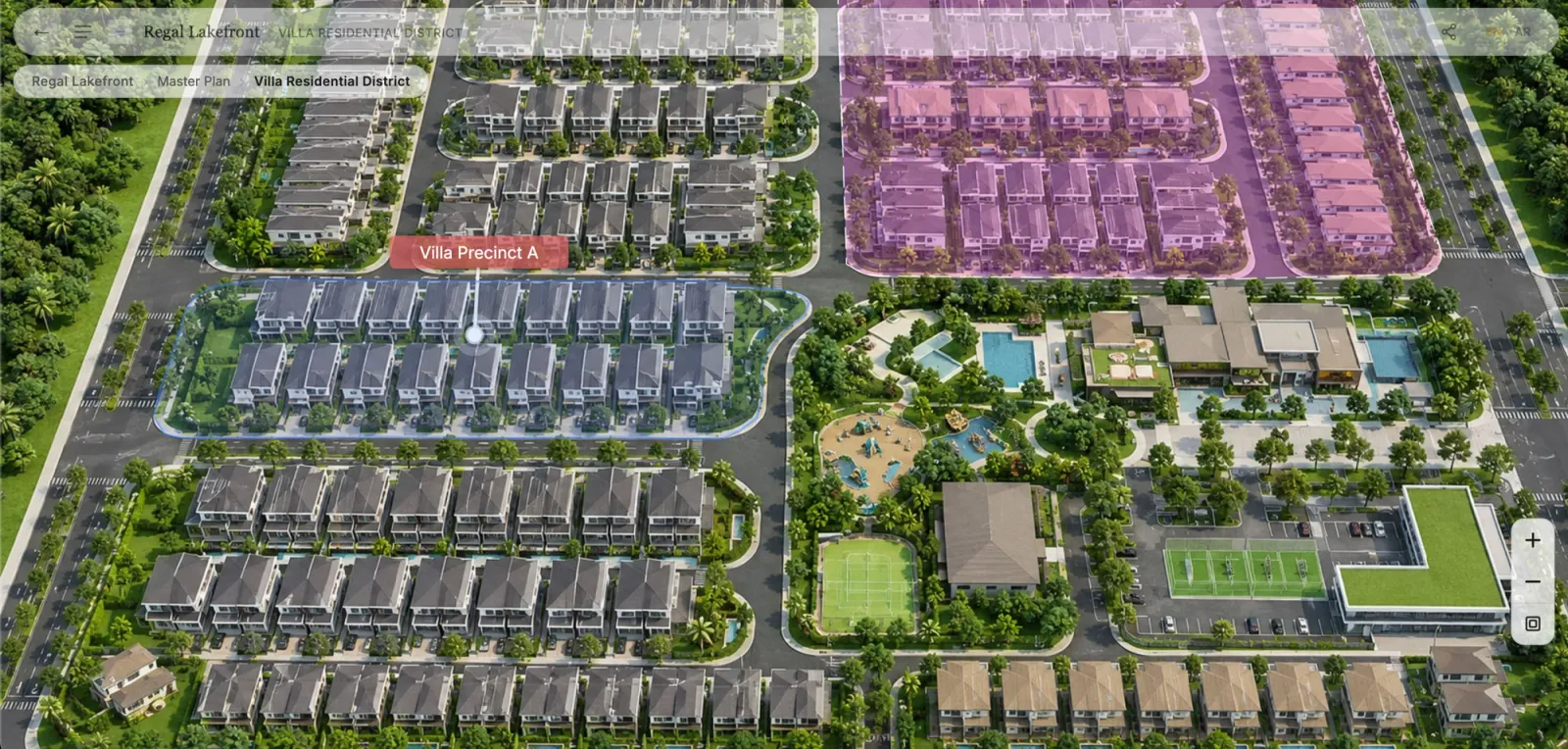
This split — raster tiles for realism, vector overlays for interaction — is why a plan with two thousand selectable units is not two thousand times heavier than a plan with one. The units are data, and data is small.
Heavy things are frozen; light things are live
The third decision is about time. A property experience contains two kinds of content that change at completely different speeds:
- The visual world — renders, tiles, geometry, navigation structure. Changes rarely (a new phase, an updated render).
- The commercial truth — availability, prices, featured units, CTAs. Changes constantly.
RegalScene publishes the visual world as frozen, versioned static assets served from CDN edges close to the buyer — cacheable, immutable, fast everywhere from Kuala Lumpur to Riyadh. The commercial truth travels separately as a small live payload merged in at view time. A buyer opening the link downloads a stable, cached experience plus a few kilobytes of today's reality.
This is also what makes updates safe: changing a price or closing a zone is a data edit, not a re-deployment of the visual world. The heavy asset that took effort to produce is produced once.
What the buyer's phone actually does
Add it up, and the device's job becomes small on purpose. It renders a handful of visible tiles, draws lightweight geometry over them, and applies status colors from a small data file. There is no 3D view graph to build, no hundred-megabyte texture set, no GPU-heavy lighting pass, no app install. First paint happens in about a second on an ordinary connection; interaction is available immediately while detail tiles sharpen in the background.
Compare the alternative: a game-engine or full-3D approach must deliver models, textures, and an engine runtime before the buyer sees anything — routinely tens to hundreds of megabytes, with performance hostage to the device's GPU and thermals. On a flagship phone in the sales gallery it's impressive. On the mid-range Android where most campaign traffic actually lands, it's an abandoned session. Immersion has its place in the journey — but as a destination within the experience, not the foundation the whole experience stands on.
Why this matters commercially, not just technically
Campaign economics. Paid clicks, QR scans, and WhatsApp shares are cold, mobile, and impatient. The distance between tap and interactive determines how much of your ad spend converts into exploration. A second of load beats a minute of loading spinner, every time, in every market.
Roadshow reality. Venue Wi-Fi and crowded mobile networks are the standard conditions of property marketing in Southeast Asia and the Gulf. Tiled experiences degrade gracefully — the plan appears and sharpens — instead of failing absolutely.
Scale without penalty. Townships, mixed-use districts, and free zones are exactly the projects that need interactive presentation most, and exactly the ones heavy approaches struggle to deliver. When the architecture makes size irrelevant, your largest projects stop being your slowest experiences.
Search and sharing. Fast pages rank better and share better. An experience that opens instantly from a link behaves like the web, travels like the web — into chats, onto agency sites, through QR codes — instead of demanding the buyer come to it.
The test to run on any vendor
Skip the feature list and run one field test: open the largest project they've built on a three-year-old mid-range phone, over mobile data, from a QR code. Count the seconds to first interaction. Then change a unit's availability and count the seconds until every view reflects it.
Those two numbers — time to interactive, time to truth — are the performance story of a digital sales experience. Everything in this article exists to make both of them small.
Related reading:
- RegalScene vs Heavy 3D Engines: Web-Native or Unreal for Property Sales
- An Interactive Master Plan, Screen by Screen: Anatomy of a Real Project
- 2D vs 3D for Property Sales: Choosing the Right Experience, Not the Most Expensive One
- Interactive Master Plans for Townships and Mixed-Use Developments
- Map, Building, Floor & Unit Views: How to Present a Project Online
- A Lightweight 2D and 3D Property Buying Journey
RegalScene publishes master plans as deep-zoom, vector-overlaid web experiences — massive projects, instant on ordinary phones, availability always live. See the platform or book a demo.