Property developers are increasingly expected to present projects through interactive digital experiences rather than static brochures, PDFs, and image galleries.
This often creates an immediate question: should the project be presented in 2D or 3D?
The answer is not that one format is always better. The right question is: which format helps buyers, tenants, brokers, and investors understand the project, find the right asset, and take the next step?
For many property projects, interactive 2D delivers most of the commercial value of a digital sales experience while allowing the developer to reuse existing assets, launch faster, and keep the experience lightweight.
What Interactive 2D Actually Means
Interactive 2D is not simply displaying a floor plan as an image.
RegalScene transforms existing visual assets into navigable, interactive sales experiences. A developer may already have master plans, site plans, building elevations, floor plans, leasing plans, rendered images, brochures, unit schedules, or workspace layouts. RegalScene uses these materials as the visual foundation of the experience.
Interactive overlays are then placed over the original asset to identify buildings, zones, floors, units, offices, retail spaces, or plots. Users select an area, view its information, move between project levels, and submit an enquiry — all within the same experience.
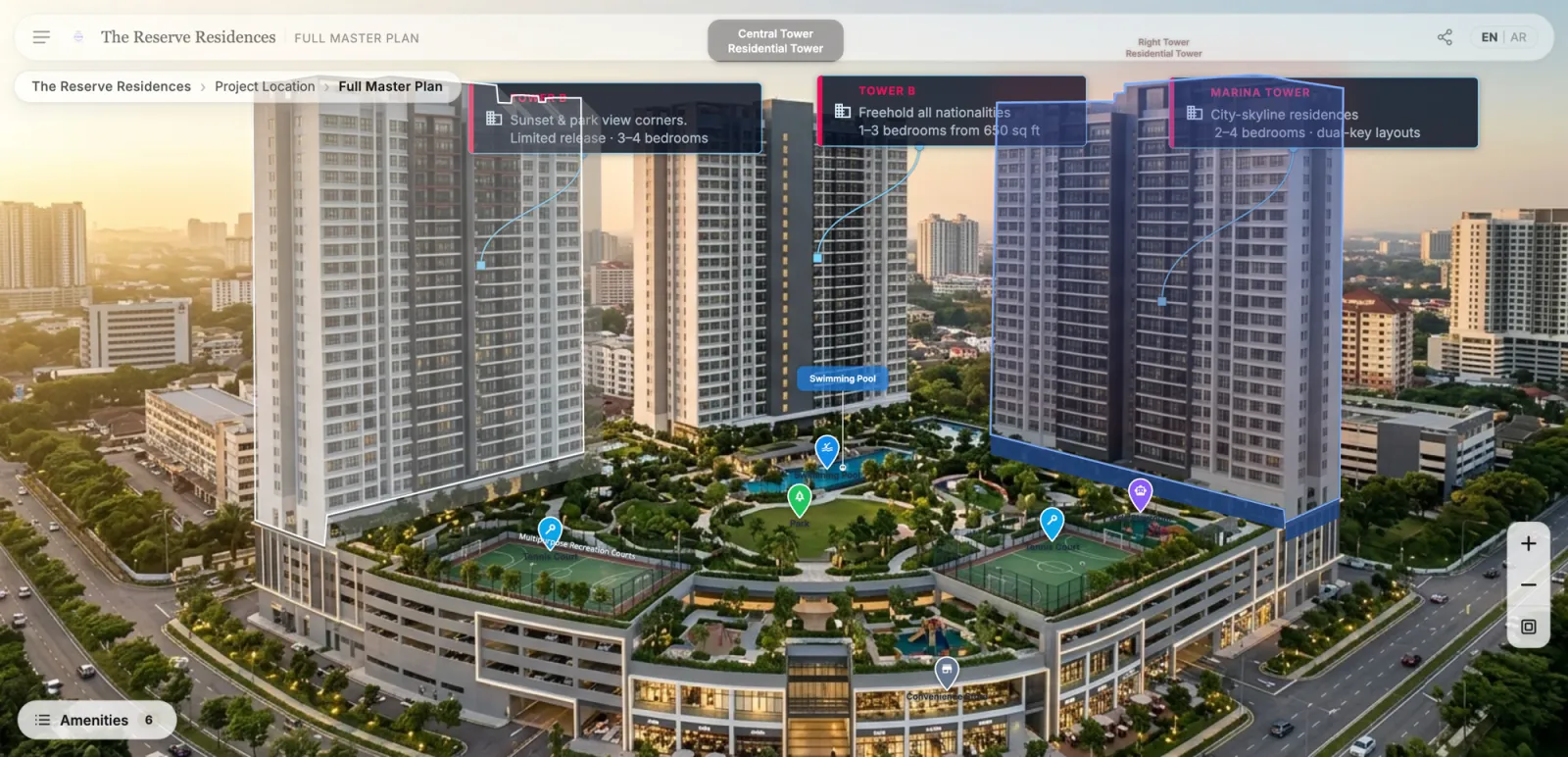 Live demoExplore an interactive master plan liveopens the interactive RegalScene demo in a new tab
Behind the scenes, the 2D experience combines deep-zoom image tiles, precise overlays, unit-level hit-testing, and floor navigation rather than treating the plan as a static file. The result is not a digital drawing. It becomes a visual interface for exploring and selling the project.
1. Reusing Existing Project Assets
One of the strongest advantages of interactive 2D is asset reuse.
Most developers already have suitable visual materials created by their architects, consultants, and agencies — originally produced for brochures, presentations, hoardings, or launch campaigns. Instead of rebuilding the project from the beginning, RegalScene uses these approved materials as the starting point.
This removes the need for:
- New 3D modeling
- Recreating architectural geometry
- Rebuilding textures and lighting
- Producing new visual assets for every design change
- Waiting for a specialist visualization team before launching
The developer keeps the visual identity of the original campaign while adding interaction, navigation, availability, and lead capture. With full 3D, existing 2D plans are often only references — the project must be modeled again before anything interactive can ship.
For projects with limited time, approved marketing materials, or frequently changing inventory, reusing existing assets is more commercially valuable than rebuilding the entire environment. (The renders you already paid for can work much harder than a brochure page.)
2. Adding an Interactive Overlay
The real value is not the 2D image itself — it is the interactive layer placed over it.
RegalScene maps individual areas of a master plan or floor plan and connects them to structured information. A user moves through master plan → zone → building → floor → unit, and at every level the experience presents what matters: availability, unit type, area, price or rental information under your display policy, images, floor plans, specifications, amenities, and enquiry actions.
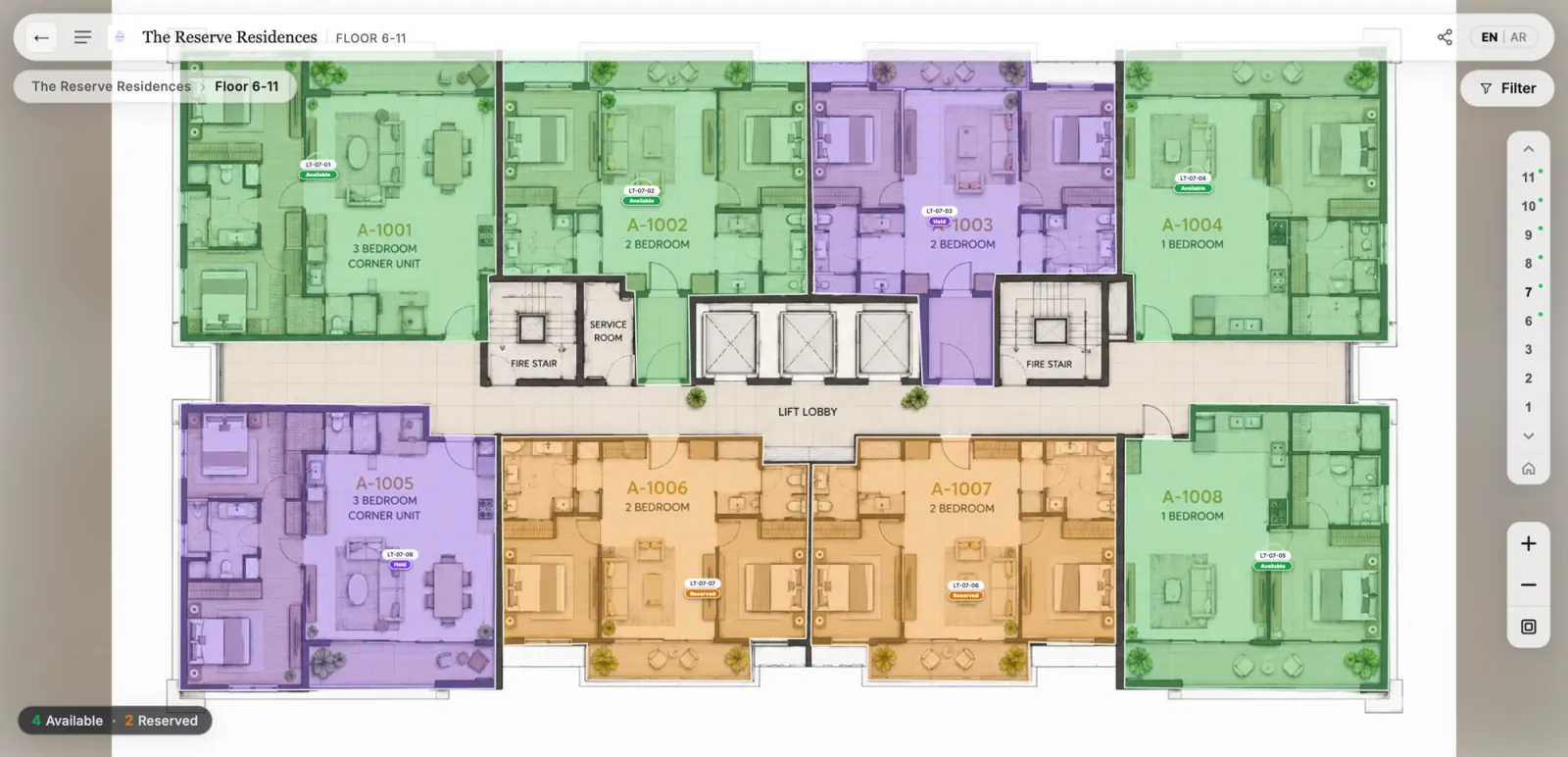 Live demoSee live unit availability in the demoopens the interactive RegalScene demo in a new tab
The original visual remains familiar, but it becomes searchable, clickable, and connected to the project inventory. This is where interactive 2D differs from a brochure: the brochure asks the visitor to interpret the plan. RegalScene lets the visitor explore it. (The full journey pattern is broken down in map, building, floor, and unit views.)
3. Interactivity Without Unnecessary Complexity
A 3D environment provides depth, atmosphere, and spatial context. It is valuable when architecture, views, interior design, or movement through the environment are central to the buying decision.
But not every sales journey requires full spatial simulation. In most cases, users want to answer practical questions:
- Where is the building located?
- Which floors are available?
- Which units match my requirements?
- How large is the space, and what is beside it?
- What does the layout look like?
- How do I enquire?
Interactive 2D answers these clearly, without asking the user to learn how to move through a virtual environment. Navigation stays direct and familiar — everyone already understands maps and floor plans.
This is particularly effective for residential developments, commercial offices, flexible workspaces, industrial parks, logistics and free zones, retail destinations, mixed-use districts, and land sales.
The goal is not interaction for its own sake. The goal is to help the customer make progress.
4. A Lightweight Mobile Experience
Property experiences are increasingly opened on mobile — from social media, messaging apps, email campaigns, QR codes, and sales-team follow-ups.
A full 3D experience means larger files, more processing power, and a stronger connection, with performance hostage to the complexity of models, textures, and lighting. Interactive 2D stays light — which matters for the buyer browsing on mobile data, opening the project from an ad, using an older device, or receiving a link from a broker.
A lighter experience shortens the distance between opening the link and interacting with the project. For marketing campaigns, that difference is decisive: a visually impressive experience has no value if the customer leaves before it loads.
5. Faster Updates for Information That Never Stops Changing
Units are reserved. Floors are released. Prices change. New phases launch. Availability moves through the entire sales cycle.
With an interactive 2D platform, the visual layer and the inventory information are managed separately — the project team updates labels, availability, images, CTAs, content, and promotions without recreating the visual experience. It is a living digital sales experience, not a one-time production.
With a highly customized 3D environment, even small changes can require specialist work, asset rebuilding, QA, and another release. RegalScene is designed around the reality that property projects keep changing after launch — that update economics is often the whole business case.
6. Lower Production and Operational Complexity
Full 3D is not only a visual decision — it is a production and operational commitment: model preparation, geometry optimization, materials, lighting, camera controls, device testing, browser compatibility, and continuous rework when the design changes.
These costs may be justified for flagship projects where immersion is central to the sales strategy. They should never be accepted simply because 3D appears more advanced.
Interactive 2D keeps the project close to assets that sales and marketing teams already understand — easier to review, approve, maintain, and update. That is what moves a developer from idea to a usable sales experience sooner.
7. Marketing Flexibility
Marketing teams need several versions of the same project story: one campaign for investors, another for families; a commercial campaign around office sizes, a broker campaign around floor plates and leasing terms.
Because RegalScene uses structured information and interactive overlays, the same project assets support different journeys — launches, phases, featured buildings, campaign audiences, international buyers, broker presentations, on-site sales centers, and website visitors. One visual foundation, reused across campaigns, instead of a separate static brochure or microsite for every audience.
The project becomes a reusable digital sales asset.
8. Customer Experience: Clarity Before Immersion
Three-dimensional environments create emotional impact. Interactive 2D creates clarity. The strongest property sales experience uses both.
3D renders and 360 virtual tours communicate atmosphere, architecture, and interior quality. Interactive 2D gives the customer the structure: understand the master plan, compare locations, navigate floors, identify available units. The formats do not compete — a single journey can move through the master plan, into a zone or building, down to a floor and unit layout, across to renders and a virtual tour, and end at an enquiry.
In this model, 2D provides the structure of the journey, and 3D enhances the moments where immersion adds genuine value. (For a deeper comparison of the content formats themselves, see virtual tour vs 3D render vs interactive master plan.)
When Should a Developer Use 3D?
3D experiences earn their cost when:
- The project must communicate a strong architectural vision
- Surrounding views are a major selling point
- Customers need to experience interiors before construction
- Movement through the environment matters to the decision
- The project is a flagship destination
- High-quality 3D assets already exist
- The budget and timeline support ongoing 3D production
When Is Interactive 2D the Better Starting Point?
Interactive 2D is the stronger starting point when:
- Master plans and floor plans already exist
- The project needs to launch quickly
- Mobile accessibility is important
- Inventory changes regularly
- The main objective is navigation and asset discovery
- The team wants lower production complexity
- The project spans many buildings, floors, or units
- The developer wants a reusable platform, not a single campaign asset
The RegalScene Approach
RegalScene does not treat 2D as a basic alternative to 3D. We treat it as a powerful visual sales layer.
The platform turns the plans and visuals developers already have into interactive digital sales centers where customers explore the project, navigate between assets, understand availability, compare options, register interest, and continue their journey with the sales team. Where 3D adds value, it becomes part of the wider experience. Where it adds cost without improving the customer journey, it is not added for appearance.
The best digital sales experience is not the one with the most complex technology. It is the one that makes the project easier to understand, easier to explore, and easier to act on.
Related reading:
- Interactive 3D Models for Property Sales: Explore a Building in 3D
- RegalScene vs Heavy 3D Engines: Web-Native or Unreal for Property Sales
- Virtual Tour vs 3D Render vs Interactive Master Plan: Which Sells Property Better?
- Map, Building, Floor & Unit Views: How to Present a Project Online
- Interactive Experiences vs Static Renders: What Actually Generates Leads
- How Much Does an Interactive Master Plan Cost?
- How Massive Master Plans Stay Fast in a Normal Browser
- A Lightweight 2D and 3D Property Buying Journey
RegalScene turns the visual assets developers already have into interactive, measurable, and reusable property sales experiences. See the platform or book a demo.