When a developer is choosing how to present a project online, the pitch often jumps straight to the most impressive-looking option: a photorealistic 3D world built in a game engine. It looks incredible in a boardroom. Then it meets a real buyer on a phone, on mobile data, and takes fifteen seconds to load, or never finishes loading at all.
The real choice between a web-native platform like RegalScene and a heavy 3D engine (Unreal Engine, or 3ds Max with V-Ray or Corona) is a trade-off: instant accessibility and sales utility on one side, cinematic graphics and immersion on the other. This is the honest comparison, with a table you can hand to a stakeholder and a clear answer for most launches.
RegalScene vs heavy 3D engines, side by side
| RegalScene (web-native) | Heavy 3D engines (Unreal / WebGL) | |
|---|---|---|
| Loading speed | Instant (lightweight vector and image layers) | Slow to moderate (heavy asset downloads or streaming) |
| Hardware needed | Any phone, tablet, or basic browser | High-end GPU, gaming PC, or a dedicated kiosk |
| Asset pipeline | Reuses existing renders, floor plans, and photos | Requires specialized 3D/CAD or BIM model conversion |
| Lead and CRM tracking | Built in (tracks unit interest and sessions) | Custom setup; usually a visual tool only |
| Visual fidelity | Clean, structured 2D/3D composite navigation | Photorealistic real-time lighting and ray tracing |
| Time and cost to launch | Days, from assets you already own | Months of specialist 3D production |
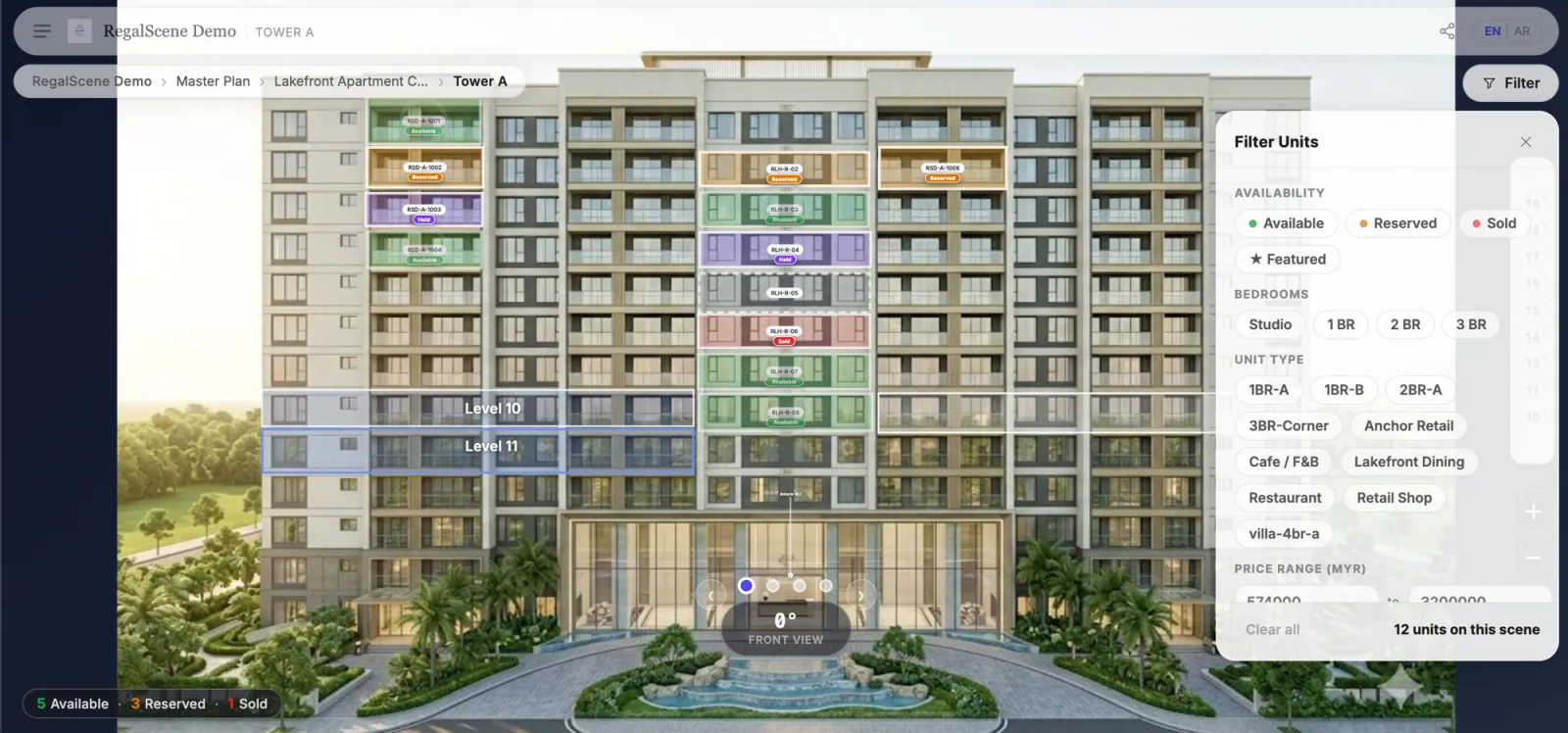 Live demoSee the web-native experience liveopens the interactive RegalScene demo in a new tab
Why developers choose web-native for sales
No drop-offs on mobile. Heavy 3D forces a buyer to download large files before anything appears. On the mid-range phone where most campaign traffic and WhatsApp referrals actually land, that wait is where the session ends. A web-native experience keeps file weights small, so the project opens before the buyer loses patience. The performance argument in full is the difference between a lead and a bounce.
Built for conversions, not just immersion. A game engine is optimized for graphics, lighting, and atmosphere. A sales platform is optimized for the sales workflow: live availability, unit comparison, price display under your policy, and enquiry in context. The buyer is not there to admire the lighting; they are there to find a unit and act. RegalScene is structured around that, with buyer-intent analytics underneath every session.
Days to launch, not months. A heavy 3D experience needs the project modeled, textured, and optimized by a specialist pipeline before anything ships, and remodeled whenever the design changes. RegalScene uses the renders and floor plans you already commissioned as its foundation, so an experience launches in a fraction of the time, and updates in minutes instead of another production cycle.
When a heavy 3D engine is the right call
This is not an argument that 3D has no place. Cinematic 3D and real-time walkthroughs earn their cost when architecture is the headline, when interior atmosphere has to be felt before construction, or when a flagship destination is selling an experience as much as a unit. The strongest approach uses both: web-native navigation as the structure of the journey, with 3D renders and 360 tours as the immersive moments where they change a decision. RegalScene brings those renders into the journey rather than being replaced by them.
The question is not which looks more realistic. It is which sells the unit and tells you what the buyer did.
The RegalScene Approach
For most property launches, the winning experience is not the most powerful graphics engine. It is the one a buyer can open instantly on the phone in their hand, navigate without instruction, and enquire from in two taps. RegalScene is built for that: web-native, instant, and structured around the sale, using the visual assets a developer already owns. Where photorealism genuinely moves a buyer, it becomes part of the experience. Where it only adds weight and cost, it is not the foundation the whole thing stands on.
Lightweight beats heavy when the goal is a sale, not a screenshot.
Related reading:
- Interactive 3D Models for Property Sales: Explore a Building in 3D
- 2D vs 3D for Property Sales: Choosing the Right Experience, Not the Most Expensive One
- How Massive Master Plans Stay Fast in a Normal Browser
- Virtual Tour vs 3D Render vs Interactive Master Plan: Which Sells Property Better?
- Real Estate Buyer Intelligence: A Guide for Developers
- How Much Does an Interactive Master Plan Cost?
- A Lightweight 2D and 3D Property Buying Journey
RegalScene turns the renders and floor plans developers already have into fast, web-native sales experiences. See the platform or book a demo.