Products · Portfolio Builder
Every development. One connected portfolio.
One place where everything you sell lives together, that a buyer can browse as a list or a map, and walk straight into any project from.
The challenge
You sell a portfolio. Buyers meet one project at a time.
Most developers present each launch as if it were the only thing they build, and then wonder why buyers treat them that way.
Every launch starts from zero.
A new microsite, a new agency, a new set of links. Nothing you built for the last project carries into the next one.
A buyer interested in one project never finds the other six.
Someone arrives for a township and leaves without knowing you also sell the tower ten minutes away that suits them better.
Nobody can answer “what else do you have?”
The answer lives in a brochure rack, a sales folder and three different websites, which is why it is usually answered badly.
Campaigns point at pages that expire.
Each campaign links somewhere different, and when a project sells out the link becomes a dead end rather than a doorway to the rest.
The solution
A layer above the projects, not another microsite.
Each development is built once as an interactive project. The portfolio is the layer that gathers them: the set a buyer sees first, the order you want them in, and the way into each one.
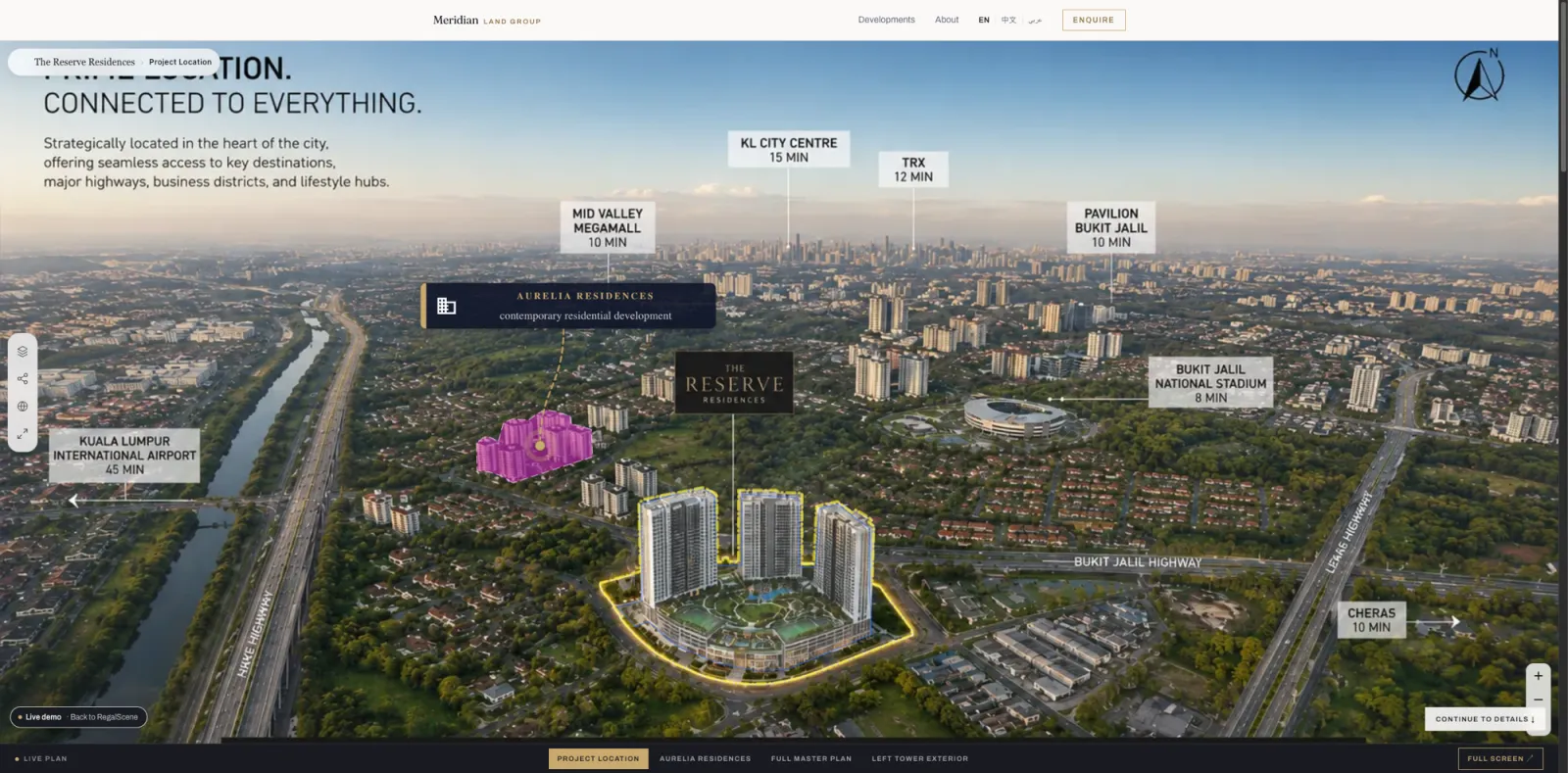
Because it sits above the projects rather than duplicating them, a project you add to a portfolio is the same project your campaigns, your agencies and your sales team are already using. There is no second copy to keep current.
Core capabilities
What the portfolio does.
All of it is in the public demonstration portfolio linked from this page.
Every project in one place
A single destination holding all the developments you want presented together, in the order you choose rather than alphabetically or by date.
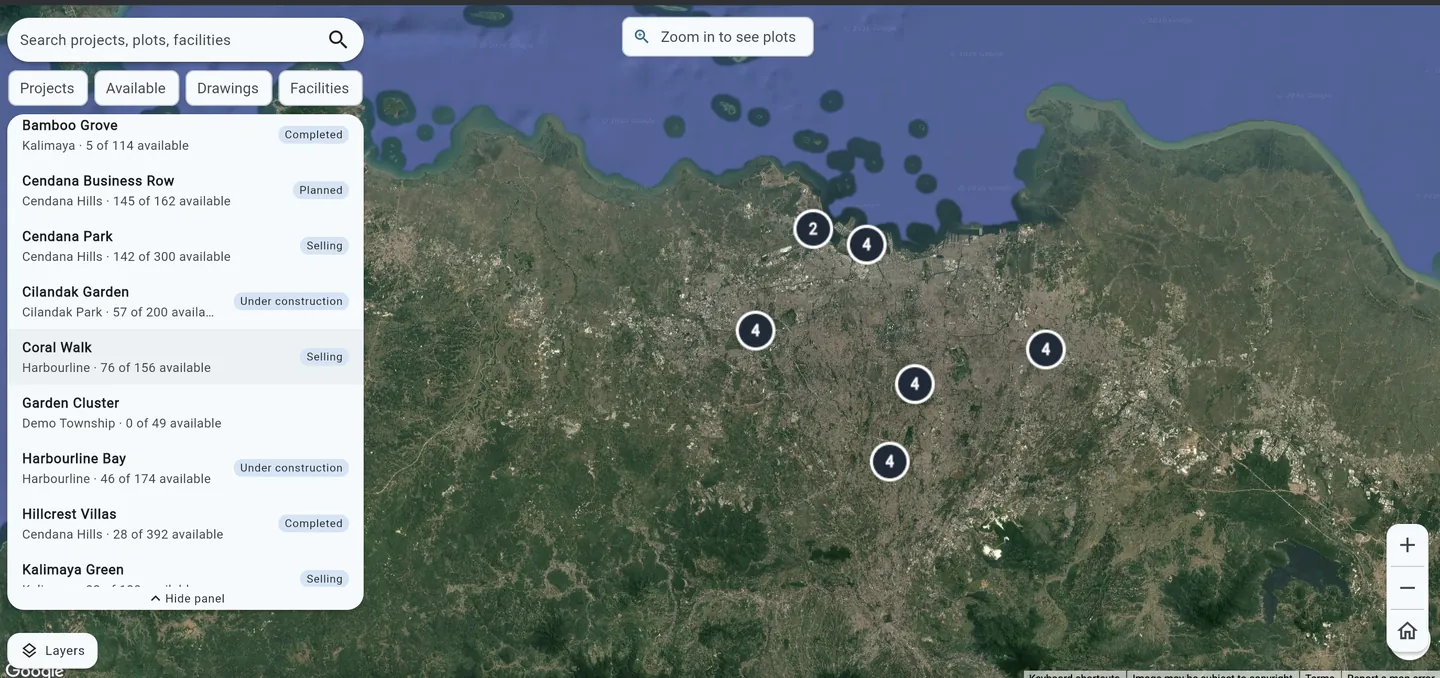
Browse as a list or a map
The same portfolio can be presented as a set of project cards or as a geographic map, and the visitor switches between them.
Straight into the project
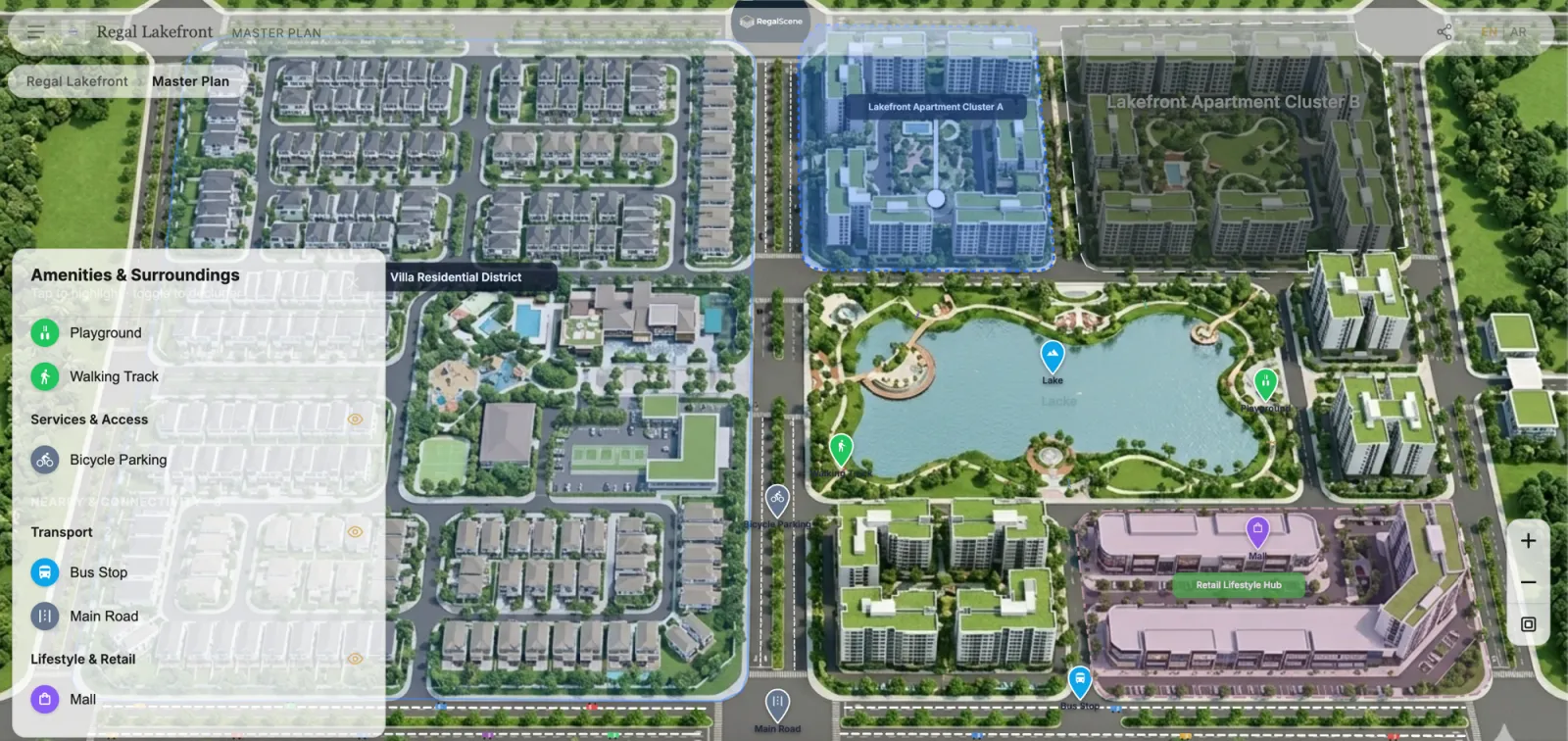
Opening a project moves the visitor into its full interactive experience without a page reload, and a back action returns them to the portfolio exactly where they left it.
One public link
The portfolio has its own address you can put in a campaign, a brochure QR code or an email, with nothing to log into.
Published in more than one language
A portfolio carries its title in English and Arabic with a language toggle, so a Gulf audience and an English one reach the same destination.
Embeddable in your own site
The portfolio can be placed inside your website rather than living only at its own address, restricted to the domains you approve.
The real thing
Open ours and go through it.
The RegalScene demonstration portfolio is public. Switch between the projects and the map, open a project, go down to a unit, then come back and see that the portfolio remembers where you were.
Opens in a new tab. No sign-up.
How it works
From separate launches to one destination.
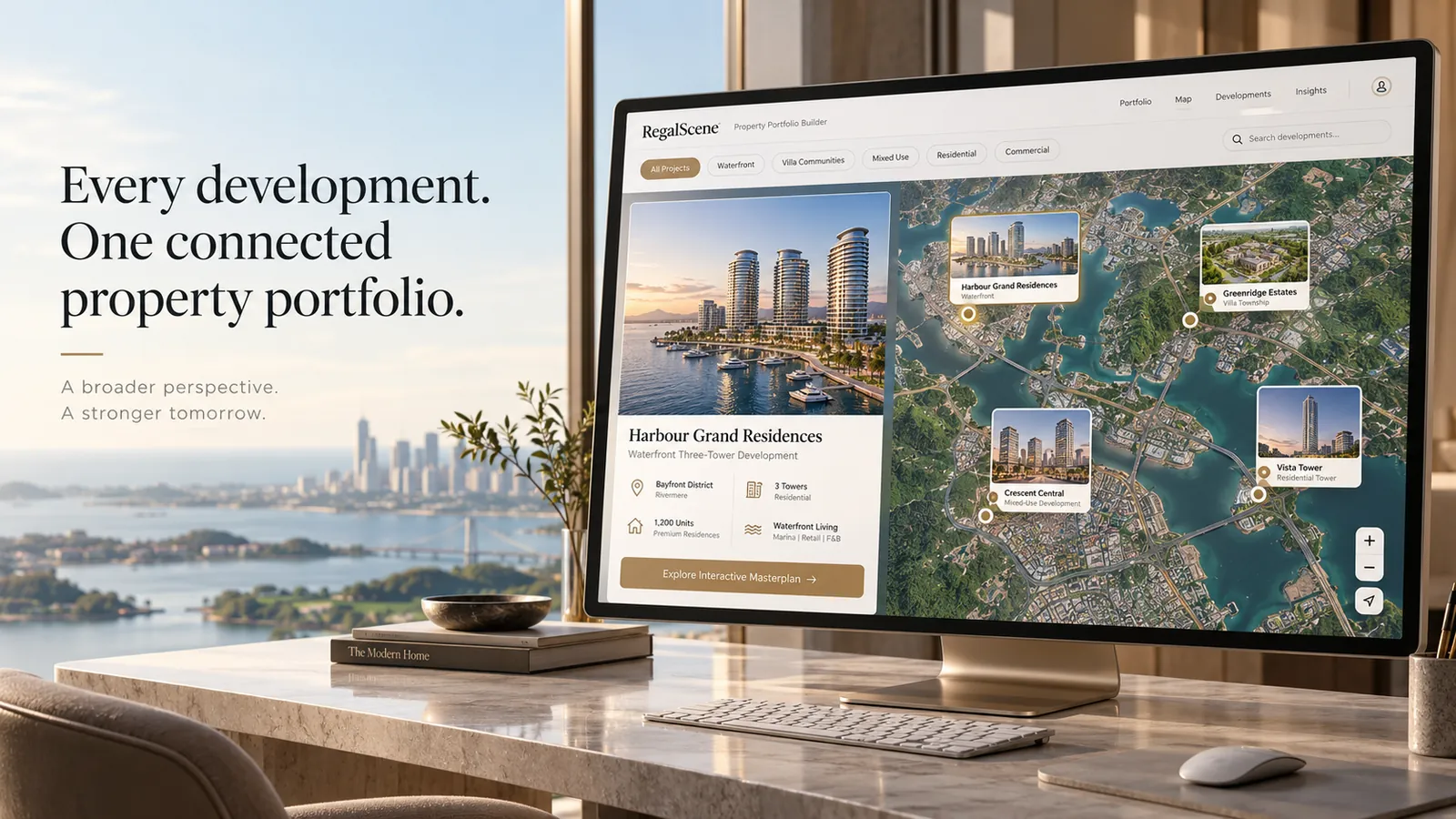
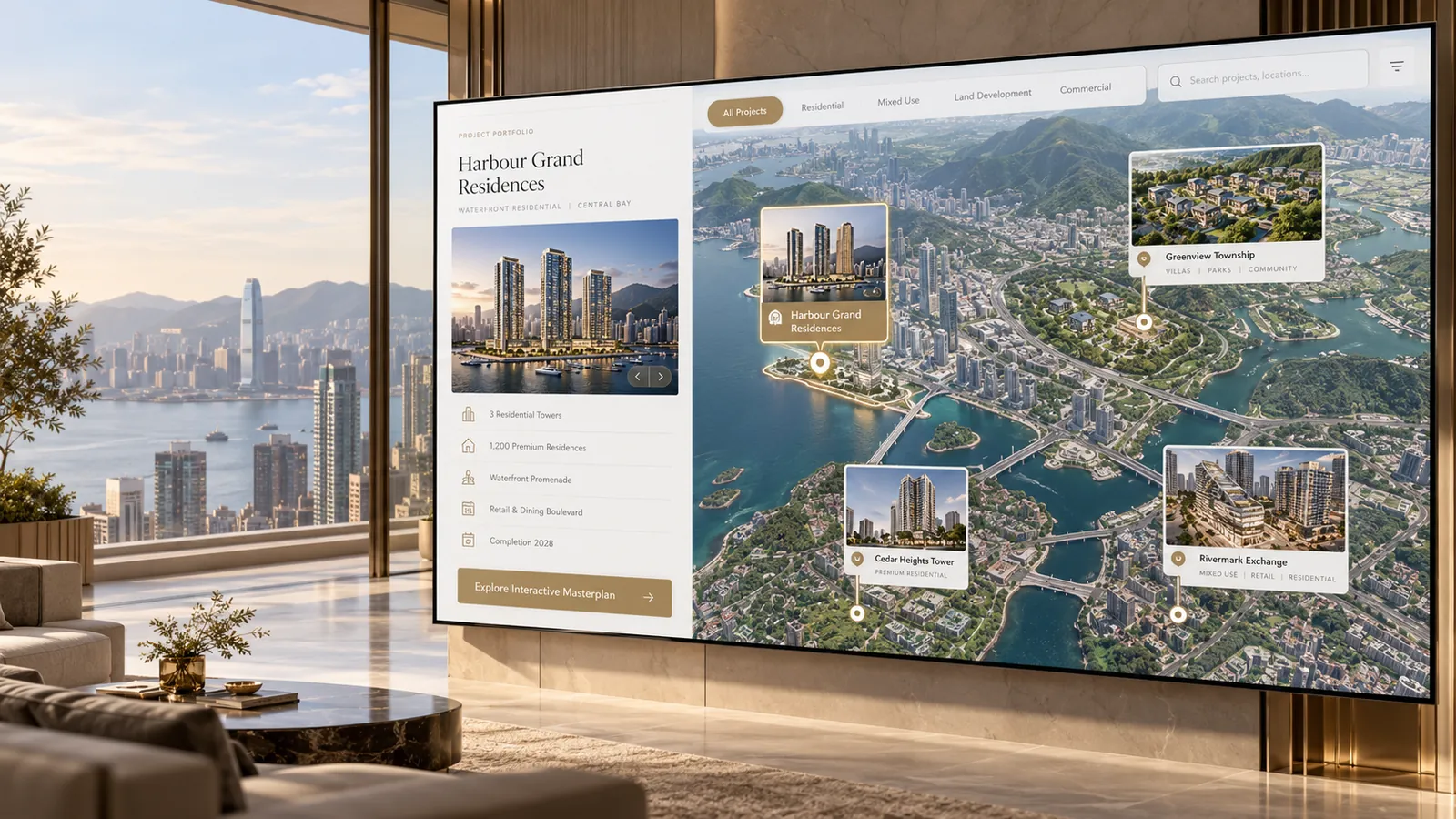
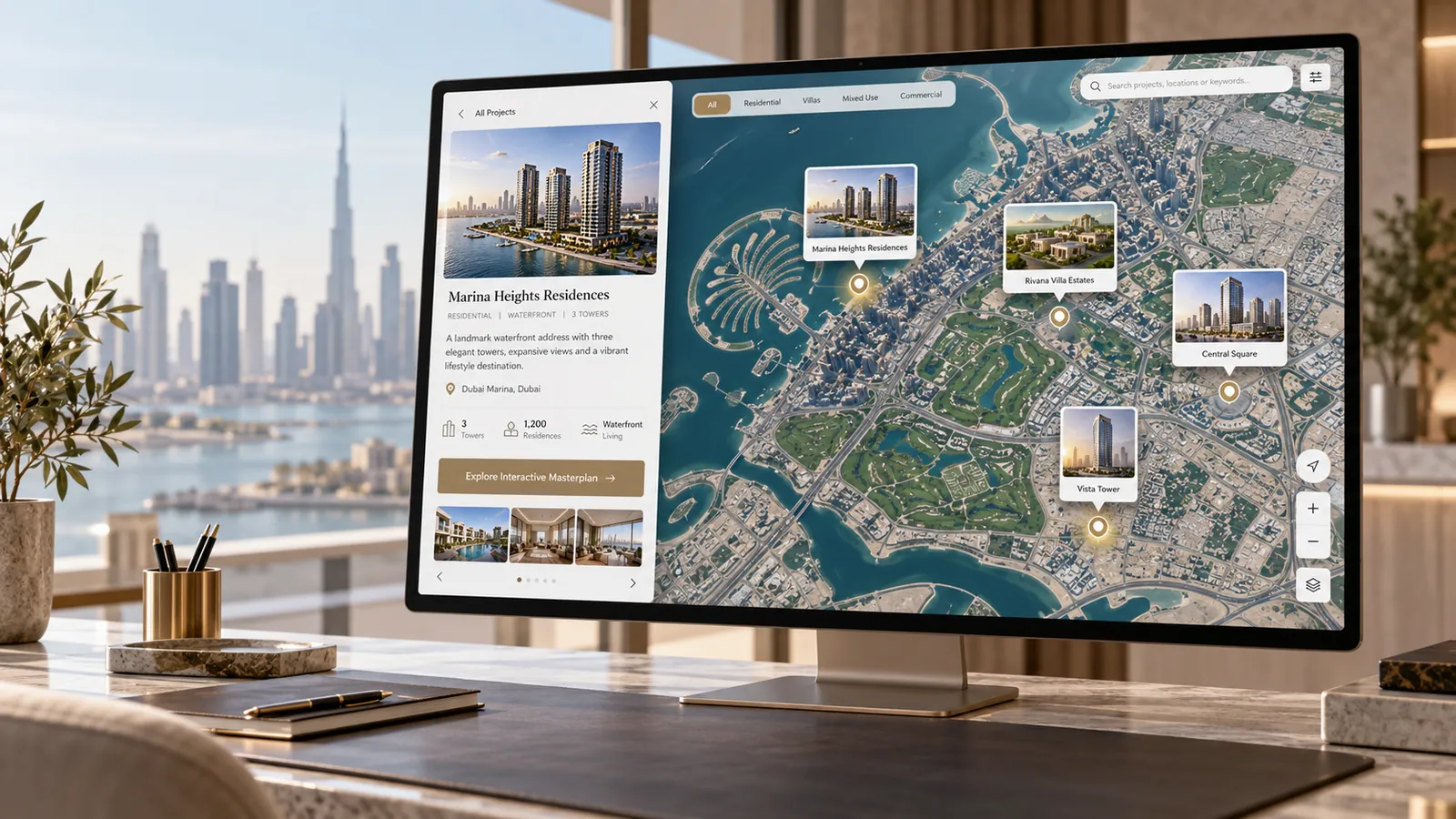
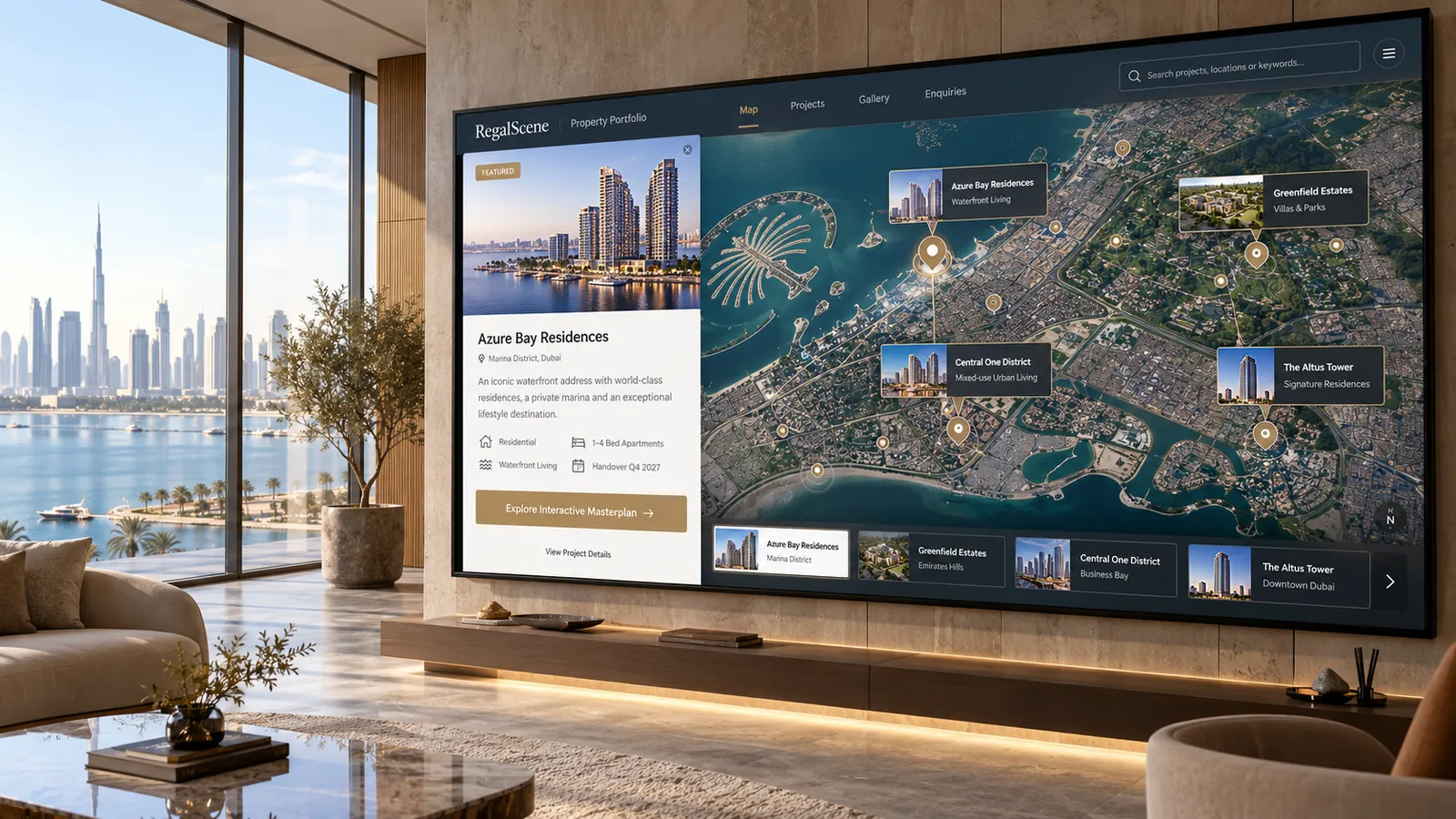
Concept visuals of a portfolio. The live portfolio linked above is the product itself.
- 01
Your projects are built in RegalScene
Each development becomes an interactive project experience first. The portfolio is the layer that gathers them, not a separate build of each one.
- 02
You choose what belongs together
Which projects appear, and in what order. A portfolio can be everything you sell, one region, or one brand within a larger group.
- 03
You choose how it opens
As a list of projects, as a map, or with both available and one of them first. Location-led portfolios usually open on the map; launch-led ones open on the projects.
- 04
It is published
The portfolio goes live at its own public address. Until you publish it, there is no public link and nothing is discoverable.
- 05
It becomes the thing you point at
Campaigns, agencies, the sales team and your own website send people to one destination instead of a different page per launch.
- 06
Buyers move between projects
Someone who came for one development can see the others and open them, which is the whole point of putting them together.
Who it's for
Anyone presenting more than one development.
One project does not need a portfolio. Three do, and by six it is usually the thing holding the marketing together.
Property development groups
Organizations with several brands or subsidiaries that want one place a buyer or an investor can see the whole operation from.
Multi-project developers
Developers running more than one launch at a time, where each project currently gets its own disconnected presence.
Property agencies
Agencies presenting a set of developments they represent, as one collection rather than a page of logos.
Phased and township developers
Where phases released over years are separate projects commercially, but have to read as one development to a buyer.
Operators with a mixed estate
Organizations whose portfolio spans residential, commercial, hospitality and industrial, and who need all of it presented coherently.
Business benefits
What it changes.
One destination instead of a page per launch
Everything you sell has a single address, so the thing you promote does not have to be rebuilt every time a project completes.
Projects presented consistently
Each development is shown the same way, which makes a group of projects read as one operation rather than a collection of campaigns.
Buyers discover more than they came for
The cross-sell happens inside the experience instead of relying on a salesperson remembering to mention the other project.
A clearer path from browsing to a specific unit
The route runs from the portfolio into a project, down to a floor and a unit, and ends in an enquiry that says which one.
Questions
Portfolio questions.
Can we brand the portfolio as our own site?
Not as a white-label microsite. Branding in RegalScene is applied inside each project experience, and the portfolio is the layer above them; it carries your project set, your naming and your ordering rather than your own logo, typefaces and domain. If a fully branded destination on your own domain is the requirement, treat it as a website project that the portfolio and the projects are embedded into.
How much detail does the portfolio show about each project?
Deliberately little: a name, a cover image and a way in. The portfolio's job is to get a buyer to the right project quickly, and the detail lives inside the project experience where the masterplan, the buildings, the floors and current availability are. It is not a listings page and does not show unit counts or prices at this level.
How is this different from WebGIS?
They are two presentations of the same portfolio. Portfolio Builder is the destination: which projects belong together, in what order, and how a buyer moves from one into another. WebGIS is the geographic presentation of it, with real positions, drawn boundaries and the places around each development. Many organizations publish both and let the visitor switch.
Can we keep a portfolio private while we prepare it?
Yes. A portfolio has no public address until it is made active, and until then a request for it is indistinguishable from a request for a portfolio that does not exist. There is no half-published state to leak.
Can we have more than one portfolio?
Yes, and it is common. A group might publish one portfolio per brand or per country, with a project appearing in more than one where that makes sense.
Is the portfolio available on every plan?
No. The portfolio layer is switched on for your organization rather than being included by default, so it is part of the conversation when your projects are scoped rather than something that simply appears.
Also in RegalScene
The rest of the platform.
Interactive Masterplan
Turn masterplans, renders and 3D models into one experience buyers can explore.
WebGIS & Geographic Intelligence
Put every development on a real map, with boundaries, surroundings and context.
Digital Sales Gallery
The same project experience for your sales team, your agencies and every screen.

How many projects are you presenting separately?
Tell us what you're selling and where. We'll show you what it looks like gathered into one portfolio, and which of your projects should lead it.