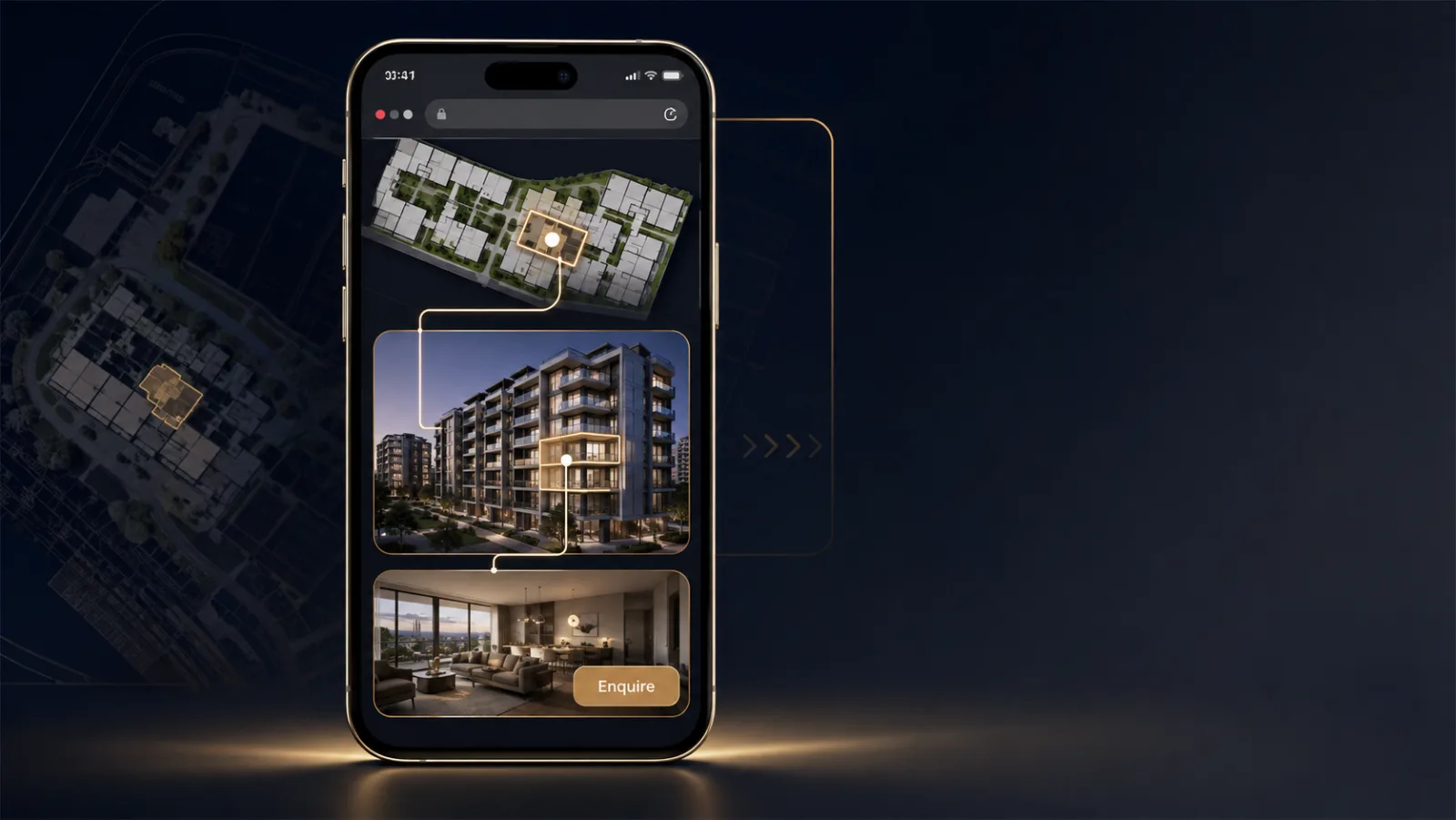
Open a property link on your phone and you can usually tell within a few seconds whether the developer values your time. Some experiences load quickly and get you to the units. Others spin and stutter, asking a mid-range phone on mobile data to run a full 3D environment before you have seen a single price.
Most property traffic is mobile now. The link arrives through WhatsApp, an Instagram ad, an email, a QR code on a hoarding. The buyer opens it between meetings, on a commute, on a patchy connection. A heavy experience punishes exactly that moment, and the visitor leaves before the project has finished loading.
A property experience that only performs on a fast desktop is built for the wrong visitor.
The point is to help buyers decide, not to keep them exploring
It is tempting to treat a digital property experience as a showcase, where the more a visitor explores, the better it has worked. Developers are not paid for exploration. They are paid for enquiries and sales.
The job of the experience is to help a buyer understand the development, find a property that fits, and take the next step. Holding someone inside an impressive environment is not the same outcome as moving them towards a decision.
Time spent admiring the technology is not progress towards an enquiry.
Why an all-3D experience is not always the right one
3D is genuinely valuable. When architecture, views or interiors drive the decision, a flagship tower, a waterfront position, a show home that does not exist yet, a well-made 3D view lets a buyer feel the space before it is built. That value is real, and RegalScene uses it.
The problem is forcing the entire journey to be 3D. A full 3D environment carries a cost the buyer pays: larger downloads, more processing, a heavier load on mobile, and a way of moving around that people have to learn first. For the practical questions that fill most of a buyer's journey, where the building sits, which units are free, how large one is, how to enquire, a heavy view is a slow route to a simple answer.
The trade-offs of running everything through a heavy engine are set out in RegalScene vs heavy 3D engines, and the wider question of when to choose 2D or 3D is worth reading alongside this.
3D should earn its place in the journey, not define the whole of it.
2D and 3D, chosen by purpose
RegalScene combines technologies by what each does best at each stage, rather than committing the whole experience to one:
- Lightweight 2D maps and master plans carry the navigation, from the portfolio down to the site, and stay fast and familiar on any device.
- Focused 3D views appear where spatial understanding adds real value: a building in its context, a view, an interior.
- Floor and unit navigation helps buyers narrow from the whole development to the specific home or space.
- Property information and current availability sit inside the same journey, not on a separate page a buyer has to go and find.
- One clear path runs from discovery to choosing a property and submitting an enquiry.
None of this requires new production. The master plans, renders, floor plans and project assets you already own become the experience, which is the same asset-reuse principle behind interactive 2D.
The right technology at each step, rather than the same technology for every step.
Built for the browser, built for mobile
Mobile-browser performance is a design principle here, not an afterthought. The experience opens from a single link in a normal browser, on a phone, tablet or desktop. There is nothing to download and no app to install, which are the two steps that lose the most visitors before they ever see the project.
Because the structure of the journey stays light, the heavier moments load only when a buyer chooses them. Open a 3D building or a render and it arrives then, not on the first screen. The deep-zoom tiling that keeps large master plans fast in a browser does that work under the surface, and it is a large part of why a web platform, rather than an app, suits how buyers actually arrive.
If it does not open quickly on a phone, from a link, it is not built for how buyers behave.
The buyer journey, end to end
Every element connects into one path:
Portfolio map → Project → Master plan → Building → Floor → Unit → Enquiry
A buyer starts on a portfolio map that can hold several projects at once, opens one, moves through its master plan into a building, down to a floor, and onto a specific unit, with availability and details at each step, then enquires without leaving the experience. The structure of those map, building, floor and unit views is what keeps the path coherent.
Each step answers one question and hands the buyer to the next. Nobody hits a dead end, and nobody has to start again on a separate microsite.
One continuous journey, from the first tap to the enquiry.
From experience to enquiry
For a developer, the value of all this is read on the enquiry form, not the frame rate:
- Less mobile drop-off. A light experience keeps the visitor who would have abandoned a heavy one.
- More enquiries from the traffic you already have. The path to enquire is short and always in reach, so more visitors act.
- Several projects and property types in one journey. A portfolio map connects launches, phases and asset types under one entry point.
- One consistent experience for marketing and sales. The same journey serves the website, campaigns, roadshows and the sales team.
- 3D used selectively. Spend on immersion where it changes a decision, not everywhere.
- Existing assets reused. Master plans, renders and floor plans become the experience, so there is less to produce and less to maintain.
Because the enquiry arrives at the end of a journey, it carries context, which project, which unit, and what the buyer looked at, so the enquiry reaches the sales team already warm.
A lighter journey is not a smaller experience. It is a shorter distance to an enquiry.
See it on your own project
The quickest way to judge this is on a project you already know. Bring a master plan, a render and a unit schedule, and watch the journey run from portfolio map to enquiry, in a browser, on your own phone.
Related reading:
- Interactive 3D Models for Property Sales: Explore a Building in 3D
- 2D vs 3D for Property Sales: Choosing the Right Experience, Not the Most Expensive One
- RegalScene vs Heavy 3D Engines: Web-Native or Unreal for Property Sales
- How Massive Master Plans Stay Fast in a Normal Browser
- One Master Plan, Many Projects: The Developer Portfolio Map
- Map, Building, Floor and Unit Views: How to Display a Property Project Online
RegalScene turns the master plans, renders and floor plans you already have into one lightweight buyer journey, from portfolio map to unit, in any browser with no app to install. See the platform or book a demo.