Tourism real estate has a selling problem that ordinary property doesn't: the product is a feeling spread across a landscape. A buyer of a beachfront villa or a resort suite isn't just buying rooms — they're buying the distance to the water, the walk to the restaurant, the view over the marina. None of that fits in a PDF fact sheet, and all of it is exactly what an interactive destination map shows.
This is Oman's moment for that story: a coastline of resorts, marinas, and heritage destinations being developed along the Arabian Sea, selling to buyers and guests across the GCC and far beyond — most of whom will decide long before they can visit. Here's how the interactive approach works, shown on a live resort demo.
The destination as a navigable map
The entry point is the resort itself — the same aerial render the marketing team already commissioned, made explorable. Hotel buildings and villa zones are outlined and clickable; the marina, mosque, restaurants, and pools sit as labeled points on the map; the Arabian Sea is where it belongs, around everything.
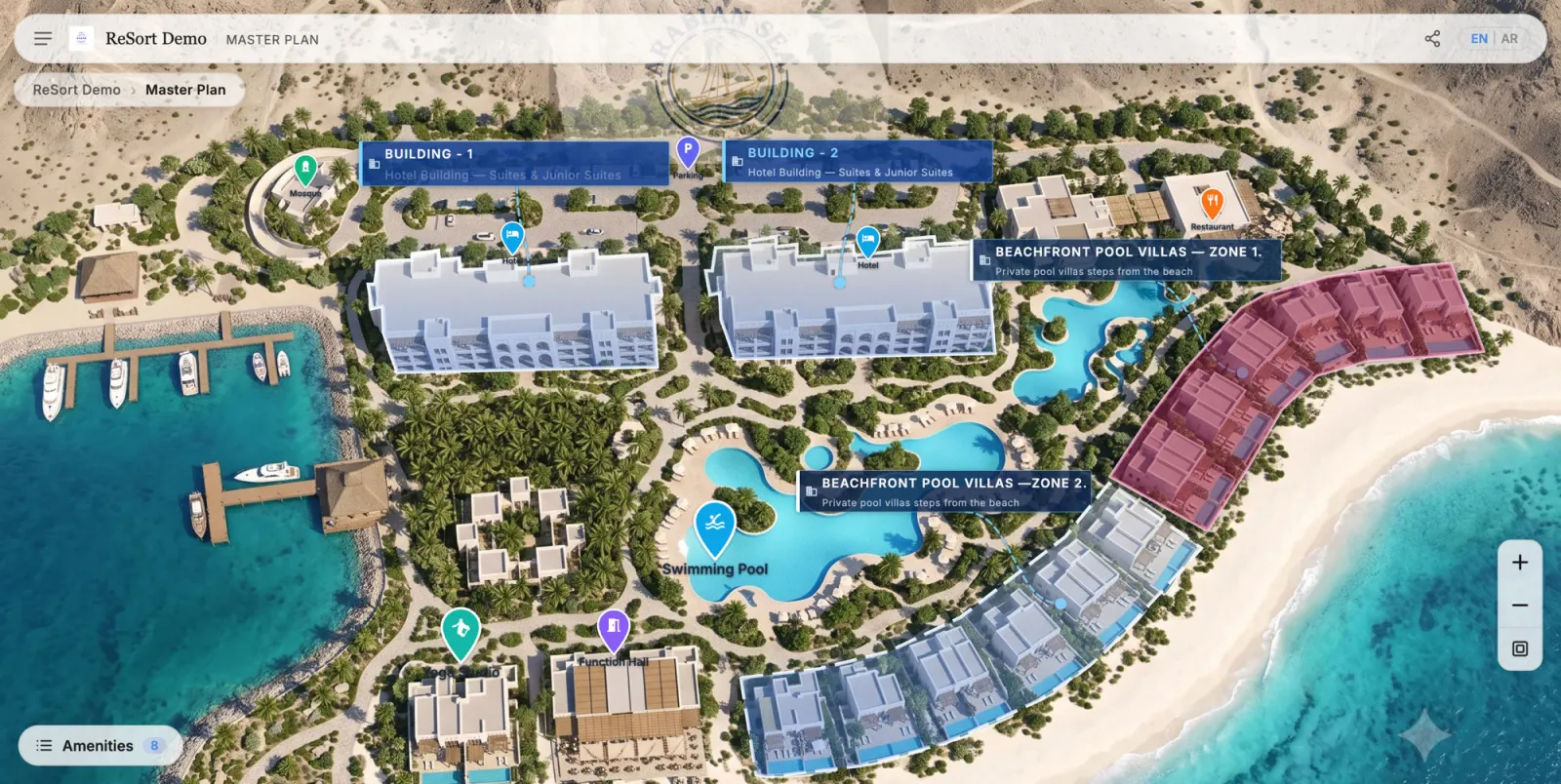
Every label answers a question before it's asked: the hotel buildings carry their suite mix, the villa zones say what they are — private pool villas steps from the beach — and every element is a doorway one click deeper.
Amenities are the product — so they get their own layer
For a resort, the amenity list isn't a footnote; it's half the purchase. The amenities panel organizes everything by category — recreation and sports, wellness, community and family, services — and toggling a category highlights those points on the map itself.
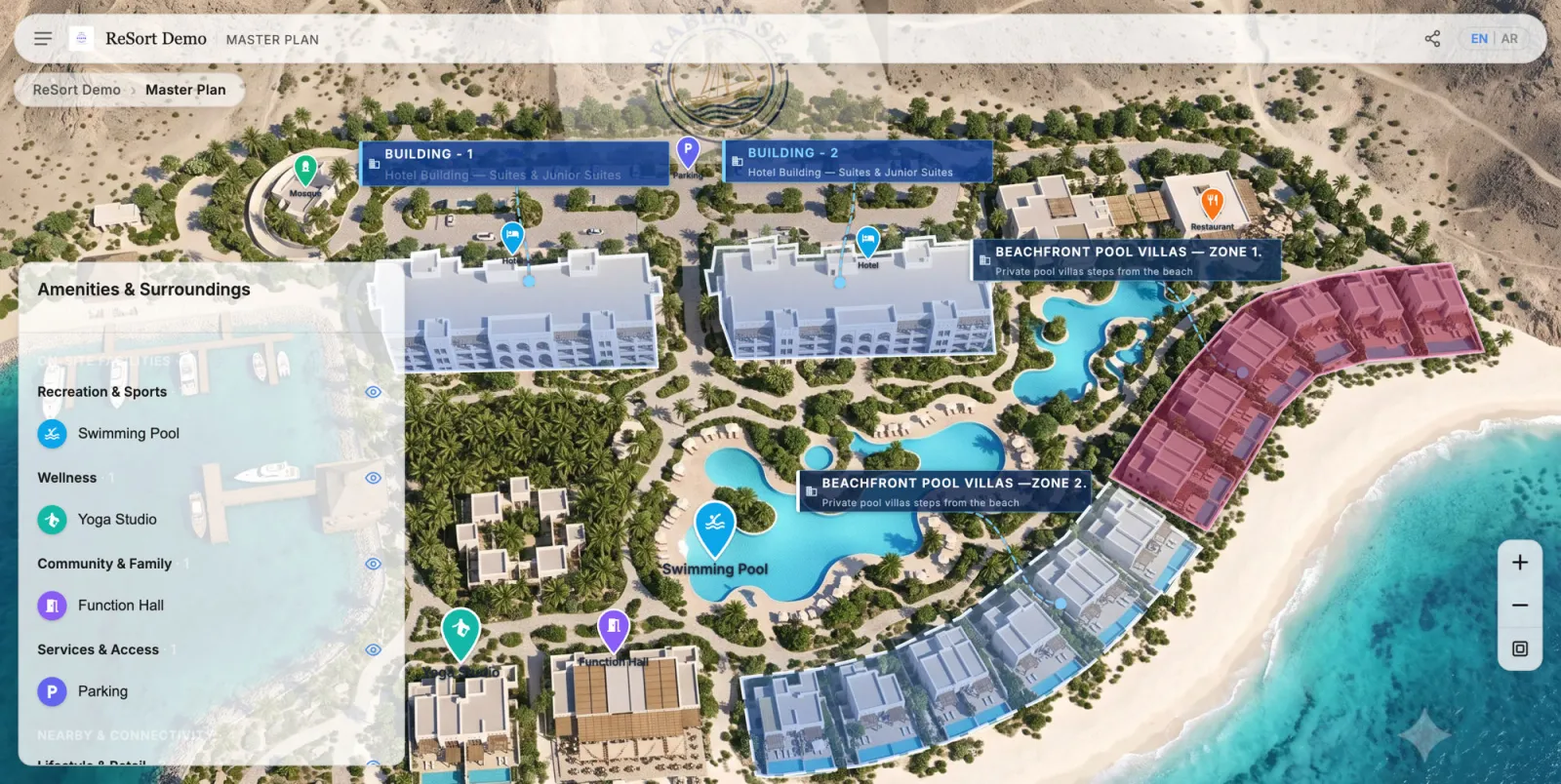
"How far is the yoga studio from Building 2?" stops being an email to the sales office. For family-oriented GCC buyers, seeing the mosque, the kids' facilities, and the function hall in place does more than any brochure paragraph.
Villa zones with real availability
Click a villa zone and the map narrows to the beachfront row — each villa a distinct, selectable shape with its own status underneath. This is where destination marketing becomes destination selling: the buyer who has found their villa on the curve of the beach, checked it's available, and enquired from it is a fundamentally different lead than a brochure download.
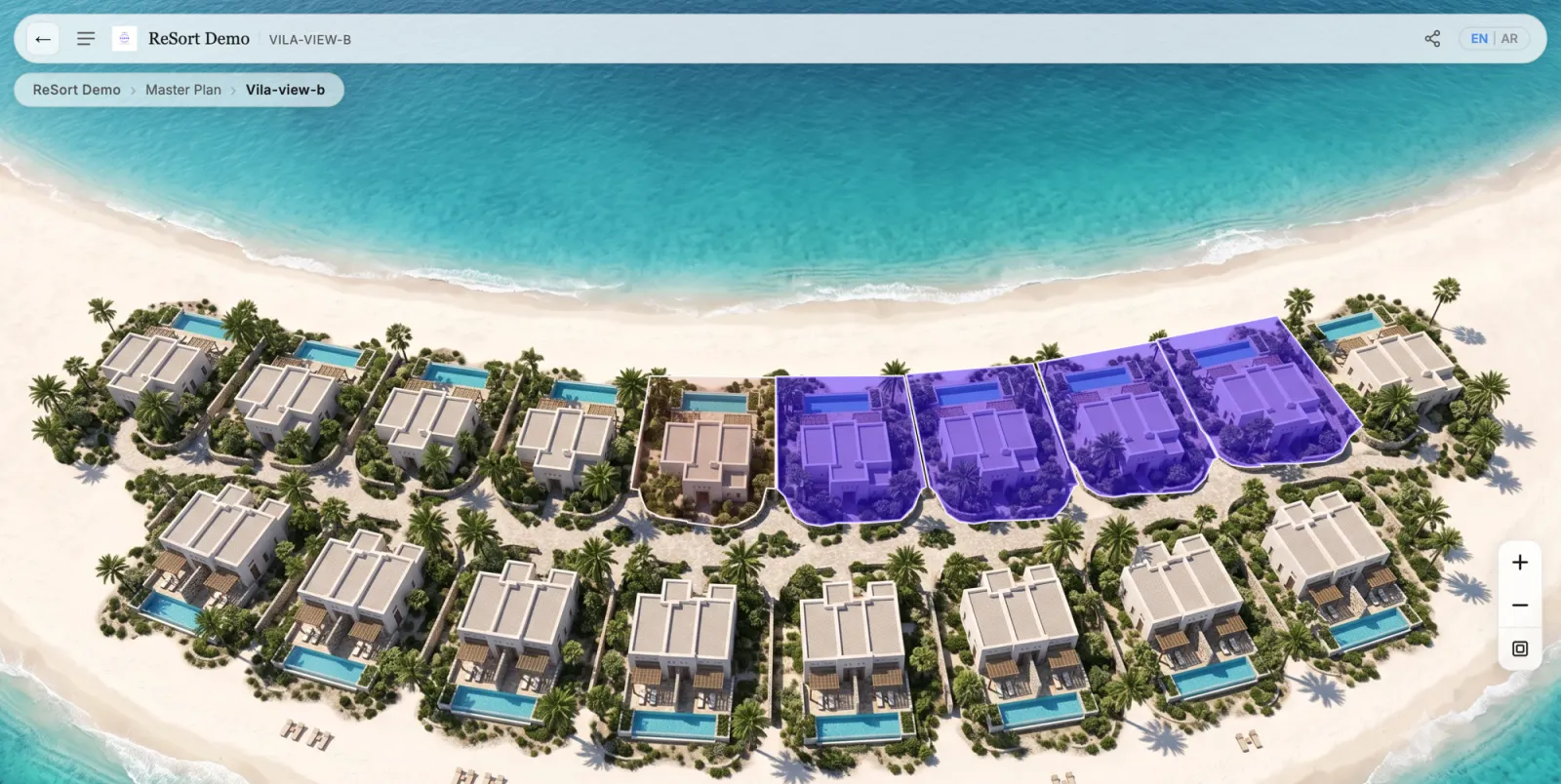
Hospitality inventory needs its own vocabulary — suites, junior suites, pool villas, berths — with attributes like sea-facing or plunge-pool rather than a residential bedrooms-and-bathrooms template. Pricing behaves resort-style too: exact, range, or on request per unit type, the same visibility controls developers use.
Built to travel: QR codes and WhatsApp
A destination's buyers are, by definition, somewhere else. Every level of the experience — the whole resort, a villa zone, one specific villa — shares as a link and a QR code, and opens instantly inside WhatsApp on any phone, nothing to install.
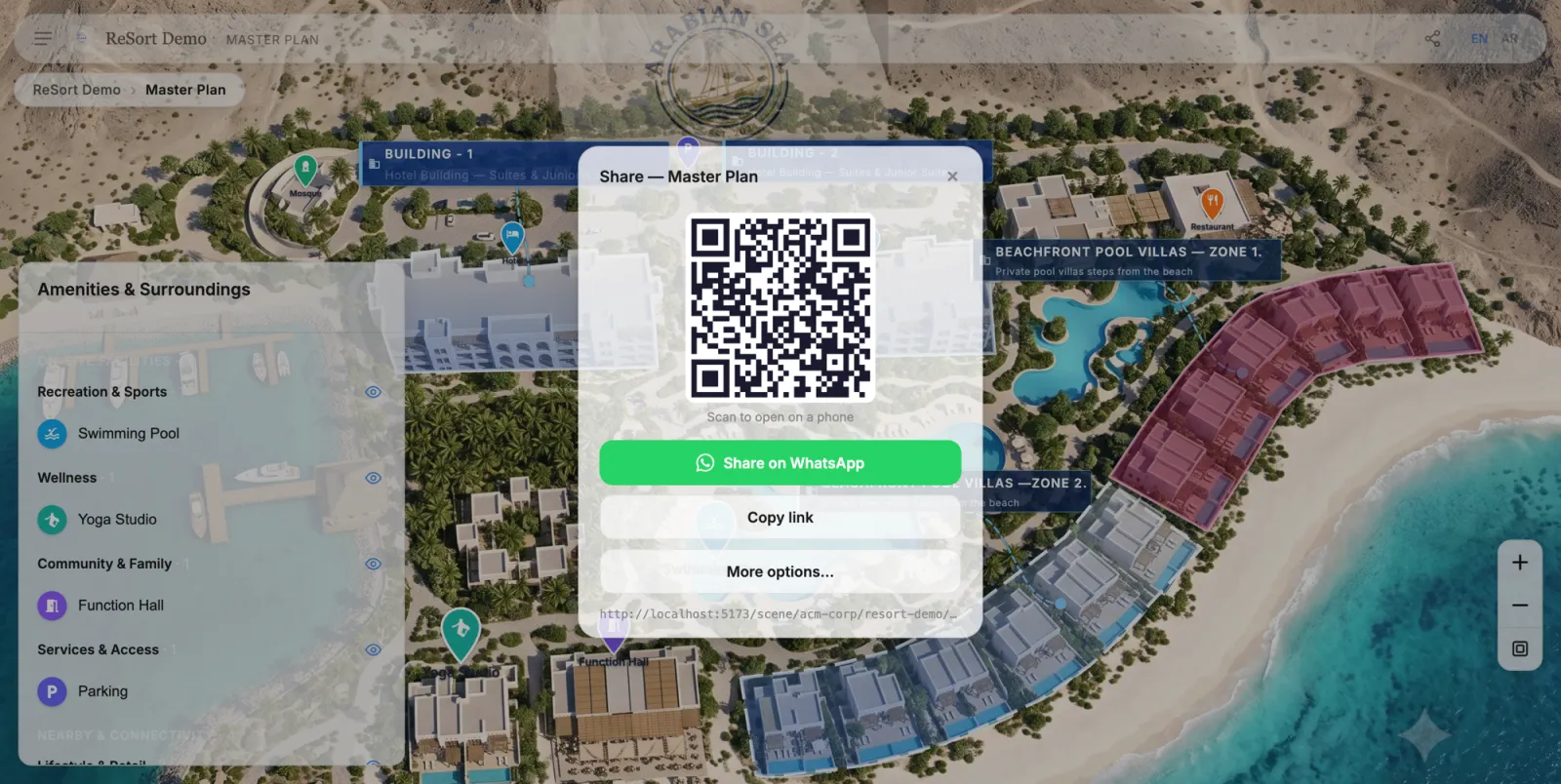
That QR goes on the exhibition stand at a travel fair, the hoarding at the site, the back page of the in-flight magazine. The person who scans it lands inside the resort — in English or Arabic, because the experience is bilingual from the same project, matching how the GCC actually buys.
The same renders, working harder
None of this required new visualization: the aerial, the building views, and the villa imagery are the renders the project already paid for, assembled into a navigable journey with live data underneath. For tourism developments — where the landscape is the product — that reuse goes furthest of all.
Related reading:
- 3D Rendering for Hotel and Resort Marketing
- How Branded Residences Are Sold Off-Plan
- Resort Map or 360 Tour: Which Sells Villas?
- Interactive Property Map for Real Estate Developers: The Complete Guide
- Interactive Master Plan Example: Anatomy of a Real Project, Screen by Screen
- RegalScene Beyond Residential: One Platform for Any Mapped Asset
RegalScene turns resort and destination renders into bilingual interactive experiences — amenity maps, villa availability, contextual enquiries, QR and WhatsApp sharing. Book a demo.