For most property, a 360 tour is a nice-to-have. A buyer standing virtually inside a two-bedroom apartment on the eleventh floor learns roughly what they already assumed.
Resorts are the exception. When the product is a villa with the water on one side and a hillside on the other, standing there virtually tells the buyer something a plan cannot: what they will actually look at. That is why hospitality developers take 360 seriously, and why much of the vendor market in Southeast Asia and the Gulf sells 360 capture as the whole answer.
It is half of one. The generic comparison between tours, renders and master plans applies across all property; this is the narrower hospitality version, where the 360 case is strongest and the gap it leaves is most expensive.
What each one is genuinely good at
A 360 tour places the buyer inside a specific point. At a resort that point carries real information: the aspect, the tree line, how close the neighbouring villa sits, what the pool looks at. It sells the experience the brand is promising, which is the reason the buyer is paying a premium.
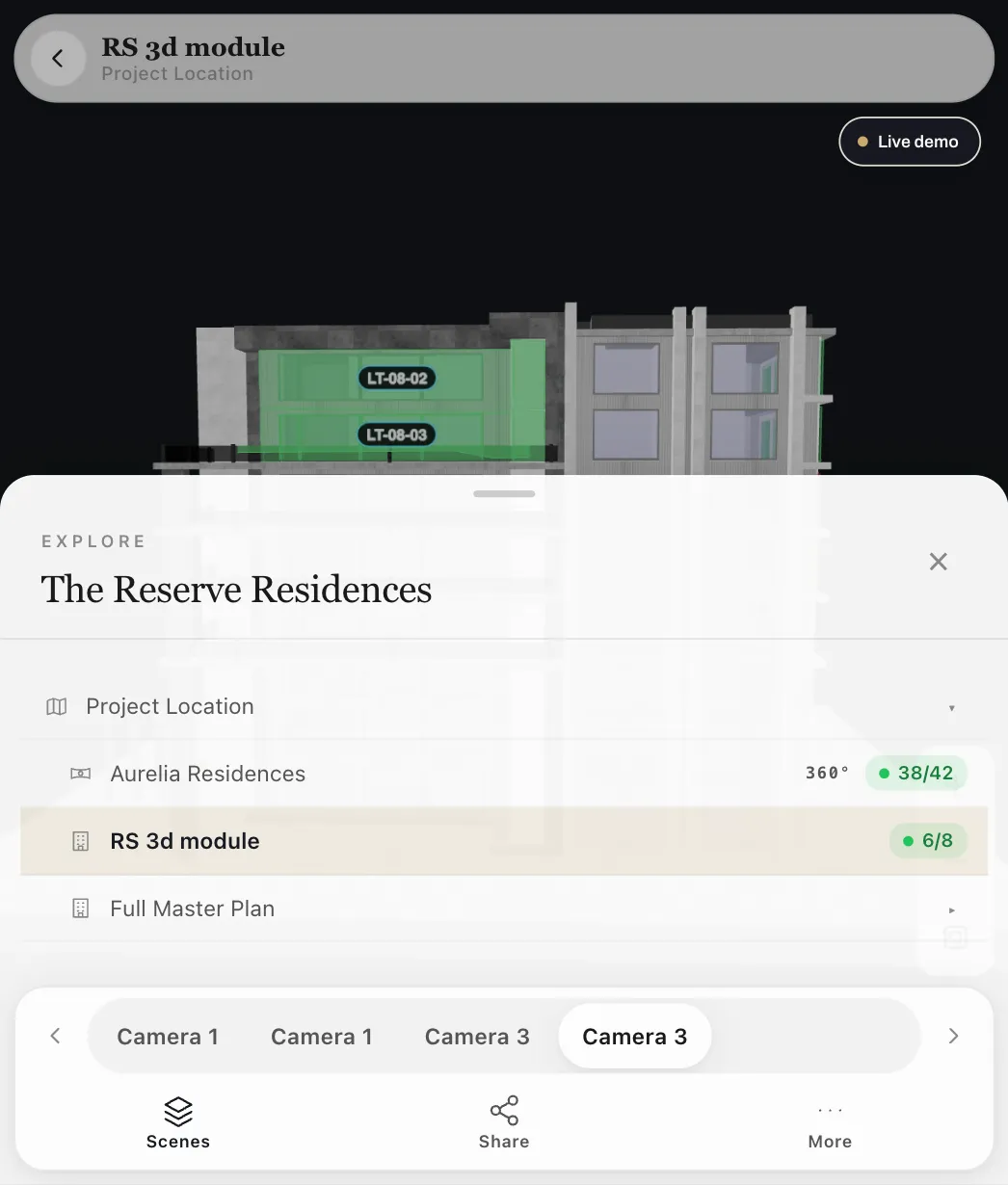
An interactive resort map answers where things are and what is left. Buyers pan the site, find the beach club and the spa marked, open a villa cluster, and read live status on each unit. It sells position, and position is what the price difference between two identical villas is made of.
These are different jobs, and the buyer needs them in a specific order. Position first, because it determines which villa they care about. Immersion second, because it confirms the one they chose.
The question a 360 tour cannot answer
Put a buyer in a beautifully captured villa and they will ask, within a minute:
- Is this one still available?
- Which villa is this, on the plan?
- What does it cost, and what is next to it?
A tour has no answer. Tours are captures, not inventory: the file does not know what has been reserved since it was shot, and reshooting when phase two releases means paying the capture cost again. That is the structural weakness of buying 360 alone: the asset is fixed at the moment it was taken, while availability changes weekly.
For a project that releases in tranches, this compounds. Every phase either gets new capture or gets represented by the last one.
The question a map cannot answer
Honesty in the other direction: a map does not tell a buyer what it feels like to be there. Amenity markers and unit status are decision infrastructure, not emotion. For a resort selling on atmosphere, a map alone under-sells the product.
This is exactly why a project with only a masterplan tends to lose the buyer at the final step, and a project with only a tour loses them at the first.
Why much of the market sells you half
The vendor landscape explains a lot of the confusion. A large part of it comes from photography and capture: studios whose core skill is shooting 360 and stitching it well. They sell what they are good at, and they are genuinely good at it.
What a capture studio cannot usually supply is the layer underneath: live unit inventory, status that updates without a reshoot, enquiries that arrive attached to a specific villa, and the same experience embedded across agency channels. That is software rather than photography, and expecting one vendor to be excellent at both is usually how projects end up with two disconnected assets.
How to combine them without paying twice
The pattern that works for resorts and destination assets:
- The map is the spine. The masterplan aerial you already commissioned becomes navigable, amenities marked, villa clusters opening into units with live status.
- 360 goes where standing there matters. One or two signature villa types, the beach club, perhaps the arrival. Not every unit: the return on the tenth capture is close to zero.
- The enquiry sits on the unit, not the tour. Whatever the buyer was looking at when they decided, the enquiry carries it.
- New phases update the map, not the captures. Availability and new clusters are data changes. The 360 library stays as it is.
Capture the places that sell the feeling; map everything that sells the decision. For a branded residence or resort villa programme, that ordering is usually the difference between an asset buyers admire and one they transact on.
Related reading:
- Virtual Tour vs 3D Render vs Interactive Master Plan: Which Sells Property Better?
- Virtual Tours for Tourism Destinations: Resorts, Hotels & Attractions
- How Branded Residences Are Sold Off-Plan
- 3D Rendering for Hotel and Resort Marketing
RegalScene provides the map layer: navigable resort masterplans, live villa availability, 360 views placed inside the journey, and enquiries that carry the unit the buyer chose. See the property sales platform or tell us about your project.