Look at a resort launch budget and the digital line item is rarely the problem. The show villa is the problem. So is the sales pavilion it sits next to, and the render and film package commissioned months before either one exists.
Those are the numbers that decide whether a launch is expensive. Yet the digital sales experience is usually the item that gets the most scrutiny, the most competitive quotes, and the longest approval chain, because it is the one nobody has bought before.
This is not a pricing guide. If you want category ranges, what an interactive master plan costs and what a virtual sales gallery costs cover them properly. This is about where a resort launch actually spends, and which questions change the digital quote.
What a resort launch spends money on
A hospitality launch carries costs a residential tower does not:
- The show villa. Built to final specification, furnished, landscaped, often on a site that has to be prepared for it alone. Frequently more than one, because villa types differ enough that buyers want to see theirs.
- The sales pavilion. A structure whose only job is to host the presentation until the resort opens, then be removed.
- The render and film package. Hospitality commissions more CGI than almost any other property category, because the product is an experience rather than a floor area.
- The roadshow programme. Branded and resort schemes sell internationally, which means flights, venues and staff in the buyer's market.
Every one of those is a physical commitment made before a single villa is sold. The digital layer is the only item on that list that can be changed after launch without rebuilding something.
The show villa is the expensive decision
A show villa earns its cost for the buyer who stands in it. Materials, ceiling height, the way light falls at four in the afternoon. No screen substitutes for that, and any vendor who claims otherwise is selling you something.
What the show villa cannot do is scale. It answers "what does this feel like" for one unit type, for buyers who travel. It does not answer "which villas are still available in phase two", "how far is this one from the beach club", or "which of these three faces the water". Those are the questions that come first, from buyers who have not yet decided to get on a plane.
Building a second show villa to answer positional questions is the most expensive way to answer them. That is the trade the digital layer is actually competing on, not the emotional one.
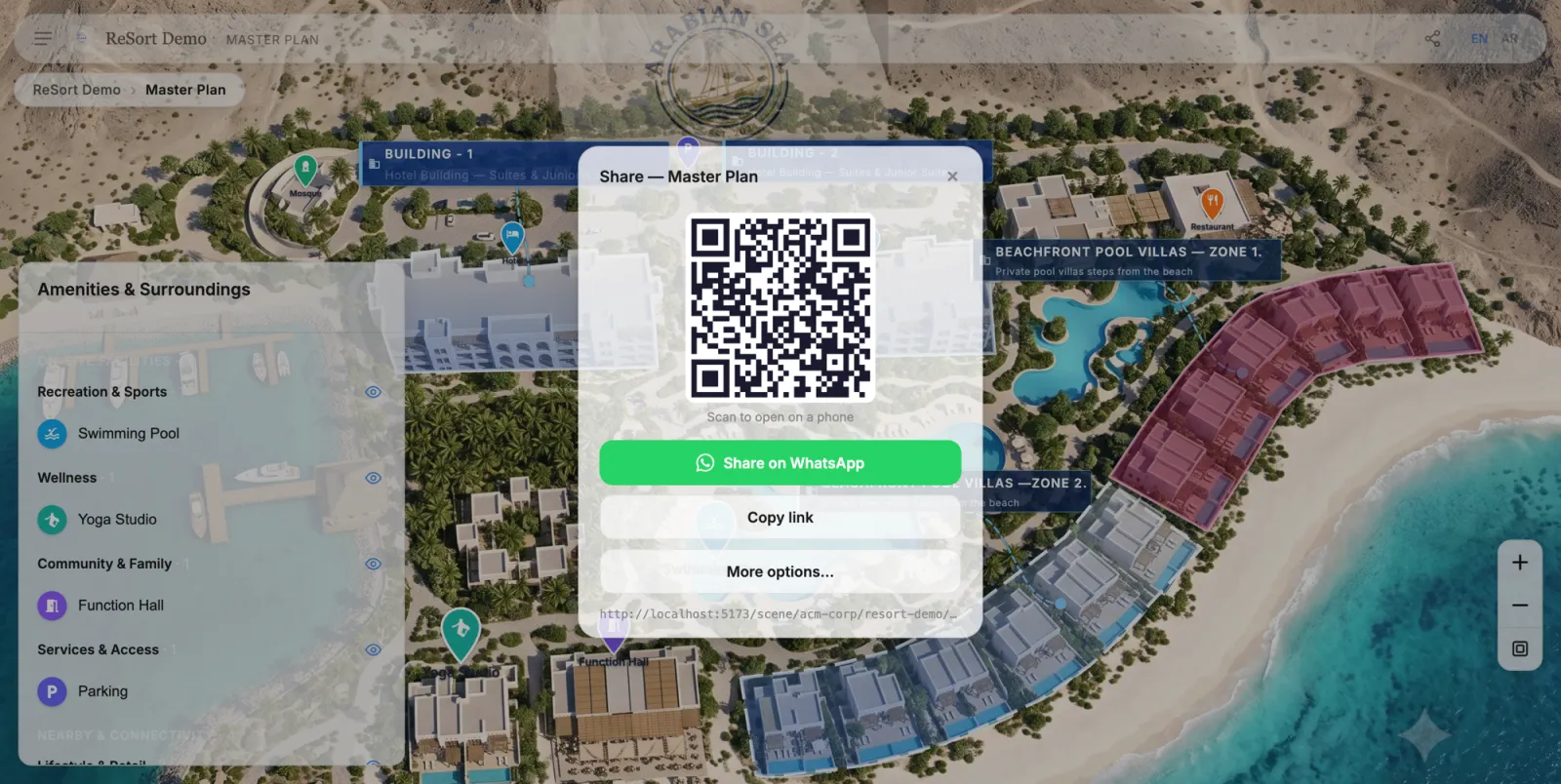
What actually moves a resort quote
Four answers change a hospitality quote more than any feature list:
Phasing. Resorts release in tranches. An experience that shows the current release honestly, and can be updated when the next one opens, is scoped differently from a one-time build of the whole masterplan.
Operator brand standards. If a hotel operator has requirements for digital presentation, they are cheaper to meet at the start than to retrofit. White-label delivery on the developer's own domain is the normal arrangement for branded residences.
Languages. International buyer sets need more than one. Each language is content to keep current, not just a translation done once.
What the render package already covers. This is the big one. Hospitality projects have usually already paid for the aerial, the elevations and the interior sets. Assembling those into something navigable costs materially less than commissioning views nobody shot, which is why reusing the renders you already paid for is the honest starting point for a resort.
Where the digital layer takes cost out
Not by replacing the show villa. By reducing what the show villa and the roadshow have to carry:
- Buyers arrive at the pavilion having already narrowed to two or three villas, so the presentation starts further along.
- A roadshow stand runs the same experience that runs on the website, rather than a separately produced deck.
- Agency partners in other markets work from current availability instead of a price list emailed in March.
- Phase two does not need a new build to be marketed, only an update.
The saving is in what you no longer have to produce separately, not in what you stop building.
What to ask before you sign either
Ask the digital vendor what happens when phase two releases, and who does it. Ask whether availability comes from your inventory or from a file someone re-uploads. Ask what the experience looks like on a phone in a market with poor connectivity, because that is where a remote buyer will open it.
And ask the show-villa question honestly: how many buyers will physically visit before they reserve? If the answer is "most of them", build the villa and keep the digital layer light. If the answer is "we are selling to three countries", the proportions are different — and worth deciding deliberately rather than by inheritance from the last project.
Related reading:
- How Much Does an Interactive Master Plan Cost?
- How Much Does a Virtual Sales Gallery Cost?
- How Branded Residences Are Sold Off-Plan
- Virtual Sales Gallery vs Physical Showroom
RegalScene assembles the masterplan, building views and unit inventory a resort project already has into one interactive sales experience, updated per phase and embeddable across operator and agency channels. See the property sales platform or tell us about your project.