A buyer looking at a large Johor township usually meets it as a PDF. A master plan render, a few precinct pages, a price list in a separate file, and an availability sheet that was accurate the week it was sent. The development might span thousands of acres and release over a decade, and the buyer is asked to hold all of that in their head from a flat image. The first question anyone asks about a township, where is this inside all of that, has no good answer on paper.
This is the project type an interactive master plan was built for. Here is what it changes for a Johor developer, using only what a buyer actually does.
The Johor context: scale, and a cross-border audience
Johor runs some of the largest master-planned developments in the country. A development such as Forest City in Iskandar Puteri sits on roughly 7,000 acres across four islands and has been designated a Special Financial Zone. Nearby, Medini Iskandar Malaysia covers about 2,230 acres and is often described as Malaysia's largest single urban development, planned for a population near 450,000. Gerbang Nusajaya spans around 4,000 acres and releases in phases over decades. A township such as Horizon Hills spreads low-density homes across eleven precincts.
Developments at this scale illustrate the type of project where a static master plan stops helping a buyer well before they reach a decision. There is simply too much to read off one image, and too much of it changes.
Johor also sells outward. Many buyers and agents sit across the causeway in Singapore, and others in Hong Kong, China, and the wider region. A brochure emailed to a dozen agencies in three markets is a dozen copies going stale at different speeds. The coordination problem this creates is the subject of a separate look at multi-agency distribution for Malaysian developers; here the focus is the experience the buyer meets first.
Where a static master plan stops helping
At township scale, static assets fragment. The brochure becomes a library of brochures, one per product and precinct. The price list becomes a spreadsheet nobody fully trusts. Floor plans live in one file and availability in another, so a buyer who likes a unit still cannot tell whether it is available without messaging an agent, who checks a WhatsApp group, who checks with the office.
The deeper problem is that a township is several products at once. Villas, apartments, shop offices, and land parcels each have their own buyer, their own pricing logic, and their own sales pace. A single flat plan cannot lead a villa buyer and an apartment investor to different places. It shows everyone the same picture and leaves each of them to work out where they fit.
A township buyer is not choosing the township. They are choosing a precinct, a street, and a unit inside it, and static assets cannot take them there.
A buyer journey through a Johor township
An interactive master plan replaces that flat image with a path the buyer walks themselves:
- Master plan. The whole development, with precincts outlined and clickable, amenities and connectivity as landmarks, and phases marked. This level sells the township story, connectivity, and scale, rather than asserting it.
- Precinct. Click a precinct and the view narrows to that cluster: its character, its phase, its product type. A villa buyer never has to wade through apartment floor plans.
- Building or villa cluster. Inside a precinct, individual buildings or villa clusters carry their own status.
- Floor. For the high-rise products, a stacking view leads to a floor plate, and the floor plate to units.
- Unit. Every unit shows availability on the actual home or apartment: available, reserved, or sold, in color, with details and a price under the developer's display policy.
- Enquiry. The buyer enquires from the unit they want, and the lead arrives carrying which precinct, which building, and which unit they were looking at.
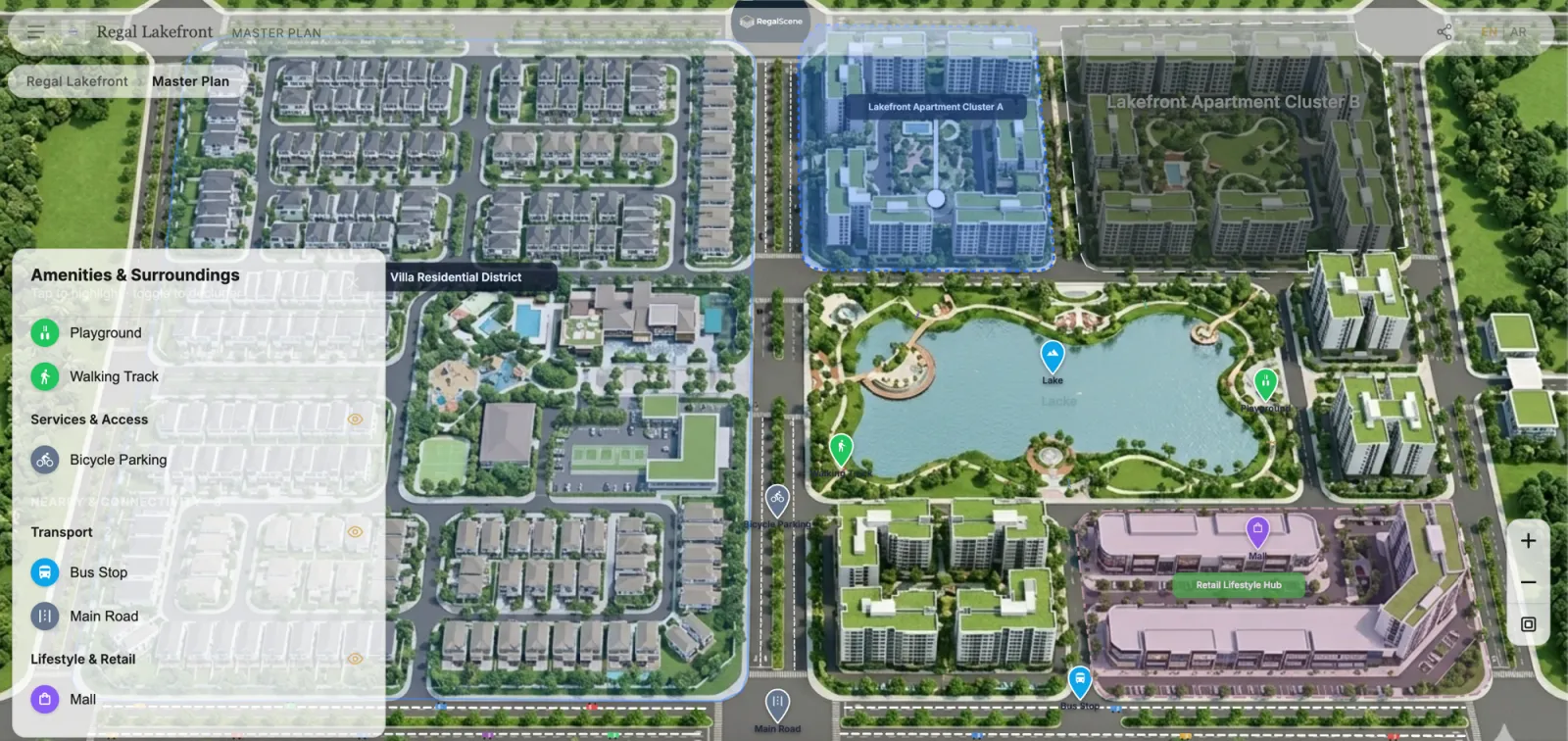
From a township of thousands of units, a buyer reaches their shortlist of two homes in about a minute, following the same map, building, floor, and unit structure the rest of the experience uses.
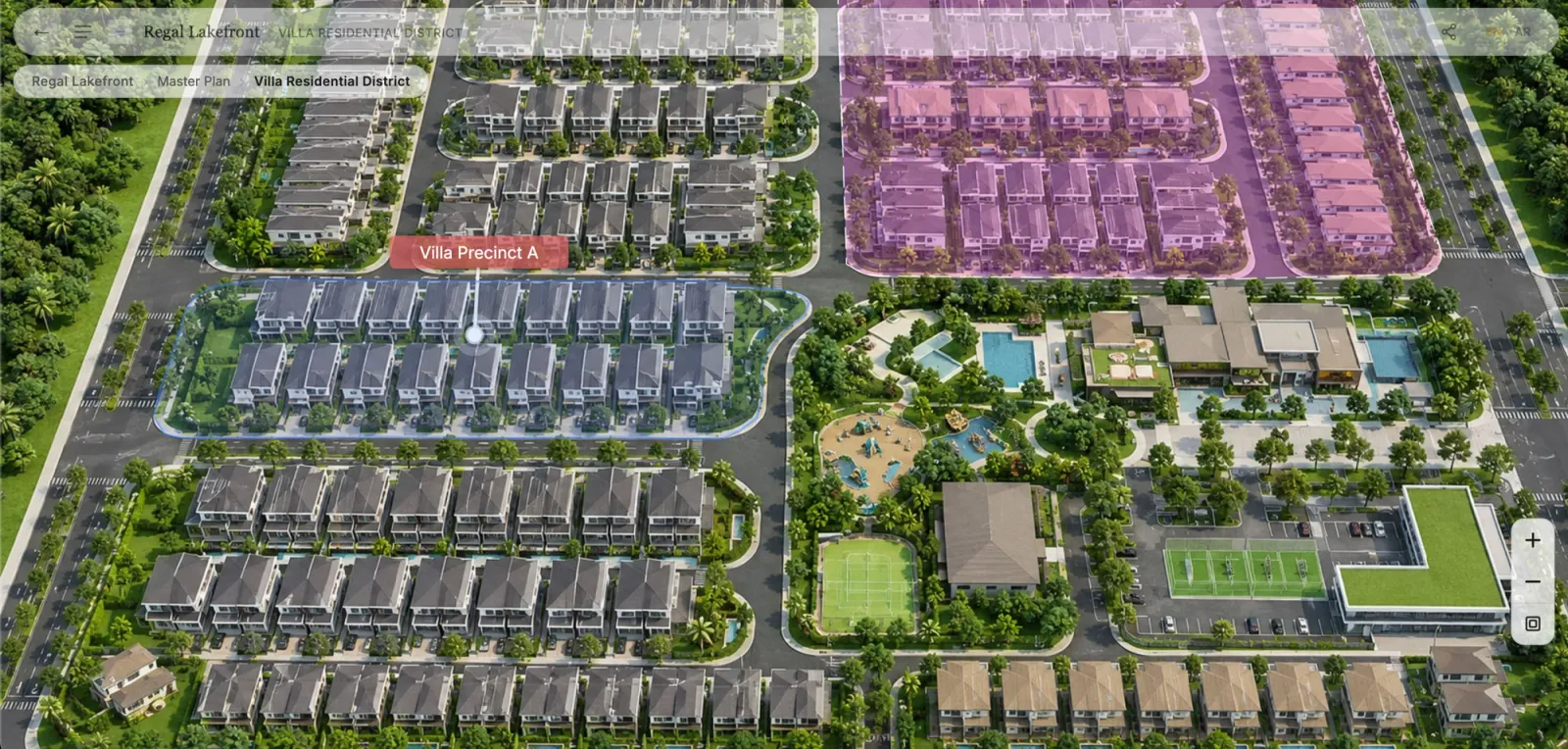
How RegalScene could support a development of this scale
For a development structured like the large Johor townships above, a buyer journey could begin at the master plan and move into individual precincts, buildings, floors, and available units, all from one link. The precincts that release later stay dark until launch day, then publish into the same link every buyer and agent already holds. No new microsite, no re-sharing.
Underneath, each unit drawn on the plan is tied to inventory. The green, amber, and red a buyer sees are current status, not paint on a render, so a sold villa reads as sold the moment the sales team updates it, with nothing to re-export. At precinct level, buyers see honest roll-ups, such as how many villas in a cluster remain available, which is the trust signal off-plan buyers read most closely.
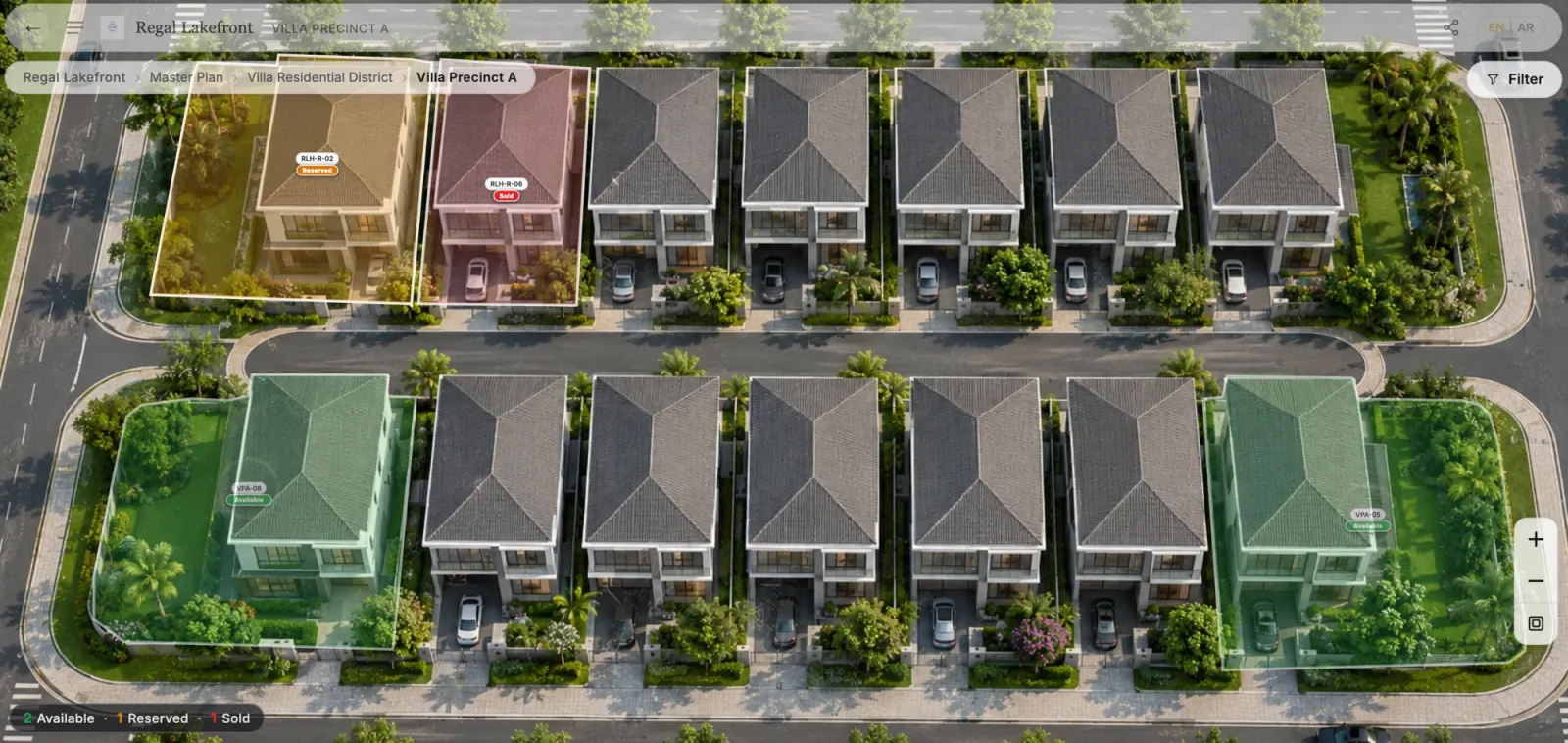
None of this implies any relationship with the developments named above. They stand only as public examples of the scale at which an interactive buyer journey earns its place.
A bigger township does not mean more views
This is the point most developers expect to be wrong, and it matters for the budget. A 7,000-acre township does not require a view per acre or a view per unit. RegalScene scopes and quotes each project around what will be delivered and operated, not a unit record.
A large township could begin with one master-plan view. Additional views are introduced only where the buyer journey needs deeper exploration: a precinct that deserves its own aerial, a tower whose floors buyers want to browse, a 360 view of a completed show unit. Thousands of units can sit inside a handful of views, because the units are inventory on those views, not views themselves. The reasoning behind scoping projects rather than charging per unit goes deeper, and the pricing page sets out what shapes a quote.
Physical project size does not set the scene count. The depth of the buyer journey does.
Built for the phone in a Johor or Singapore buyer's hand
A cross-border buyer meets the project on a phone, on mobile data, from a link in a message. RegalScene keeps that true. The experience opens in a normal browser with nothing to install, and a complex township still loads quickly on a standard smartphone, for the same reason large master plans stay fast in a browser: deep-zoom tiles and light overlays, not a heavy download.
Because it is a link, the same live master plan reaches an agent briefing a room in Singapore, an agency running WeChat groups in Hong Kong, and a walk-in buyer at the sales gallery in Johor Bahru. Each of them shows the current project, not a snapshot from two weeks ago.
What this asks of the developer
Three practical things make a township experience work at this scale. The inventory model has to hold different products honestly, so villas carry plot sizes, apartments carry floors, and shop offices carry frontage, without forcing everything into an apartment template. Publishing has to be phase-aware, so future precincts stay dark and then go live into the existing link. And the display policy has to be the developer's decision, so whether agents and buyers see prices is set centrally, not left to each agency.
For a township that sells for a decade, the interactive layer is a small line against the render and media budget, and it serves every phase rather than one launch window. Which precincts draw attention also informs the product mix of the next release, turning the sales tool into a read on demand.
See it on a development you know
The fastest way to judge this is on a project you understand. Bring a master plan and a unit schedule for a Johor township, and watch a buyer move from the whole development to a single available villa to an enquiry, in a browser, on a phone.
Related reading:
- Property Marketing in Malaysia: Virtual Sales Galleries and Multi-Agency Sales
- Digital Sales Galleries for Johor Bahru Developments
- Interactive Master Plans for Townships and Mixed-Use Developments
- Map, Building, Floor and Unit Views: How to Present a Project Online
- How Massive Master Plans Stay Fast in a Normal Browser
- Why RegalScene Isn't Priced Per Unit
RegalScene turns the master plans, floor plans, and renders Johor developers already have into one interactive sales experience, from master plan to unit, in any browser. See the platform or tell us about your project.