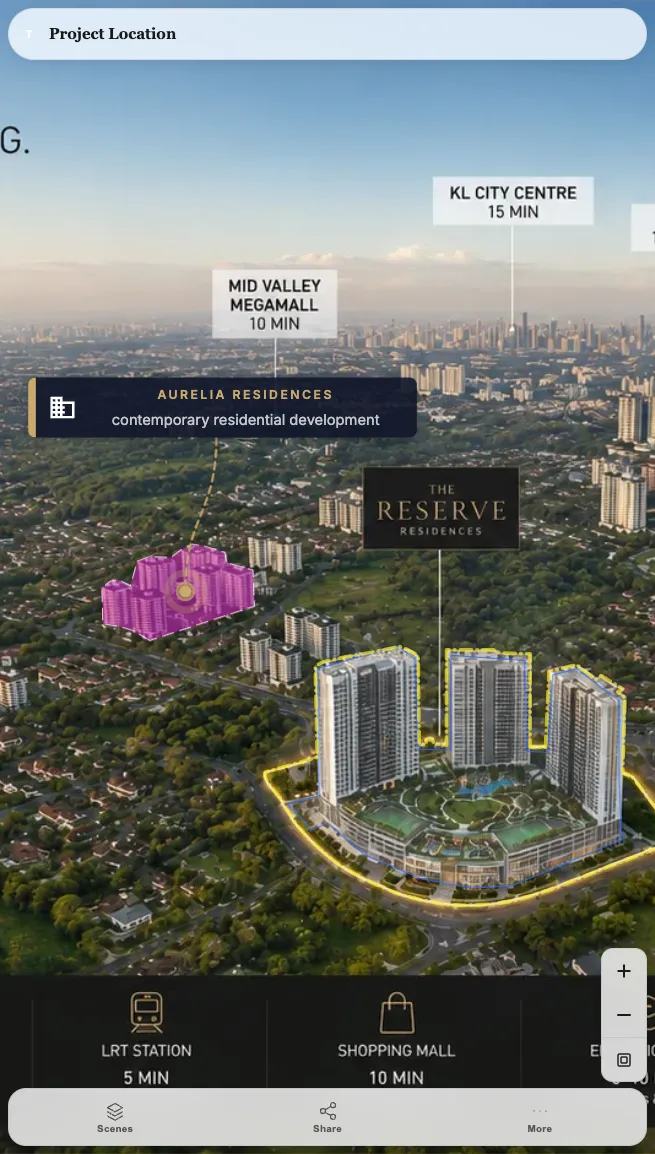
A serious buyer for your project might be three time zones away, holding a phone at midnight, and they will decide whether to enquire before they ever consider a flight. They are not being difficult. Cross-border and out-of-town buying is now ordinary, and the sales gallery visit that used to come first has moved to the end of the process, if it happens at all. The question for a developer is no longer how to get that buyer into the room. It is whether your project gives them enough to decide while they are still at their desk.
A brochure does not. A price list does not. What a distant buyer needs is the closest thing to walking the project themselves, and that is now something you can hand them through a link.
The buyer who decides without ever visiting
The old sequence assumed proximity. A buyer saw an ad, visited the sales gallery, walked the show unit, and signed. Every step depended on being physically near the project. That sequence still exists, but it no longer describes how a large share of buyers actually behave. A buyer in Singapore looking at Kuala Lumpur, a buyer in Hong Kong looking at the Gulf, or a buyer two states away looking at a coastal launch will do almost all of their deciding remotely.
For those buyers, the sales gallery is not step one. It is confirmation of a decision they have mostly already made online, and sometimes it is skipped entirely.
If your project cannot be understood from a distance, you are invisible to the buyer who was never going to visit first.
Exploration is the walkthrough now
The reason a show unit works is that it lets a buyer understand the whole before committing to a part. They get a feel for how the development fits together before picturing the one unit they would actually buy. An interactive master plan does the same thing without the travel: the buyer starts at the full development, moves into a building, opens a floor, and lands on a unit, following the same path from master plan to unit a sales agent would walk them through in person.
That path is what a static gallery of renders can never give. Renders show a buyer what a place looks like. Exploration lets them understand where they would actually live, which floor faces the water, and which units are near the amenities they care about. For a remote buyer, that understanding is the difference between a vague interest and a shortlist.
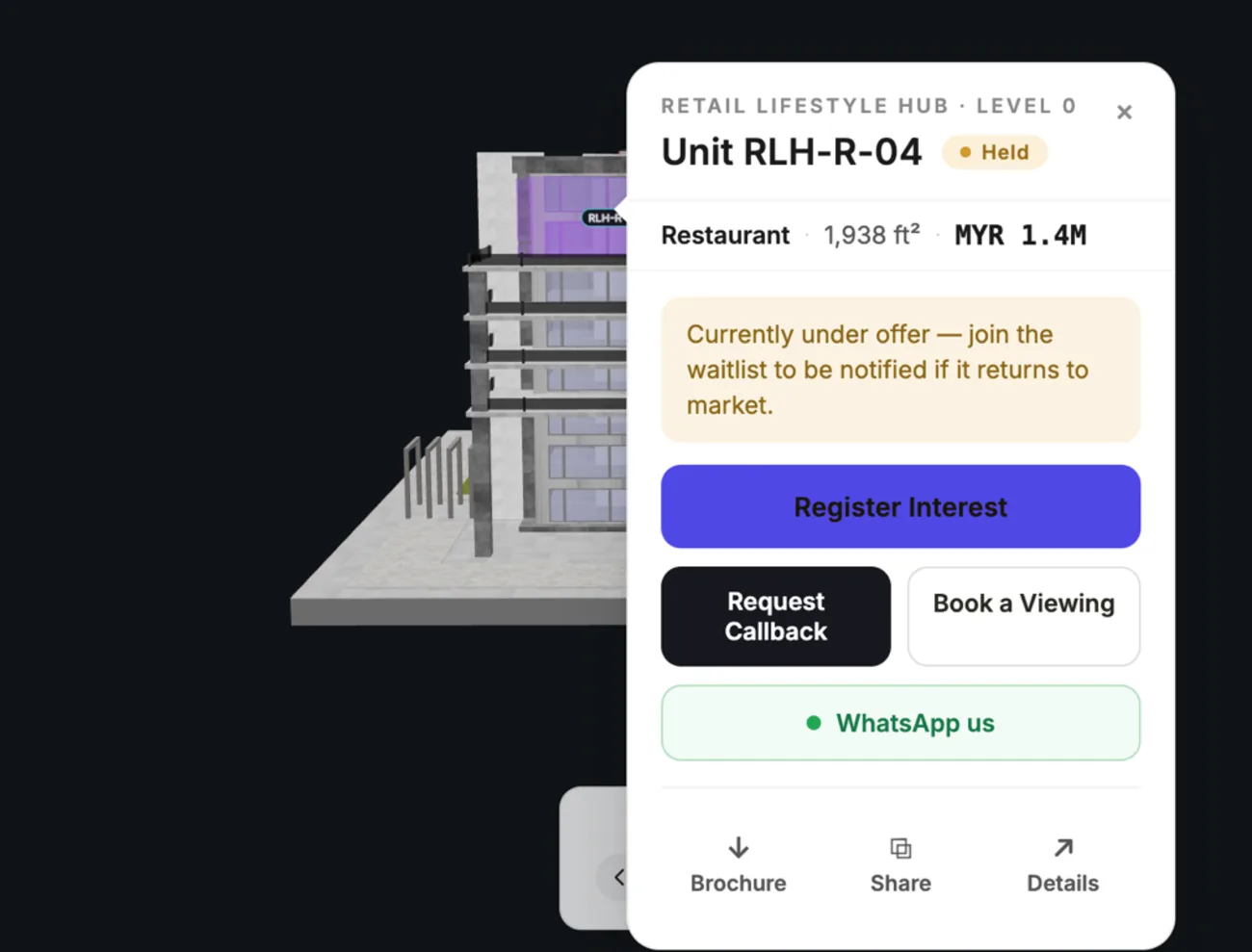 Live demoExplore a unit the way a distant buyer wouldopens the interactive RegalScene demo in a new tab
Live availability turns looking into deciding
A distant buyer's biggest quiet fear is wasting effort on something that is already gone. A brochure cannot answer whether a unit is still available, so the buyer hesitates, sends an email, and waits a day for a reply that may say the unit sold last week. Every hour in that gap is a chance to cool off.
When availability is live inside the experience, that gap closes. The buyer sees which units are open right now, which are reserved, and which are sold, and they act while the interest is warm. Showing exact prices, a range, or price-on-request stays your decision per market, so the same experience can be direct in one country and discreet in another without a second build.
A remote buyer commits when they trust that what they are looking at is real and still on the market.
The enquiry should carry what they explored
The follow-up call to a buyer in another time zone is hard to get right. You may have one chance, at an awkward hour, and a generic script wastes it. It does not have to be that way. When the enquiry arrives from inside the experience, it can carry what the buyer actually explored: the units they opened, the floors they compared, the price band they filtered to, and how long they spent.
A lead that arrives with its context changes the call. Instead of asking a stranger what they are looking for, your team already knows, and the conversation starts where the buyer left off. Across a time-zone gap, where every contact costs more to arrange, starting warm is worth more than it is for a local walk-in.
A distant lead you can follow up with precision is worth more than ten you have to start from zero.
Distribution gets the experience to them; the experience is why they buy
There is a related question that deserves to stay separate: how the experience physically reaches a buyer's market. Often it travels through local partners, and selling through agency networks online is how a project in one country gets in front of buyers in another. That is the distribution side, and it matters.
But distribution only decides whether the buyer sees your project. It is the experience that decides whether they act on it. An agent in Singapore or a partner reaching Chinese buyers can put your project in front of the right audience, but if what lands is a PDF, the same old hesitation returns. The reach is only as good as what the buyer finds at the end of the link.
Getting seen and getting bought are two different problems, and the immersive experience solves the second one.
One link, any device, any time zone
A remote buyer meets your project on whatever screen they have and in whatever moment they have it, often a phone, late, after work. The experience has to hold up there, not only on a sales gallery display. It should open fast on a mid-range phone, read cleanly in the buyer's own language, and let them explore without an app to install or a form to clear first.
The link itself travels through the channels the buyer already lives in. A local agent can drop it into WhatsApp, WeChat, LINE, or Zalo, and it opens in the app the buyer had in hand a second earlier. There is no download, no login wall, and no reason to put it off until they are back at a computer they may never open for this.
The buyer who will never fly to your sales gallery can still spend twenty minutes inside your project tonight, on the phone in their hand.
The RegalScene Approach
You can sell to buyers you will never meet in person when the project, its live inventory, the buyer's exploration, and the enquiry are one connected experience rather than four disconnected assets. RegalScene is built for exactly that: one immersive experience that covers a project end to end, with availability current in one place, price visibility set per market, and every enquiry arriving with the units and floors the buyer explored attached.
The developers winning distant buyers are not the ones with the glossiest brochure. They are the ones whose project can be understood, trusted, and acted on from anywhere, before anyone books a flight.
Related reading:
- Sell Property Through Agencies Online
- From First Click to Unit Selection: The Online Property Buyer Journey
- Contextual Leads in Real Estate: Why Source and Intent Matter
- Digital Showflats and New Launch Marketing in Singapore
RegalScene connects visual exploration, live inventory, and lead capture into one platform for property developers. See how it works or contact us to sell your next project to buyers anywhere.