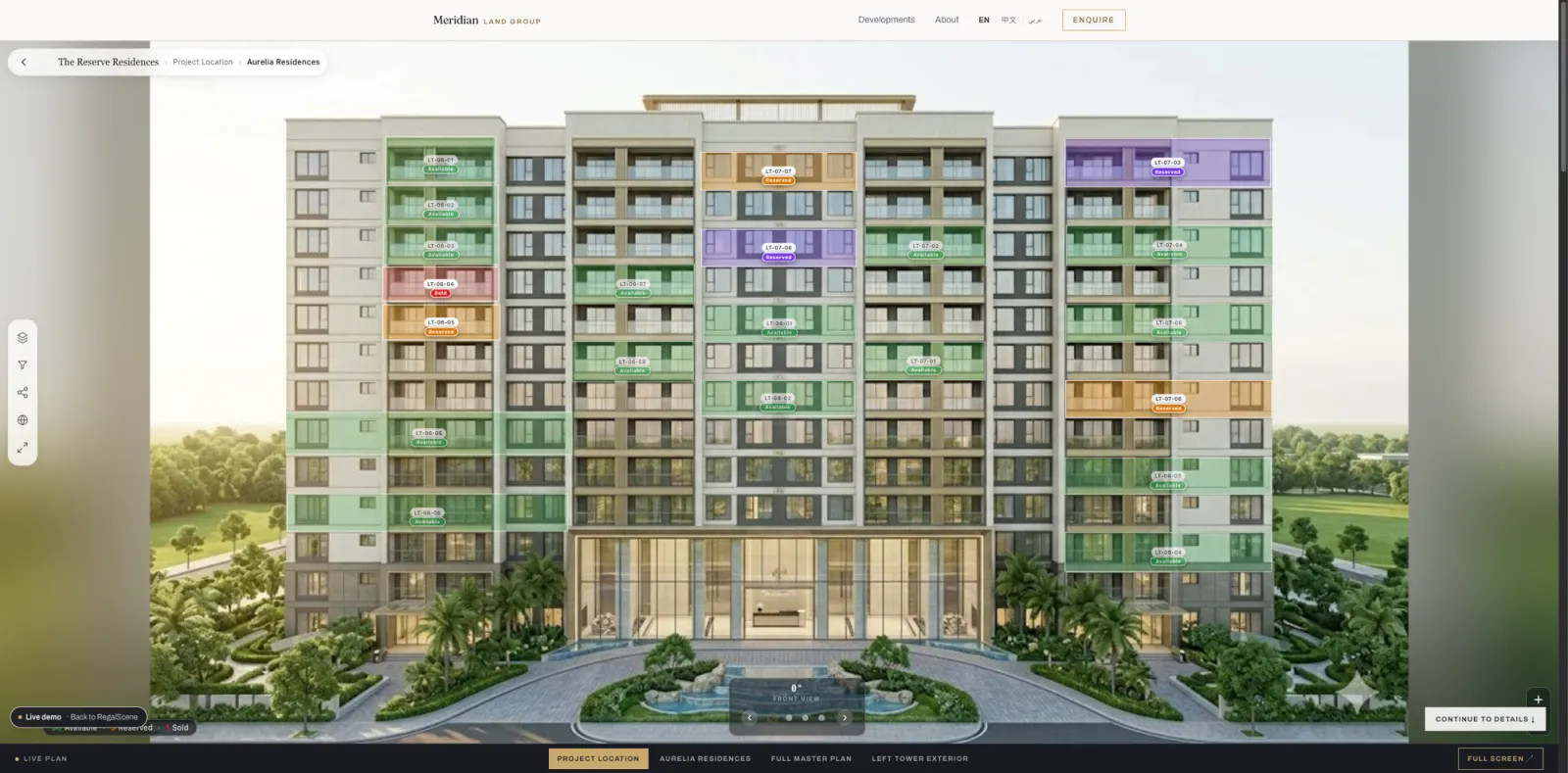
A unit is reserved on Monday afternoon. The sales system is updated immediately. On Thursday, that same unit is still shown as available on the project website, is still on the spreadsheet an agency sent to a client that morning, and is still circled on the printed price list in the sales gallery.
Nobody made a mistake. Every one of those was correct when it was created. They drifted because each is a separate copy, and a sale only ever updates one of them directly.
Availability does not go stale because teams are careless. It goes stale because the same fact is stored in four places.
Where the copies come from
Trace a single unit through a typical developer's channels and the duplication is obvious once you look for it.
The project website was built by an agency from an export supplied at launch. Updating it means sending a new file and waiting for someone to apply it.
The portal listings were entered by hand, one unit at a time. Nobody is going back to edit ninety of them because one sold.
The agency and broker packs went out as attachments. Every recipient now holds a version frozen at the moment it was sent, and there is no mechanism to pull it back.
The printed collateral in the sales gallery froze at the print run.
The sales system is the only one that is genuinely current, and it is the only one no buyer ever sees.
The one accurate copy is the one that faces inward. Everything the buyer sees is a photocopy of a photocopy.
What it costs, and why the cost stays hidden
The visible failure is the awkward one. A buyer enquires about unit 12-03, having seen it marked available, and is told it went last week. That conversation costs more than the unit. It teaches the buyer that nothing else on the page can be trusted either, including the availability of the alternative your agent is about to suggest.
The invisible failure is worse and nobody ever measures it. A unit shows as sold because a stale export said so. It was actually released again after a reservation lapsed. A buyer who wanted exactly that unit sees it is gone, does not enquire, and leaves. Nothing appears in any report. There is no record of the enquiry that did not happen.
That asymmetry is why the problem survives for years. One failure mode generates a complaint. The other generates silence, and silence is easy to read as an absence of a problem.
The fix is structural, not procedural
The instinct is to update more often. Add a weekly sync, assign someone to reconcile the channels, build a checklist.
That treats a design problem as a discipline problem. If one sale requires four updates, then the interval between the first and the last is a window where buyers see the wrong answer, and no amount of diligence closes it. Shorten the interval and you have a smaller window, not no window.
The structural fix is to reduce the number of copies to one, and to have every buyer-facing surface read from that one rather than hold its own.
Stop synchronizing copies. Remove the copies.
What one status looks like in practice
The unit inventory becomes the single record. Status lives there and only there. Everything a buyer can see reads from it at the moment they look.
The interactive master plan and building views paint status onto the artwork from the inventory, so a facade or a floor plan is never a snapshot. This is what a visual inventory layer rather than a CMS means in practice: the picture is generated from the data, not exported alongside it.
Embedded experiences on your own site and on partner sites read the same record. An agency embedding the experience shows what you show, which removes the pack-of-attachments problem entirely and is a large part of selling through multiple brokerages without losing control.
Shared links and QR codes resolve at open time, not at send time. A link sent through WhatsApp three weeks ago shows today's availability when the recipient finally taps it.
The sales gallery screen is the same experience, so the consultant and the buyer at home are looking at the same state.
One update in one place, and every surface is current. Not because they were synchronized quickly, but because there was never anything to synchronize.
What still needs a person
Being honest about the boundary matters, because the failure mode above is caused by overpromising.
Someone still has to change the status when a unit is reserved or sold. That is a human decision and it should be. What changes is that this becomes one action rather than four, so the gap between the sale and the world knowing about it closes to the length of that single action.
Portals that require their own listing format still require their own listing. A platform that reads your inventory does not reach into a third party's database. What it does is remove your own website, your embeds, your shared links, and your gallery screens from the list of things that drift, which is most of the surface area.
Print stays print. If your market still uses a printed price list, it will still be out of date the day after it is printed. The realistic answer is to print less, or to print a QR code to the live plan rather than a table of unit statuses.
Cut the copies you control. Be honest about the ones you do not.
Where to start
Count the places a buyer can currently see a unit status. If the number is above one, the interval between updating the first and updating the last is your exposure, and everything else is detail.
For developments where that count is high, the interactive master plan is usually the consolidation point, because it is the surface buyers use most and the one every other channel can embed or link to.
Related reading:
- Why Real Estate Developers Need a Visual Inventory Layer, Not Just a CMS
- How Developers Can Sell Through Multiple Brokerages Without Losing Control
- Shareable Interactive Property Links: QR Codes and WhatsApp
- Interactive Property Map for Real Estate Developers: The Complete Guide
- Interactive Master Plan Software for Property Developers
RegalScene holds one unit inventory and every buyer-facing surface reads from it. See the platform or tell us about your project.